

316
WORLD ATLAS OF CORAL REEFS
synchronized, with individuals of the same species
releasing eggs and sperm often within minutes of one
another over wide areas of the reef The phenomenon was
only first observed in November 1982, and yet is one of the
most spectacular events on any coral reef Vast numbers of
eggs and sperm are released and form massive slicks on the
sea surface. The spawning allows for cross-fertilization
between colonies, while the massive scale of such an event
ensures that would-be predators are fully satiated, thereby
increasing the chances of survival of individual larvae.
In addition to its considerable diversity in terms of
coral reef organisms, the Great Barrier Reef is also an
extremely important region for other marine and coastal
ecosystems, most notably seagrass and mangrove
communities. Mangroves generally lie a considerable
distance from coral reef communities - with the exception
of a few fringing reef systems. But some 37 mangrove
species from 19 families have been recorded at the Great
Barrier Reef, with the highest levels of diversity in the "wet
tropics'" north of Cairns. Seagrass communities are also
widespread, with some 3 000 square kilometers of mapped
shallow seagrasses, and an estimate of at least 2 000 square
kilometers of deep (>15 meters) seagrasses. Both seagrass
beds and mangroves are extensively used as breeding and
nursery grounds by many species, including a number of
commercially important species, and some reef species.
Seagrass beds are also important for some turtle species as
well as large populations of dugongs. Green, hawksbill.
loggerhead and flatback turtles all nest in considerable
numbers in the region. Unfortunately, with the exception
of the flatback turtle, most individuals spend substantial
amounts of time in neighboring countries where they are
severely threatened by direct hunting and indirect killing,
notably as fisheries by-catch. There are globally important
populations of dugongs in the region. While there is some
traditional hunting of these by Aboriginal and Torres Strait
Islander communities the northern population of some
8 000 individuals is considered stable. By contrast, the
smaller southern population of about 3 500 individuals
is now declining, largely as a result of deaths associated
with boat collisions, entanglement in gill nets, and also
entanglement in shark nets placed near swimming beaches.
In addition some 26 species of cetacean are resident or
visitors to the Great Barrier Reef, including significant
numbers of humpback whales which breed in the southern
and central waters.
There are important seabird communities on the
Great Barrier Reef with over 55 major nesting islands and
1.4-1.7 million breeding birds from some 23 species, with
a further 32 non-breeding species. Most of these islands
are in the north and south, with around 75 percent of the
total seabird biomass in the Capricorn-Bunker group.
The Great Barrier Reef has been one of the regions
most extensively impacted by the crown-of-thorns
starfish, with the first mass outbreak of this predator
observed on Green Island, off Cairns, in 1962. The
possible causes of these outbreaks have been debated for
some time (see Chapter 2), with much of the work having
been conducted on the Great Barrier Reef While there is
still much to learn about these outbreaks, it is clear that
they have had a significant impact on the ecology of the
region, causing apparently periodic massive losses of live
coral cover. Most outbreaks have been recorded in the
central sections of the Great Barrier Reef The 1998
bleaching event also impacted a number of reefs, most
notably in the inner shelf areas where some 25 percent of
reefs showed bleaching of 60 percent or greater. Overall,
bleaching was worst in the central sections of the Great
Barrier Reef while outer reefs generally showed only low
levels of bleaching. Mortality was generally low, although
some inshore fringing reefs suffered greatly.
Socio-economic considerations
In general the Great Barrier Reef is not heavily affected
by human activities, but there are some concerns that
deforestation, poor agricultural practices and high concentrations of agricultural chemicals and nutrients in
terrestrial runoff may have some impacts, particularly on
those reefs closest to the mainland. The majority of reefs,
however, are far offshore and this, combined with the
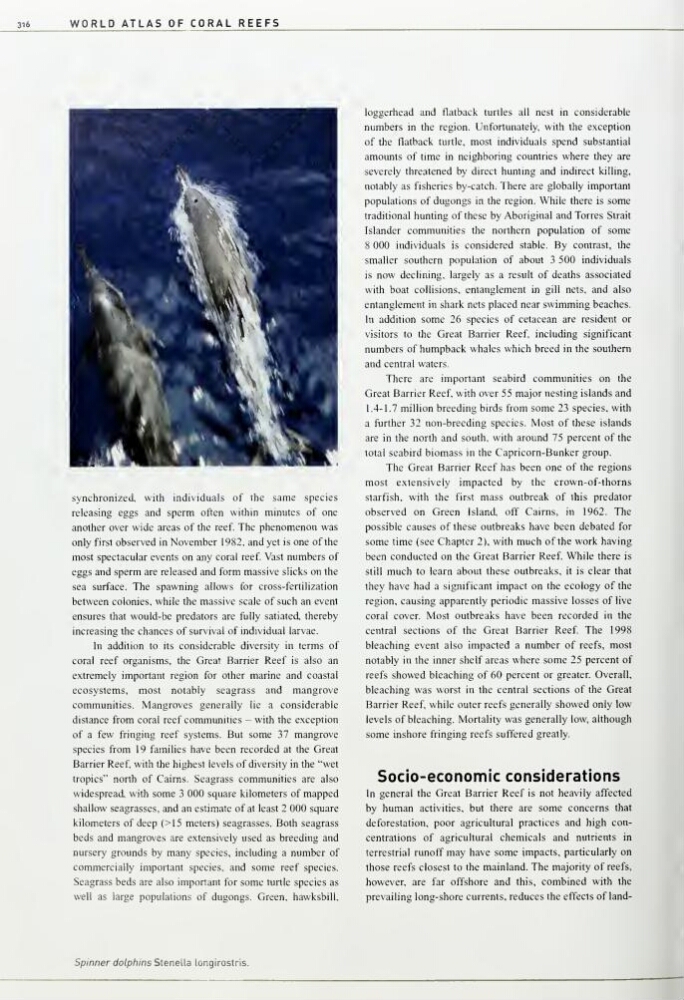
prevailing long-shore currents, reduces the effects of landSpinner dolphins Stenella longirostris.
WORLD ATLAS OF CORAL REEFS
synchronized, with individuals of the same species
releasing eggs and sperm often within minutes of one
another over wide areas of the reef The phenomenon was
only first observed in November 1982, and yet is one of the
most spectacular events on any coral reef Vast numbers of
eggs and sperm are released and form massive slicks on the
sea surface. The spawning allows for cross-fertilization
between colonies, while the massive scale of such an event
ensures that would-be predators are fully satiated, thereby
increasing the chances of survival of individual larvae.
In addition to its considerable diversity in terms of
coral reef organisms, the Great Barrier Reef is also an
extremely important region for other marine and coastal
ecosystems, most notably seagrass and mangrove
communities. Mangroves generally lie a considerable
distance from coral reef communities - with the exception
of a few fringing reef systems. But some 37 mangrove
species from 19 families have been recorded at the Great
Barrier Reef, with the highest levels of diversity in the "wet
tropics'" north of Cairns. Seagrass communities are also
widespread, with some 3 000 square kilometers of mapped
shallow seagrasses, and an estimate of at least 2 000 square
kilometers of deep (>15 meters) seagrasses. Both seagrass
beds and mangroves are extensively used as breeding and
nursery grounds by many species, including a number of
commercially important species, and some reef species.
Seagrass beds are also important for some turtle species as
well as large populations of dugongs. Green, hawksbill.
loggerhead and flatback turtles all nest in considerable
numbers in the region. Unfortunately, with the exception
of the flatback turtle, most individuals spend substantial
amounts of time in neighboring countries where they are
severely threatened by direct hunting and indirect killing,
notably as fisheries by-catch. There are globally important
populations of dugongs in the region. While there is some
traditional hunting of these by Aboriginal and Torres Strait
Islander communities the northern population of some
8 000 individuals is considered stable. By contrast, the
smaller southern population of about 3 500 individuals
is now declining, largely as a result of deaths associated
with boat collisions, entanglement in gill nets, and also
entanglement in shark nets placed near swimming beaches.
In addition some 26 species of cetacean are resident or
visitors to the Great Barrier Reef, including significant
numbers of humpback whales which breed in the southern
and central waters.
There are important seabird communities on the
Great Barrier Reef with over 55 major nesting islands and
1.4-1.7 million breeding birds from some 23 species, with
a further 32 non-breeding species. Most of these islands
are in the north and south, with around 75 percent of the
total seabird biomass in the Capricorn-Bunker group.
The Great Barrier Reef has been one of the regions
most extensively impacted by the crown-of-thorns
starfish, with the first mass outbreak of this predator
observed on Green Island, off Cairns, in 1962. The
possible causes of these outbreaks have been debated for
some time (see Chapter 2), with much of the work having
been conducted on the Great Barrier Reef While there is
still much to learn about these outbreaks, it is clear that
they have had a significant impact on the ecology of the
region, causing apparently periodic massive losses of live
coral cover. Most outbreaks have been recorded in the
central sections of the Great Barrier Reef The 1998
bleaching event also impacted a number of reefs, most
notably in the inner shelf areas where some 25 percent of
reefs showed bleaching of 60 percent or greater. Overall,
bleaching was worst in the central sections of the Great
Barrier Reef while outer reefs generally showed only low
levels of bleaching. Mortality was generally low, although
some inshore fringing reefs suffered greatly.
Socio-economic considerations
In general the Great Barrier Reef is not heavily affected
by human activities, but there are some concerns that
deforestation, poor agricultural practices and high concentrations of agricultural chemicals and nutrients in
terrestrial runoff may have some impacts, particularly on
those reefs closest to the mainland. The majority of reefs,
however, are far offshore and this, combined with the
prevailing long-shore currents, reduces the effects of landSpinner dolphins Stenella longirostris.