

Australia
North Australia
MAP lib
North
of Port Headland and Eighty Mile Beach
the continental shelf of Australia widens considerably while the coastline of Indonesia and
East Timor forms a northern boundary enclosing the
Timor Sea. To the east of Darwin this continental shelf
widens further still and connects Australia to New Guinea
across the Arafura Sea and the Gulf of Carpentaria. This is
Australia's least known and least populated coastline.
Wide areas are dominated by an intricate network of rivers
and channels with extensive mangrove communities. To
the east, in the Arafura Sea. the waters are shallow and
turbid and there is little reef development. Fringing reefs
are reported further west, but are very poorly described.
The only reefs in this region which have received attention
are those lying in the northwest on the continental shelf
edge or just beyond.
The Rowley Shoals, Scott Reef and Sermgapatam
Reef are shelf edge atolls lying on the continental slope
in clear oceanic waters. An extensive line of other reefs.
mcluding Lynher, Carrier, Ashmore and Hibernia, lies just
on the continental shelf, and it has been suggested that
these may in fact be barrier structures. A number of
deeper shoals on the shelf edge indicate that there may
have been a more extensive barrier reef along this shelf
during recent periods of lower sea level, but that only
these structures kept up with rising sea levels. Tidal ranges
are very high around these reefs and there is considerable
wave energy, so the reef crests are dominated by coralline
algae, while only compact coral formations have developed on windward shores. This is also an area regularly
affected by cyclones.
Coral cover is typically high. In early 1995 hard coral
cover averaged nearly 50 percent on reef slopes in Scott
Reef and the Rowley Shoals, but cyclone damage later
that same year caused a considerable reduction in this
figure. Ashmore Reef has the greatest biodiversity in
the region: some 255 species of hermatypic corals
have been recorded, 747 fish. 433 molluscs and 192
echinoderms. These compare with 213 hermatypic corals
at Scott and Seringapatam Reefs and 184 at the Rowley
Shoals. The region also probably has a greater diversity
of sea snakes than anywhere else in the world, with 12
species recorded at Ashmore Reef, three of which are
thought to be endemic to the Ashmore. Carrier and Hibernia
Reefs. Seabird nesting colonies are also extremely
important and 17 species (with an estimated 50 000 pairs)
have been recorded nesting on the islands of Ashmore. This
area was strongly impacted by warm waters associated
with the 1998 El Nino event. Widespread coral bleaching
was followed by 80 percent mortality at some sites on
Scon Reef
The more northerly reefs lie relatively close to
Indonesia and are regularly fished by Indonesians under
a joint use agreement. Elsewhere, including near Scott
Reef, there is some extraction of natural gas, and further
exploratory drilling and the establishment of new oil and
gas platforms could bring further human impacts to these
otherwise remote reefs. There is also some fishing on all
reefs, including collection of trochus, shark and other reef
fish, although there is little detailed information available
on its impacts. Diving on the Rowley Shoals is increasingly popular, and the reefs are widely regarded as
offering some of the best diving in the region. Ashmore
Reef and the Rowley Shoals all have some degree of legal
protection, and there is ongoing monitoring of Scott Reef
and the Rowley Shoals.
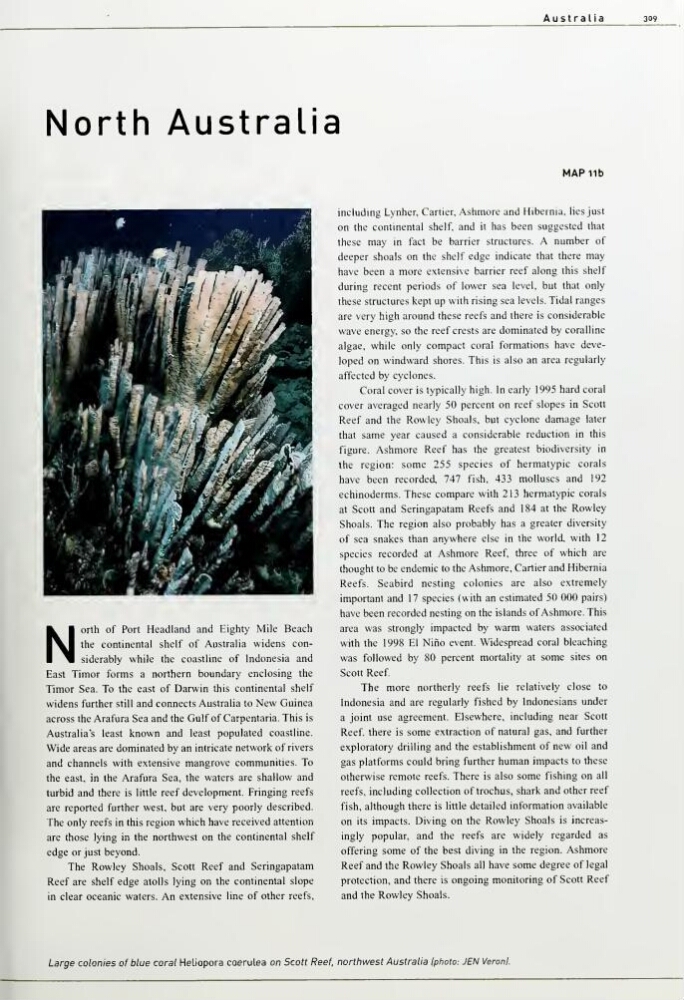
Large colonies of blue coral Heliopora coerulea on Scott Reef, northwest Australia Iphoto: JEN Veronl.
North Australia
MAP lib
North
of Port Headland and Eighty Mile Beach
the continental shelf of Australia widens considerably while the coastline of Indonesia and
East Timor forms a northern boundary enclosing the
Timor Sea. To the east of Darwin this continental shelf
widens further still and connects Australia to New Guinea
across the Arafura Sea and the Gulf of Carpentaria. This is
Australia's least known and least populated coastline.
Wide areas are dominated by an intricate network of rivers
and channels with extensive mangrove communities. To
the east, in the Arafura Sea. the waters are shallow and
turbid and there is little reef development. Fringing reefs
are reported further west, but are very poorly described.
The only reefs in this region which have received attention
are those lying in the northwest on the continental shelf
edge or just beyond.
The Rowley Shoals, Scott Reef and Sermgapatam
Reef are shelf edge atolls lying on the continental slope
in clear oceanic waters. An extensive line of other reefs.
mcluding Lynher, Carrier, Ashmore and Hibernia, lies just
on the continental shelf, and it has been suggested that
these may in fact be barrier structures. A number of
deeper shoals on the shelf edge indicate that there may
have been a more extensive barrier reef along this shelf
during recent periods of lower sea level, but that only
these structures kept up with rising sea levels. Tidal ranges
are very high around these reefs and there is considerable
wave energy, so the reef crests are dominated by coralline
algae, while only compact coral formations have developed on windward shores. This is also an area regularly
affected by cyclones.
Coral cover is typically high. In early 1995 hard coral
cover averaged nearly 50 percent on reef slopes in Scott
Reef and the Rowley Shoals, but cyclone damage later
that same year caused a considerable reduction in this
figure. Ashmore Reef has the greatest biodiversity in
the region: some 255 species of hermatypic corals
have been recorded, 747 fish. 433 molluscs and 192
echinoderms. These compare with 213 hermatypic corals
at Scott and Seringapatam Reefs and 184 at the Rowley
Shoals. The region also probably has a greater diversity
of sea snakes than anywhere else in the world, with 12
species recorded at Ashmore Reef, three of which are
thought to be endemic to the Ashmore. Carrier and Hibernia
Reefs. Seabird nesting colonies are also extremely
important and 17 species (with an estimated 50 000 pairs)
have been recorded nesting on the islands of Ashmore. This
area was strongly impacted by warm waters associated
with the 1998 El Nino event. Widespread coral bleaching
was followed by 80 percent mortality at some sites on
Scon Reef
The more northerly reefs lie relatively close to
Indonesia and are regularly fished by Indonesians under
a joint use agreement. Elsewhere, including near Scott
Reef, there is some extraction of natural gas, and further
exploratory drilling and the establishment of new oil and
gas platforms could bring further human impacts to these
otherwise remote reefs. There is also some fishing on all
reefs, including collection of trochus, shark and other reef
fish, although there is little detailed information available
on its impacts. Diving on the Rowley Shoals is increasingly popular, and the reefs are widely regarded as
offering some of the best diving in the region. Ashmore
Reef and the Rowley Shoals all have some degree of legal
protection, and there is ongoing monitoring of Scott Reef
and the Rowley Shoals.
Large colonies of blue coral Heliopora coerulea on Scott Reef, northwest Australia Iphoto: JEN Veronl.