

Australia
West Australia
MAPua
The
reefs in the west of Australia encompass a
variety of types in a very broad range of oceanographic conditions. For the most part this is a very
dry coasthne with little terrestrial runofT. It is also, from a
human perspective, very sparsely populated and poorly
documented. One critical oceanographic feature is the
Leeuwin Current which flows south from Indonesia,
carrying warm waters to relatively high latitudes, particularly along the continental shelf edge.
Along the mainland coast, reefs are discontinuous but
very well developed in places. In the north the continental
shelf is very wide and dominated by turbid waters with
strong currents. Reef development is little known off the
Eighty Mile Beach, though further west there are scattered
reefs among the Dampier Archipelago and the Monte Bello
Islands. Here, as the continental shelf narrows, there is a
great range of oceanographic conditions associated with
the gradient between nearshore turbid waters and clear
offshore waters, mixed by the complex current regime.
Australia's longest continuous fringing reef system is
the Ningaloo Reef which follows some 230 kilometers of
coastline running southwards from North West Cape. The
reef flats are well developed, lying between 0.5 and 7
kilometers offshore. The continental shelf is narrower here
than anywhere else in the country, with the 200 meter
contour less than 20 kilometers offshore. These reefs receive
the full impact of oceanic waves, so corals tend to be quite
low and compact. Biodiversity is relatively high, with some
300 species of coral, nearly 500 species of fish and over
600 molluscs. The area is also noted for the appearance
of whale sharks. These giant plankton-feeders occur in
considerable numbers between mid-March and mid-May.
The marine areas of the Shark Bay World Heritage Site
are of considerable interest, including some of the most
extensive seagrass communities in the world and harboring
what is probably the largest dugong population in the world
(over 10 000). Monkey Mia Bay has become famous for a
tame group of bottle-nosed dolphins, but the region is also
of considerable importance for other cetaceans, including
humpback and southern right whales. Hamelin Pool, within
the Shark Bay area, is one of the few places in the world
where there are actively growing stromatolites. Hypersaline
conditions prevent the survival of most organisms, but
photosynthetic bacteria and microalgae survive and form
microbial mats as they trap and bind sediments. Over the
last 4 000 years these mats have developed into relatively
large structures - columns or mounds up to 1.5 meters high.
Similar structures have been recorded in fossils dating back
3.5 billion years, some of the earliest known forms of life.
Despite this, there are no true coral reefs in the Shark Bay
area, although some 80 coral species have been recorded.
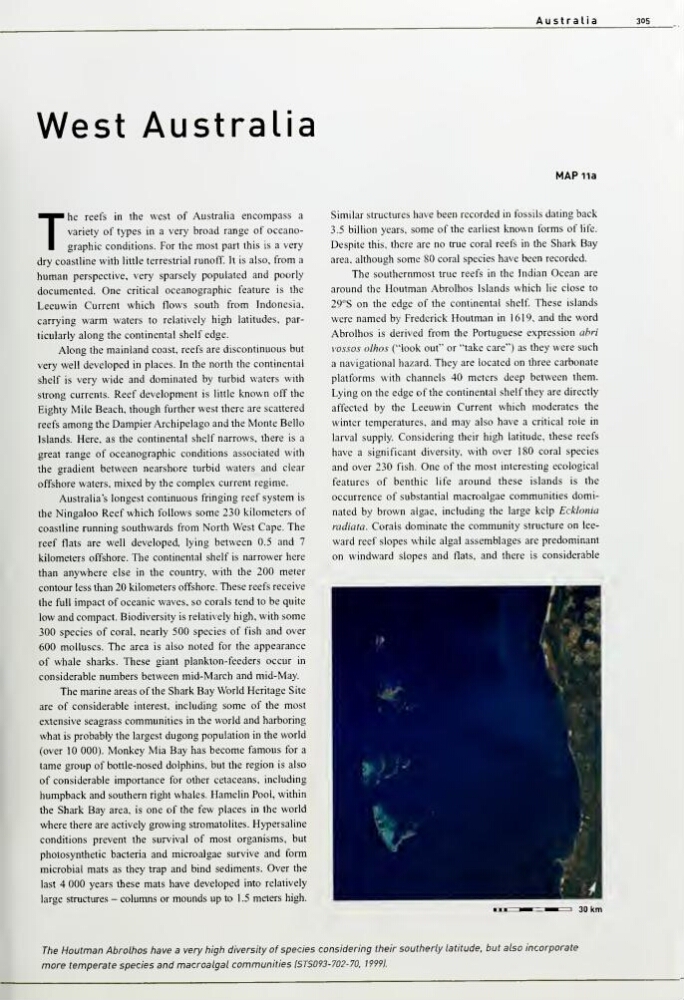
The southernmost true reefs in the Indian Ocean are
around the Houtman Abrolhos Islands which lie close to
29°S on the edge of the continental shelf. These islands
were named by Frederick Houtman in 1619, and the word
Abrolhos is derived from the Portuguese expression abri
vossos olhos ("look out" or "take care") as they were such
a navigational hazard. They are located on three carbonate
platforms with channels 40 meters deep between them.
Lying on the edge of the continental shelf they are directly
affected by the Leeuwin Current which moderates the
winter temperatures, and may also have a critical role in
larval supply. Considering their high latitude, these reefs
have a significant diversity, with over 180 coral species
and over 230 fish. One of the most interesting ecological
features of benthic life around these islands is the
occurrence of substantial macroalgae communities dominated by brown algae, including the large kelp Ecklonia
radiata. Corals dominate the community structure on leeward reef slopes while algal assemblages are predominant
on windward slopes and flats, and there is considerable
30 km
The Houtman Abrolhos have a very high diversity of species considering their southerly latitude, but also incorporate
more temperate species and macroalgal communities ISTS093-702-70, 19991.
West Australia
MAPua
The
reefs in the west of Australia encompass a
variety of types in a very broad range of oceanographic conditions. For the most part this is a very
dry coasthne with little terrestrial runofT. It is also, from a
human perspective, very sparsely populated and poorly
documented. One critical oceanographic feature is the
Leeuwin Current which flows south from Indonesia,
carrying warm waters to relatively high latitudes, particularly along the continental shelf edge.
Along the mainland coast, reefs are discontinuous but
very well developed in places. In the north the continental
shelf is very wide and dominated by turbid waters with
strong currents. Reef development is little known off the
Eighty Mile Beach, though further west there are scattered
reefs among the Dampier Archipelago and the Monte Bello
Islands. Here, as the continental shelf narrows, there is a
great range of oceanographic conditions associated with
the gradient between nearshore turbid waters and clear
offshore waters, mixed by the complex current regime.
Australia's longest continuous fringing reef system is
the Ningaloo Reef which follows some 230 kilometers of
coastline running southwards from North West Cape. The
reef flats are well developed, lying between 0.5 and 7
kilometers offshore. The continental shelf is narrower here
than anywhere else in the country, with the 200 meter
contour less than 20 kilometers offshore. These reefs receive
the full impact of oceanic waves, so corals tend to be quite
low and compact. Biodiversity is relatively high, with some
300 species of coral, nearly 500 species of fish and over
600 molluscs. The area is also noted for the appearance
of whale sharks. These giant plankton-feeders occur in
considerable numbers between mid-March and mid-May.
The marine areas of the Shark Bay World Heritage Site
are of considerable interest, including some of the most
extensive seagrass communities in the world and harboring
what is probably the largest dugong population in the world
(over 10 000). Monkey Mia Bay has become famous for a
tame group of bottle-nosed dolphins, but the region is also
of considerable importance for other cetaceans, including
humpback and southern right whales. Hamelin Pool, within
the Shark Bay area, is one of the few places in the world
where there are actively growing stromatolites. Hypersaline
conditions prevent the survival of most organisms, but
photosynthetic bacteria and microalgae survive and form
microbial mats as they trap and bind sediments. Over the
last 4 000 years these mats have developed into relatively
large structures - columns or mounds up to 1.5 meters high.
Similar structures have been recorded in fossils dating back
3.5 billion years, some of the earliest known forms of life.
Despite this, there are no true coral reefs in the Shark Bay
area, although some 80 coral species have been recorded.
The southernmost true reefs in the Indian Ocean are
around the Houtman Abrolhos Islands which lie close to
29°S on the edge of the continental shelf. These islands
were named by Frederick Houtman in 1619, and the word
Abrolhos is derived from the Portuguese expression abri
vossos olhos ("look out" or "take care") as they were such
a navigational hazard. They are located on three carbonate
platforms with channels 40 meters deep between them.
Lying on the edge of the continental shelf they are directly
affected by the Leeuwin Current which moderates the
winter temperatures, and may also have a critical role in
larval supply. Considering their high latitude, these reefs
have a significant diversity, with over 180 coral species
and over 230 fish. One of the most interesting ecological
features of benthic life around these islands is the
occurrence of substantial macroalgae communities dominated by brown algae, including the large kelp Ecklonia
radiata. Corals dominate the community structure on leeward reef slopes while algal assemblages are predominant
on windward slopes and flats, and there is considerable
30 km
The Houtman Abrolhos have a very high diversity of species considering their southerly latitude, but also incorporate
more temperate species and macroalgal communities ISTS093-702-70, 19991.