

306
WORLD ATLAS OF CORAL REEFS
the country for more than ^0 000 years. These people,
and the Torres Strait Islanders who occupy parts of the
far northeast of the country, have traditionally made
considerable use of reef resources. It seems likely,
however, that their overall impacts remained minimal.
Population densities were low, and a large area of
offshore reef remained inaccessible to them.
The continent was first described by European
travelers in the 17th century. Dampier visited parts
of the northwestern coast in 1688 and 1699. Captain
James Cook was the first to navigate the waters of the
Great Barrier Reef, and indeed ran aground there in
1770. The first British settlement was established in
Australia in 1788.
The Aboriginal population has decreased considerably since European occupation, while many of
those who remain have been dispossessed of their traditional lands and have ceased to practice their traditional
lifestyles. A few remaining coastal populations still have
considerable rights regarding their traditional use of the
reefs, but their numbers are so low that they are unlikely
to have any significant impact except, perhaps, in parts
of the Torres Strait region. The dominant human impacts
can now be related to fisheries and terrestrial runoff
from deforestation, overgrazing and certain agricultural
practices. Compared with most countries, however,
these impacts remain few. Population densities are low
in all coral reef areas, while the location of many reefs at
some distance from the shore further protects them
from human impacts.
Considerable resources have been put into coral
reef research in Australia and, despite the vast area of
reefs in the country, there is a good deal of information
describing their distribution and biodiversity. Equally
importantly, the great majority of Australia's reefs fall
within protected areas. The Great Barrier Reef Marine
Park is the largest protected reef in the world, and is
well managed with a detailed zoning plan, providing
areas of strict protection alongside much larger areas
of multiple use.
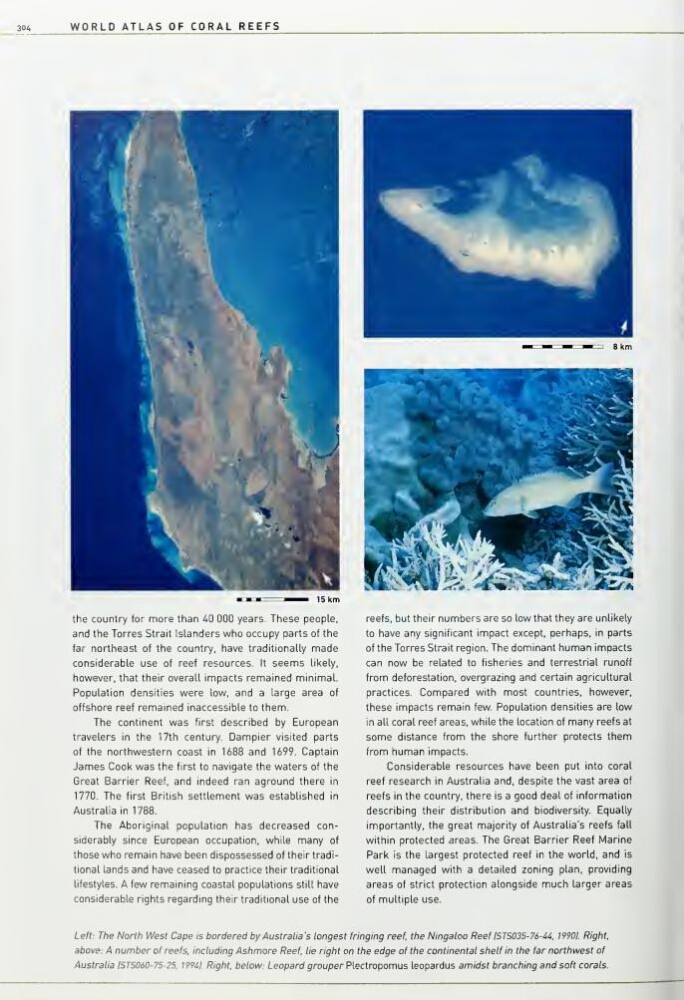
Left: The North West Cape is bordered by Australia's longest fringing reef the Ningatoo Reef ISTS035-76-44. 19901. Right,
above: A number of reefs, including Ashmore Reef, lie right on the edge of the continental shelf in the far northwest of
Australia ISTS060-75-25, 19941. Right, below: Leopard grouper Plectropomus leopardus amidst branching and soft corals.
WORLD ATLAS OF CORAL REEFS
the country for more than ^0 000 years. These people,
and the Torres Strait Islanders who occupy parts of the
far northeast of the country, have traditionally made
considerable use of reef resources. It seems likely,
however, that their overall impacts remained minimal.
Population densities were low, and a large area of
offshore reef remained inaccessible to them.
The continent was first described by European
travelers in the 17th century. Dampier visited parts
of the northwestern coast in 1688 and 1699. Captain
James Cook was the first to navigate the waters of the
Great Barrier Reef, and indeed ran aground there in
1770. The first British settlement was established in
Australia in 1788.
The Aboriginal population has decreased considerably since European occupation, while many of
those who remain have been dispossessed of their traditional lands and have ceased to practice their traditional
lifestyles. A few remaining coastal populations still have
considerable rights regarding their traditional use of the
reefs, but their numbers are so low that they are unlikely
to have any significant impact except, perhaps, in parts
of the Torres Strait region. The dominant human impacts
can now be related to fisheries and terrestrial runoff
from deforestation, overgrazing and certain agricultural
practices. Compared with most countries, however,
these impacts remain few. Population densities are low
in all coral reef areas, while the location of many reefs at
some distance from the shore further protects them
from human impacts.
Considerable resources have been put into coral
reef research in Australia and, despite the vast area of
reefs in the country, there is a good deal of information
describing their distribution and biodiversity. Equally
importantly, the great majority of Australia's reefs fall
within protected areas. The Great Barrier Reef Marine
Park is the largest protected reef in the world, and is
well managed with a detailed zoning plan, providing
areas of strict protection alongside much larger areas
of multiple use.
Left: The North West Cape is bordered by Australia's longest fringing reef the Ningatoo Reef ISTS035-76-44. 19901. Right,
above: A number of reefs, including Ashmore Reef, lie right on the edge of the continental shelf in the far northwest of
Australia ISTS060-75-25, 19941. Right, below: Leopard grouper Plectropomus leopardus amidst branching and soft corals.