

WORLD ATLAS OF CORAL REEFS
to the air at low tides. Water circulation is also quite
limited and oxygen levels are often rapidly depleted.
The base of this zone is usually coral rock, but it is
often covered by a mix of sand and rubble patches, over
which there may be algae or seagrass. Corals continue to
grow in deeper depressions, and small coral communities
develop in larger areas of deep water (such areas are
sometimes known as moats). A considerable number of
small invertebrates live permanently on the reef flat.
Large numbers of organisms feed on the reef flat at high
tide, while foraging birds visit during the lowest tides.
Reef crest
The edge of the reef flat facing the ocean is an area of high
energy, with almost constant wave action, and occasional
exposure to the air. There is a rapid and constant circulation of the water, and water temperatures are generally
more constant than those of the reef flat. Conditions for
coral growth are not ideal, but a few species, dominated
by branching forms, have adapted to them. On some
reefs coralline algae are even better adapted and may
predominate. Their combined growth builds up to make
this the shallowest zone of the reef, often drying out at
low tides. In more exposed reefs deep surge channels may
be gouged into this reef crest and serve to dissipate the
wave energy.
Reef front or reef slope
Beyond the reef crest is the zone with the greatest
diversity and abundance of life. Typically this reef front
or reef slope falls quite steeply towards the seabed. In
this zone conditions change quite rapidly with depth and
exposure. The shallowest waters, particularly on exposed
reefs, may still be subject to considerable wave action and
the growth of corals may be restricted. In such places
branching corals predominate, and in the most exposed
areas their growth forms are typically low and compact.
Wave action often leads to the development of deep
channels and high ridges known as spur and groove
formations.
Below the influence of wave action diversity is
unparalleled. Reefs are rarely dominated by single
species, and both the corals and most other species groups
form highly complex mixed communities. As depths
increase, light is rapidly filtered out by the overlying
water Certain species can only grow in bright waters, and
so are limited to depths of only 10 or 20 meters. A smaller
number of species have adapted to darker conditions and
may begin to dommate. The depth limits to coral growth
arc variable, as the water clarity determines the degree of
light penetration. Reefs on more turbid continental
margins typically have no active coral growth below about
50 meters and active reef accumulation may stop at 20
meters or less. In the clear waters of oceanic atolls
extensive coral growth has been observed as deep as 100
meters, although this is probably unusual.
There is clearly enormous variation across the world
of coral reefs, but these broad zones are widespread. Even
among the less developed reefs, the natural propensity
towards these patterns of zonation is often visible.
It is also important to remember that most of the reefs
visible today are in fact ancient structures and much of
their present-day shape has been developed over millennia,
under quite varied conditions. In some cases there are
vestigial structures marking former sea levels. Terraces are
often observed on reef slopes, mdicating patterns of growth
towards an earlier low sea level, while entire submerged
reefs may show many of the structures described above,
but with reef flats and lagoons now at considerable depths
below the present sea surface. Similarly, raised reefs are
quite common, with atolls or platform reefs raised up to
form modern islands, and the subsequent development of
fringing reefs around their margins.
Patterns of diversity on a coral reef are the subject of
a great range of influences, from the patterns produced by
history, including the massive perturbations of recent ice
ages to the present day patterns of temperature, sediments
and nutrients. On particular reefs new patterns emerge, the
result of a great complexity of local influences, including
light, exposure and water circulation. The final section
of this chapter examines some of the great wealth of
diversity which makes up life on the reef. It provides an
overview of all of the major groups which are so critical,
not only to the development and functioning of the reef,
but also to the great value of coral reefs as a natural
resource for humanity.
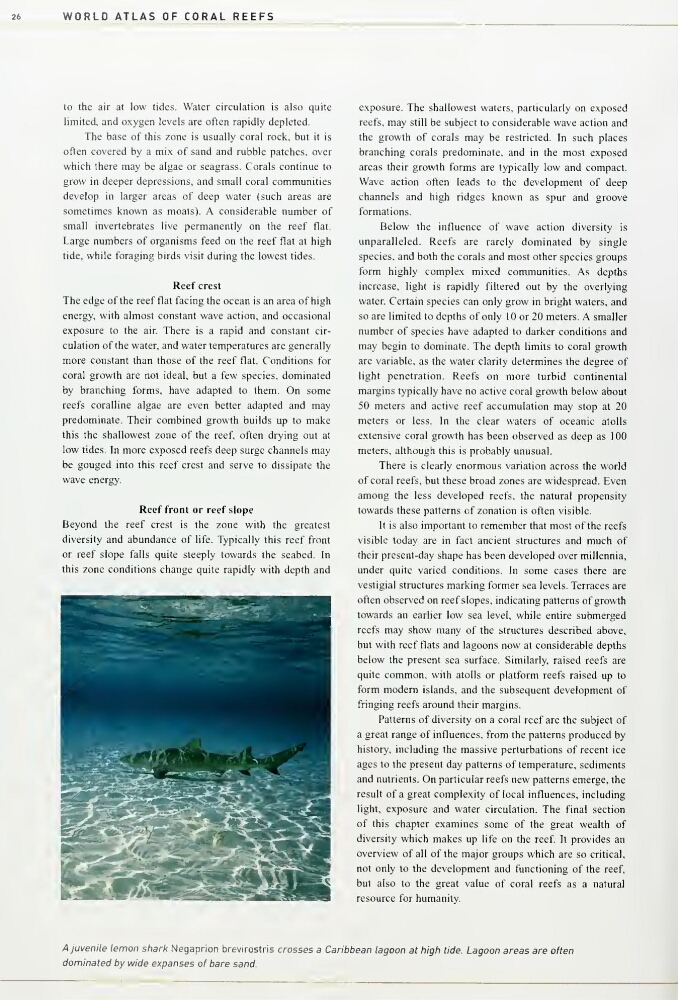
A Juvenile lemon shark Negaprion brevirostris crosses a Caribbean lagoon at higli tide. Lagoon areas are often
dominated by wide expanses of bare sand.
to the air at low tides. Water circulation is also quite
limited and oxygen levels are often rapidly depleted.
The base of this zone is usually coral rock, but it is
often covered by a mix of sand and rubble patches, over
which there may be algae or seagrass. Corals continue to
grow in deeper depressions, and small coral communities
develop in larger areas of deep water (such areas are
sometimes known as moats). A considerable number of
small invertebrates live permanently on the reef flat.
Large numbers of organisms feed on the reef flat at high
tide, while foraging birds visit during the lowest tides.
Reef crest
The edge of the reef flat facing the ocean is an area of high
energy, with almost constant wave action, and occasional
exposure to the air. There is a rapid and constant circulation of the water, and water temperatures are generally
more constant than those of the reef flat. Conditions for
coral growth are not ideal, but a few species, dominated
by branching forms, have adapted to them. On some
reefs coralline algae are even better adapted and may
predominate. Their combined growth builds up to make
this the shallowest zone of the reef, often drying out at
low tides. In more exposed reefs deep surge channels may
be gouged into this reef crest and serve to dissipate the
wave energy.
Reef front or reef slope
Beyond the reef crest is the zone with the greatest
diversity and abundance of life. Typically this reef front
or reef slope falls quite steeply towards the seabed. In
this zone conditions change quite rapidly with depth and
exposure. The shallowest waters, particularly on exposed
reefs, may still be subject to considerable wave action and
the growth of corals may be restricted. In such places
branching corals predominate, and in the most exposed
areas their growth forms are typically low and compact.
Wave action often leads to the development of deep
channels and high ridges known as spur and groove
formations.
Below the influence of wave action diversity is
unparalleled. Reefs are rarely dominated by single
species, and both the corals and most other species groups
form highly complex mixed communities. As depths
increase, light is rapidly filtered out by the overlying
water Certain species can only grow in bright waters, and
so are limited to depths of only 10 or 20 meters. A smaller
number of species have adapted to darker conditions and
may begin to dommate. The depth limits to coral growth
arc variable, as the water clarity determines the degree of
light penetration. Reefs on more turbid continental
margins typically have no active coral growth below about
50 meters and active reef accumulation may stop at 20
meters or less. In the clear waters of oceanic atolls
extensive coral growth has been observed as deep as 100
meters, although this is probably unusual.
There is clearly enormous variation across the world
of coral reefs, but these broad zones are widespread. Even
among the less developed reefs, the natural propensity
towards these patterns of zonation is often visible.
It is also important to remember that most of the reefs
visible today are in fact ancient structures and much of
their present-day shape has been developed over millennia,
under quite varied conditions. In some cases there are
vestigial structures marking former sea levels. Terraces are
often observed on reef slopes, mdicating patterns of growth
towards an earlier low sea level, while entire submerged
reefs may show many of the structures described above,
but with reef flats and lagoons now at considerable depths
below the present sea surface. Similarly, raised reefs are
quite common, with atolls or platform reefs raised up to
form modern islands, and the subsequent development of
fringing reefs around their margins.
Patterns of diversity on a coral reef are the subject of
a great range of influences, from the patterns produced by
history, including the massive perturbations of recent ice
ages to the present day patterns of temperature, sediments
and nutrients. On particular reefs new patterns emerge, the
result of a great complexity of local influences, including
light, exposure and water circulation. The final section
of this chapter examines some of the great wealth of
diversity which makes up life on the reef. It provides an
overview of all of the major groups which are so critical,
not only to the development and functioning of the reef,
but also to the great value of coral reefs as a natural
resource for humanity.
A Juvenile lemon shark Negaprion brevirostris crosses a Caribbean lagoon at higli tide. Lagoon areas are often
dominated by wide expanses of bare sand.