

Southeast Asia
283
be turbid and much of the reef area is reported to have been
destroyed by blast fishing. At the mouth of the Lingayen
Gulf there are wide fringing reefs around Bolinao and the
nearby islands, with discontinuous fringing reefs running
south to Manila Bay. The explosion of Mount Pinatubo,
with its massive ashfall and mud flows, caused a steep
decline in live coral cover from 60-70 percent down to 1020 percent on the nearest fringing reefs. There is little
information about the development of reefs along the east
coast of Luzon, although fringing reefs are described at the
Polillo Islands and in the Northern Sierra Madre Natural
Park. There is little published mformation describmg the
reefs around the southern coastline of Luzon, and little
for Mindoro and Marinduque, but there are discontinuous
fringmg reefs in many areas, notably around Puerto Galera
in Mindoro. Over 200 kilometers west of Luzon is the atolllike formation of Scarborough Reef
Fringing reefs are widespread along much of the
coastline of the Visayas, although broken up by areas of
soft sediments, particularly close to river mouths. Live
cover on some parts of these reefs can exceed 50 percent,
and fish diversity is also high, particularly on protected or
less heavily fished reefs such as Sumilon and Apo Islands
south of Cebu and Negros. Reefs around Mindanao are
poorly known, although fringing structures are widespread,
and diversity is reportedly high on reefs around Arangasa
Island on the east coast.
The Sulu Archipelago has not been described in detail,
but includes fringing and barrier reef systems. To the
northwest there are two major atoll systems in the Sulu
Sea, the Cagayan Islands and Tubbataha, the latter being
a structure composed of two atolls. Further west, Palawan
has some of the best developed reefs in the country, with
fringing and patch reefs along most of the coast and live
coral cover reaching between 50 and 90 percent in some
places. A number of banks and shoals off the west coast of
Palawan are thought to be part of a long, sub-surface barrier
reef system. Finally, due west of Palawan lies the large
complex of the Spratly Islands, which are disputed between
several countries, and so considered in a separate section.
Many of the reefs in this country are severely
impacted by human activities. Dense populations utilize
fish communities in almost all areas. The vast majority
of this fishing is small-scale - coastal waters up to 15
kilometers from the shore fall under local government
control and are often closed to larger commercial vessels.
It has been estimated that reefs may yield up to 10-15
percent of the total annual fisheries production of the
country, and studies have shown that individual reefs may
support yields of between 3 and 36 tons offish per square
kilometer per year. Despite this, demersal fish stocks
including reef fish, as well as small pelagics, are
considered to be biologically and economically overfished
in almost all areas other than eastern Luzon, Palawan and
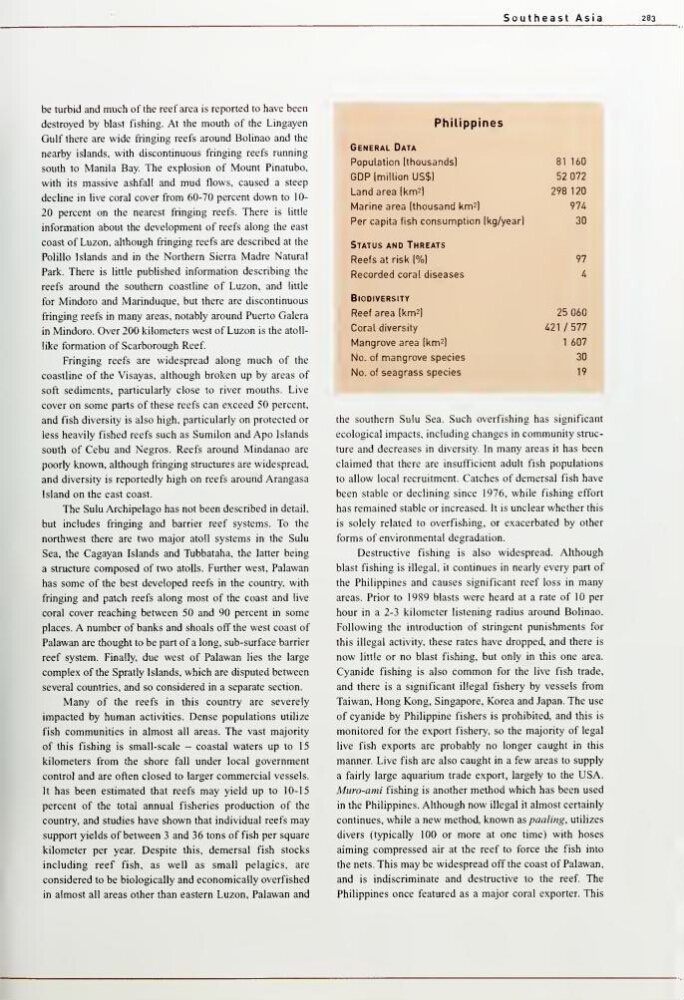
Philippi nes
General Data
Population Ithousandsl
81 160
GDP (million US$1
52 072
Land area (km^l
298 120
Marine area (thousand km^l
97i
Per capita fish consumption (kg/year)
30
Status and Threats
Reefs at risk (%|
97
Recorded coral diseases
It
Biodiversity
Reef area (km^j
25 060
Coral diversity
421 / 577
Mangrove area (km^l
1 607
No. of mangrove species
30
No. of seagrass species
19
the southern Sulu Sea. Such overfishing has significant
ecological impacts, including changes in community structure and decreases in diversity. In many areas it has been
claimed that there are insufficient adult fish populations
to allow local recruitment. Catches of demersal fish have
been stable or declining since 1976, while fishing effort
has remained stable or increased. It is unclear whether this
is solely related to overfishing, or exacerbated by other
forms of environmental degradation.
Destructive fishing is also widespread. Although
blast fishing is illegal, it continues in nearly every part of
the Philippines and causes significant reef loss in many
areas. Prior to 1989 blasts were heard at a rate of 10 per
hour in a 2-3 kilometer listening radius around Bolinao.
Following the introduction of stringent punishments for
this illegal activity, these rates have dropped, and there is
now little or no blast fishing, but only in this one area.
Cyanide fishing is also common for the live fish trade,
and there is a significant illegal fishery by vessels from
Taiwan, Hong Kong, Singapore, Korea and Japan. The use
of cyanide by Philippine fishers is prohibited, and this is
monitored for the export fishery, so the majority of legal
live fish exports are probably no longer caught in this
manner. Live fish are also caught in a few areas to supply
a fairly large aquarium trade export, largely to the USA.
Muro-ami fishing is another method which has been used
in the Philippines. Although now illegal it almost certainly
continues, while a new method, known as pooling, utilizes
divers (typically 100 or more at one time) with hoses
aiming compressed air at the reef to force the fish into
the nets. This may be widespread off the coast of Palawan,
and is indiscriminate and destructive to the reef The
Philippines once featured as a major coral exporter. This
283
be turbid and much of the reef area is reported to have been
destroyed by blast fishing. At the mouth of the Lingayen
Gulf there are wide fringing reefs around Bolinao and the
nearby islands, with discontinuous fringing reefs running
south to Manila Bay. The explosion of Mount Pinatubo,
with its massive ashfall and mud flows, caused a steep
decline in live coral cover from 60-70 percent down to 1020 percent on the nearest fringing reefs. There is little
information about the development of reefs along the east
coast of Luzon, although fringing reefs are described at the
Polillo Islands and in the Northern Sierra Madre Natural
Park. There is little published mformation describmg the
reefs around the southern coastline of Luzon, and little
for Mindoro and Marinduque, but there are discontinuous
fringmg reefs in many areas, notably around Puerto Galera
in Mindoro. Over 200 kilometers west of Luzon is the atolllike formation of Scarborough Reef
Fringing reefs are widespread along much of the
coastline of the Visayas, although broken up by areas of
soft sediments, particularly close to river mouths. Live
cover on some parts of these reefs can exceed 50 percent,
and fish diversity is also high, particularly on protected or
less heavily fished reefs such as Sumilon and Apo Islands
south of Cebu and Negros. Reefs around Mindanao are
poorly known, although fringing structures are widespread,
and diversity is reportedly high on reefs around Arangasa
Island on the east coast.
The Sulu Archipelago has not been described in detail,
but includes fringing and barrier reef systems. To the
northwest there are two major atoll systems in the Sulu
Sea, the Cagayan Islands and Tubbataha, the latter being
a structure composed of two atolls. Further west, Palawan
has some of the best developed reefs in the country, with
fringing and patch reefs along most of the coast and live
coral cover reaching between 50 and 90 percent in some
places. A number of banks and shoals off the west coast of
Palawan are thought to be part of a long, sub-surface barrier
reef system. Finally, due west of Palawan lies the large
complex of the Spratly Islands, which are disputed between
several countries, and so considered in a separate section.
Many of the reefs in this country are severely
impacted by human activities. Dense populations utilize
fish communities in almost all areas. The vast majority
of this fishing is small-scale - coastal waters up to 15
kilometers from the shore fall under local government
control and are often closed to larger commercial vessels.
It has been estimated that reefs may yield up to 10-15
percent of the total annual fisheries production of the
country, and studies have shown that individual reefs may
support yields of between 3 and 36 tons offish per square
kilometer per year. Despite this, demersal fish stocks
including reef fish, as well as small pelagics, are
considered to be biologically and economically overfished
in almost all areas other than eastern Luzon, Palawan and
Philippi nes
General Data
Population Ithousandsl
81 160
GDP (million US$1
52 072
Land area (km^l
298 120
Marine area (thousand km^l
97i
Per capita fish consumption (kg/year)
30
Status and Threats
Reefs at risk (%|
97
Recorded coral diseases
It
Biodiversity
Reef area (km^j
25 060
Coral diversity
421 / 577
Mangrove area (km^l
1 607
No. of mangrove species
30
No. of seagrass species
19
the southern Sulu Sea. Such overfishing has significant
ecological impacts, including changes in community structure and decreases in diversity. In many areas it has been
claimed that there are insufficient adult fish populations
to allow local recruitment. Catches of demersal fish have
been stable or declining since 1976, while fishing effort
has remained stable or increased. It is unclear whether this
is solely related to overfishing, or exacerbated by other
forms of environmental degradation.
Destructive fishing is also widespread. Although
blast fishing is illegal, it continues in nearly every part of
the Philippines and causes significant reef loss in many
areas. Prior to 1989 blasts were heard at a rate of 10 per
hour in a 2-3 kilometer listening radius around Bolinao.
Following the introduction of stringent punishments for
this illegal activity, these rates have dropped, and there is
now little or no blast fishing, but only in this one area.
Cyanide fishing is also common for the live fish trade,
and there is a significant illegal fishery by vessels from
Taiwan, Hong Kong, Singapore, Korea and Japan. The use
of cyanide by Philippine fishers is prohibited, and this is
monitored for the export fishery, so the majority of legal
live fish exports are probably no longer caught in this
manner. Live fish are also caught in a few areas to supply
a fairly large aquarium trade export, largely to the USA.
Muro-ami fishing is another method which has been used
in the Philippines. Although now illegal it almost certainly
continues, while a new method, known as pooling, utilizes
divers (typically 100 or more at one time) with hoses
aiming compressed air at the reef to force the fish into
the nets. This may be widespread off the coast of Palawan,
and is indiscriminate and destructive to the reef The
Philippines once featured as a major coral exporter. This