

2S0
WORLD ATLAS OF CORAL REEFS
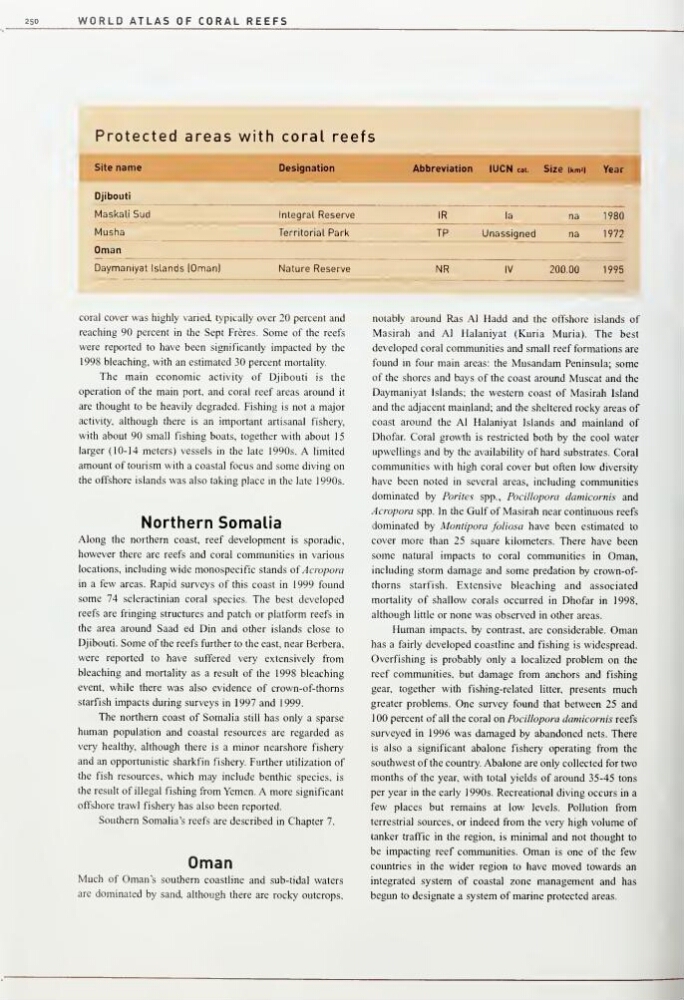
Protected areas with coral reefs
Site name
Designation
Djibouti
Abbreviation
lUCN cat.
Size ikm'!
Year
Maskali Sud
Integral Reserve
IR
la
na
1980
Musha
Territorial Park
TP
Unassigned
na
1972
Oman
Daymaniyat Islands (OmanI
Nature Reserve
NR
IV
200.00
1995
coral cover was highly varied, typically over 20 percent and
reaching 90 percent in the Sept Freres. Some of the reefs
were reported to have been significantly impacted by the
1998 bleaching, with an estimated 30 percent mortality.
The main economic activity of Djibouti is the
operation of the main port, and coral reef areas around it
are thought to be heavily degraded. Fishing is not a major
activity, although there is an important artisanal fishery,
with about 90 small fishing boats, together with about 15
larger (10-14 meters) vessels in the late 1990s. A limited
amount of tourism with a coastal focus and some diving on
the offshore islands was also taking place in the late 1990s.
Northern Somalia
Along the northern coast, reef development is sporadic,
however there are reefs and coral communities in various
locations, including wide monospecific stands of Acropora
in a few areas. Rapid surveys of this coast in 1999 found
some 74 scleractinian coral species. The best developed
reefs are fringing structures and patch or platform reefs in
the area around Saad ed Din and other islands close to
Djibouti. Some of the reefs further to the east, near Berbera,
were reported to have suffered very extensively from
bleaching and mortality as a resuh of the 1998 bleaching
event, while there was also evidence of crown-of-thoms
starfish impacts during surveys in 1997 and 1999.
The northern coast of Somalia still has only a sparse
human population and coastal resources are regarded as
very healthy, although there is a minor nearshore fishery
and an opportunistic sharkfin fishery. Further utilization of
the fish resources, which may include benthic species, is
the result of illegal fishing from Yemen. A more significant
offshore trawl fishery has also been reported.
Southern Somalia's reefs are described in Chapter 7.
Oman
Much of Oman's southern coastline and sub-tidal waters
are dominated by sand, although there are rocky outcrops.
notably around Ras Al Hadd and the offshore islands of
Masirah and Al Halaniyat (Kuria Muria). The best
developed coral communities and small reef formations are
found in four main areas: the Musandam Peninsula: some
of the shores and bays of the coast around Muscat and the
Daymaniyat Islands: the western coast of Masirah Island
and the adjacent mainland: and the sheltered rocky areas of
coast around the Al Halaniyat Islands and mainland of
Dhofar. Coral growth is restricted both by the cool water
upwellings and by the availability of hard substrates. Coral
communities with high coral cover but often low diversity
have been noted in several areas, including communities
dominated by Porites spp., Pocillopora damicornis and
Acropora spp. In the Gulf of Masirah near continuous reefs
dominated by Monlipora foliosa have been estimated to
cover more than 25 square kilometers. There have been
some natural impacts to coral communities in Oman,
including storm damage and some predation by crown-ofthoms starfish. Extensive bleaching and associated
mortality of shallow corals occurred in Dhofar in 1998,
although little or none was observed in other areas.
Human impacts, by contrast, are considerable. Oman
has a fairly developed coastline and fishing is widespread.
Overfishing is probably only a localized problem on the
reef communities, but damage from anchors and fishing
gear, together with fishing-related litter, presents much
greater problems. One survey found that between 25 and
100 percent of all the coral on Pocillopora damicornis reefs
surveyed in 1996 was damaged by abandoned nets. There
is also a significant abalone fishery operating from the
southwest of the country. Abalone are only collected for two
months of the year, with total yields of around 35-45 tons
per year in the early 1990s. Recreational diving occurs in a
few places but remains at low levels. Pollution from
terrestrial sources, or indeed from the very high volume of
tanker traffic in the region, is minimal and not thought to
be impacting reef communities. Oman is one of the few
countries in the wider region to have moved towards an
integrated system of coastal zone management and has
begun to designate a system of marine protected areas.
WORLD ATLAS OF CORAL REEFS
Protected areas with coral reefs
Site name
Designation
Djibouti
Abbreviation
lUCN cat.
Size ikm'!
Year
Maskali Sud
Integral Reserve
IR
la
na
1980
Musha
Territorial Park
TP
Unassigned
na
1972
Oman
Daymaniyat Islands (OmanI
Nature Reserve
NR
IV
200.00
1995
coral cover was highly varied, typically over 20 percent and
reaching 90 percent in the Sept Freres. Some of the reefs
were reported to have been significantly impacted by the
1998 bleaching, with an estimated 30 percent mortality.
The main economic activity of Djibouti is the
operation of the main port, and coral reef areas around it
are thought to be heavily degraded. Fishing is not a major
activity, although there is an important artisanal fishery,
with about 90 small fishing boats, together with about 15
larger (10-14 meters) vessels in the late 1990s. A limited
amount of tourism with a coastal focus and some diving on
the offshore islands was also taking place in the late 1990s.
Northern Somalia
Along the northern coast, reef development is sporadic,
however there are reefs and coral communities in various
locations, including wide monospecific stands of Acropora
in a few areas. Rapid surveys of this coast in 1999 found
some 74 scleractinian coral species. The best developed
reefs are fringing structures and patch or platform reefs in
the area around Saad ed Din and other islands close to
Djibouti. Some of the reefs further to the east, near Berbera,
were reported to have suffered very extensively from
bleaching and mortality as a resuh of the 1998 bleaching
event, while there was also evidence of crown-of-thoms
starfish impacts during surveys in 1997 and 1999.
The northern coast of Somalia still has only a sparse
human population and coastal resources are regarded as
very healthy, although there is a minor nearshore fishery
and an opportunistic sharkfin fishery. Further utilization of
the fish resources, which may include benthic species, is
the result of illegal fishing from Yemen. A more significant
offshore trawl fishery has also been reported.
Southern Somalia's reefs are described in Chapter 7.
Oman
Much of Oman's southern coastline and sub-tidal waters
are dominated by sand, although there are rocky outcrops.
notably around Ras Al Hadd and the offshore islands of
Masirah and Al Halaniyat (Kuria Muria). The best
developed coral communities and small reef formations are
found in four main areas: the Musandam Peninsula: some
of the shores and bays of the coast around Muscat and the
Daymaniyat Islands: the western coast of Masirah Island
and the adjacent mainland: and the sheltered rocky areas of
coast around the Al Halaniyat Islands and mainland of
Dhofar. Coral growth is restricted both by the cool water
upwellings and by the availability of hard substrates. Coral
communities with high coral cover but often low diversity
have been noted in several areas, including communities
dominated by Porites spp., Pocillopora damicornis and
Acropora spp. In the Gulf of Masirah near continuous reefs
dominated by Monlipora foliosa have been estimated to
cover more than 25 square kilometers. There have been
some natural impacts to coral communities in Oman,
including storm damage and some predation by crown-ofthoms starfish. Extensive bleaching and associated
mortality of shallow corals occurred in Dhofar in 1998,
although little or none was observed in other areas.
Human impacts, by contrast, are considerable. Oman
has a fairly developed coastline and fishing is widespread.
Overfishing is probably only a localized problem on the
reef communities, but damage from anchors and fishing
gear, together with fishing-related litter, presents much
greater problems. One survey found that between 25 and
100 percent of all the coral on Pocillopora damicornis reefs
surveyed in 1996 was damaged by abandoned nets. There
is also a significant abalone fishery operating from the
southwest of the country. Abalone are only collected for two
months of the year, with total yields of around 35-45 tons
per year in the early 1990s. Recreational diving occurs in a
few places but remains at low levels. Pollution from
terrestrial sources, or indeed from the very high volume of
tanker traffic in the region, is minimal and not thought to
be impacting reef communities. Oman is one of the few
countries in the wider region to have moved towards an
integrated system of coastal zone management and has
begun to designate a system of marine protected areas.