

212
WORLD ATLAS OF CORAL REEFS
Chapter 8
Central Indian Ocean
The
southern continental coastline of Central
Asia, stretching fronn Pakistan to Bangladesh,
has remarkably little reef development. There
are no true reefs recorded off Pakistan, while
most of the western and eastern coastlines of
India are dominated by high levels of sediments,
preventing reef formation. In the far southeast of India
there is some reef development and there are a tew
important reefs around Sri Lanka. In stark contrast to
these continental shores, the oceanic waters to the
south, and around the Andaman and Nicobar Islands
in the east, abound with reefs. The dominant formation
is a single arc stretching from the Indian islands of
Lakshadweep. along the chain of the Maldives, to the
Chagos Archipelago. This follows the Chagos-Laccadive
Ridge, a volcanic structure left by the northward movement of the oceanic crust over the Reunion hotspot.
These reefs include the worlds largest atoll structures.
Biogeographically this is a region of transition.
India's Andaman and Nicobar Islands lie on the edges
of insular Southeast Asia, the region of highest reef
biodiversity in the world. The fauna on these reefs
includes many species restricted to Southeast Asia, or
which have the Andaman and Nicobar Islands as the
westernmost edge of their range. To the west, the reefs
from India south to the Chagos Archipelago include
certain elements of more typically Indian Ocean species,
as well as small numbers of species which characterize
the Western Indian Ocean. Maps showing patterns of
species diversity on coral reefs (see Chapter 1) clearly
show how diversity is restricted to a narrow path of
maximum diversity - the "Chagos Stricture" - centered
on the southern Maldives and Chagos Archipelago.
Similar levels of diversity again become widespread
further west along the coast of East Africa and the
Arabian Peninsula. It is considered, from these patterns
and others, that the Central Indian Ocean reefs could
provide a critical link between the eastern and western
margins of the Indian Ocean.
Human pressures on the reefs in the region vary
considerably The reefs of the Chagos and parts of
the Andaman and Nicobar Islands are among the least
impacted coral reefs worldwide. Studies on water
quality in the Chagos Archipelago suggest that these
may be some of the least polluted waters in the world,
and that even persistent organic pollutants from remote
sources may be lower here than elsewhere. By contrast
the coral reefs in Sri Lanka and parts of mainland India
are under enormous pressure. Although historical data
on the distribution of reefs is scarce, it seems highly
probable that some reefs have already been lost from
these areas. The importance of reefs to the social and
economic well-being of the regions people is widely
recognized, and there are a number of efforts at the
national level to restrict damaging activities and set
aside areas for conservation.
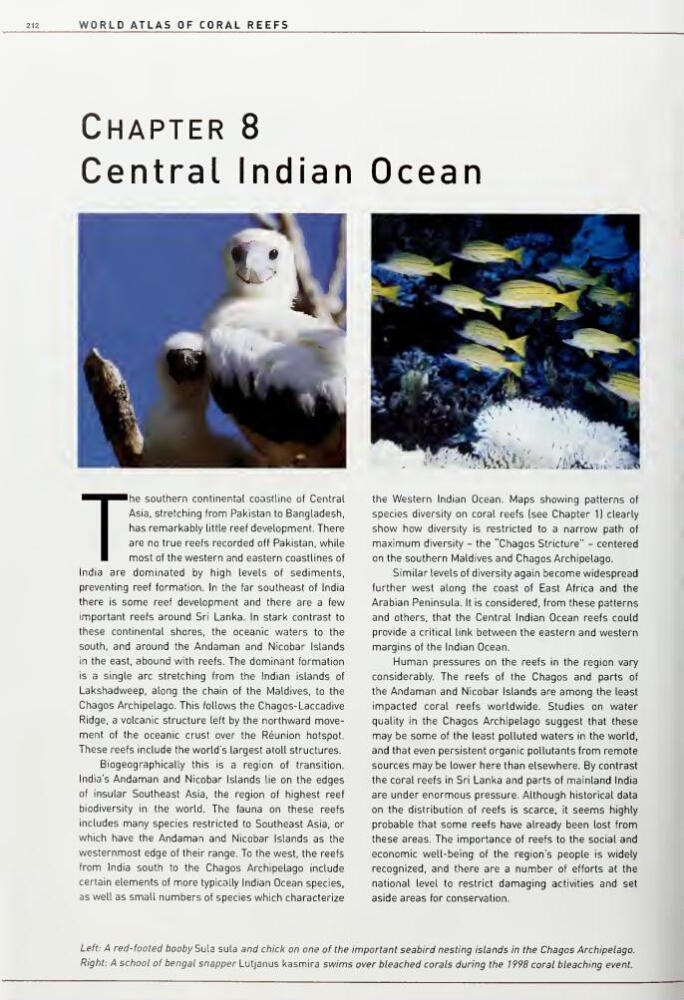
Left: A red-footed booby Sula sula and chick on one of the important seabird nesting islands in the Chagos Archipelago.
Right: A school of bengal snapper Lutjanus kasmira swims over bleached corals during the 1998 coral bleaching event.
WORLD ATLAS OF CORAL REEFS
Chapter 8
Central Indian Ocean
The
southern continental coastline of Central
Asia, stretching fronn Pakistan to Bangladesh,
has remarkably little reef development. There
are no true reefs recorded off Pakistan, while
most of the western and eastern coastlines of
India are dominated by high levels of sediments,
preventing reef formation. In the far southeast of India
there is some reef development and there are a tew
important reefs around Sri Lanka. In stark contrast to
these continental shores, the oceanic waters to the
south, and around the Andaman and Nicobar Islands
in the east, abound with reefs. The dominant formation
is a single arc stretching from the Indian islands of
Lakshadweep. along the chain of the Maldives, to the
Chagos Archipelago. This follows the Chagos-Laccadive
Ridge, a volcanic structure left by the northward movement of the oceanic crust over the Reunion hotspot.
These reefs include the worlds largest atoll structures.
Biogeographically this is a region of transition.
India's Andaman and Nicobar Islands lie on the edges
of insular Southeast Asia, the region of highest reef
biodiversity in the world. The fauna on these reefs
includes many species restricted to Southeast Asia, or
which have the Andaman and Nicobar Islands as the
westernmost edge of their range. To the west, the reefs
from India south to the Chagos Archipelago include
certain elements of more typically Indian Ocean species,
as well as small numbers of species which characterize
the Western Indian Ocean. Maps showing patterns of
species diversity on coral reefs (see Chapter 1) clearly
show how diversity is restricted to a narrow path of
maximum diversity - the "Chagos Stricture" - centered
on the southern Maldives and Chagos Archipelago.
Similar levels of diversity again become widespread
further west along the coast of East Africa and the
Arabian Peninsula. It is considered, from these patterns
and others, that the Central Indian Ocean reefs could
provide a critical link between the eastern and western
margins of the Indian Ocean.
Human pressures on the reefs in the region vary
considerably The reefs of the Chagos and parts of
the Andaman and Nicobar Islands are among the least
impacted coral reefs worldwide. Studies on water
quality in the Chagos Archipelago suggest that these
may be some of the least polluted waters in the world,
and that even persistent organic pollutants from remote
sources may be lower here than elsewhere. By contrast
the coral reefs in Sri Lanka and parts of mainland India
are under enormous pressure. Although historical data
on the distribution of reefs is scarce, it seems highly
probable that some reefs have already been lost from
these areas. The importance of reefs to the social and
economic well-being of the regions people is widely
recognized, and there are a number of efforts at the
national level to restrict damaging activities and set
aside areas for conservation.
Left: A red-footed booby Sula sula and chick on one of the important seabird nesting islands in the Chagos Archipelago.
Right: A school of bengal snapper Lutjanus kasmira swims over bleached corals during the 1998 coral bleaching event.