

208
WORLD ATLAS OF CORAL REEFS
to have severely degraded nearly 30 percent of the reef
flats. Efforts are underway to reduce impacts on the coral
reefs, including tighter controls on land-based sources
of pollution.
Most of the coral reefs are formally protected within
a marine park, which had 1 1 park rangers in 2000. The
area incorporates a number of fishing reserves, while
consideration is being given to the designation of nature
reserves or other additional forms of protection within the
park boundaries.
Outlying French territories
France administers a number of islands (Maps 7e and h)
around Madagascar (administered alongside Madagascar
prior to its independence). Sometimes known by the collective title of lies Eparses (scattered islands), these islands
are all administered from Reunion, although their ownership remains disputed with Madagascar. Most of these are
located in the Mozambique Channel. Recent information
on the status of any of these reefs is unavailable.
On the same latitude as Grande Comore, but close to
Reunion
General Data
Population (thousands)
721
GDP (million US$1
6 U8
Land area Ikm^l
2 576
Marine area (thousand km^j
318
Per capita fish consumption ( kg/yea r|
10
Status and Threats
Reefs at risk (%|
100
Recorded coral diseases
Q
Biodiversity
Reef area* (kmz)
<50
Coral diversity
13^/295
Mangrove area (km^l
na
No. of mangrove species
na
No. of seagrass species
na
• The lies Eparses have a further 243 km^ of reef. with a land area
of 23 km2 in a marine area of 640 000 km'
.
.
_
_._._,. ._.
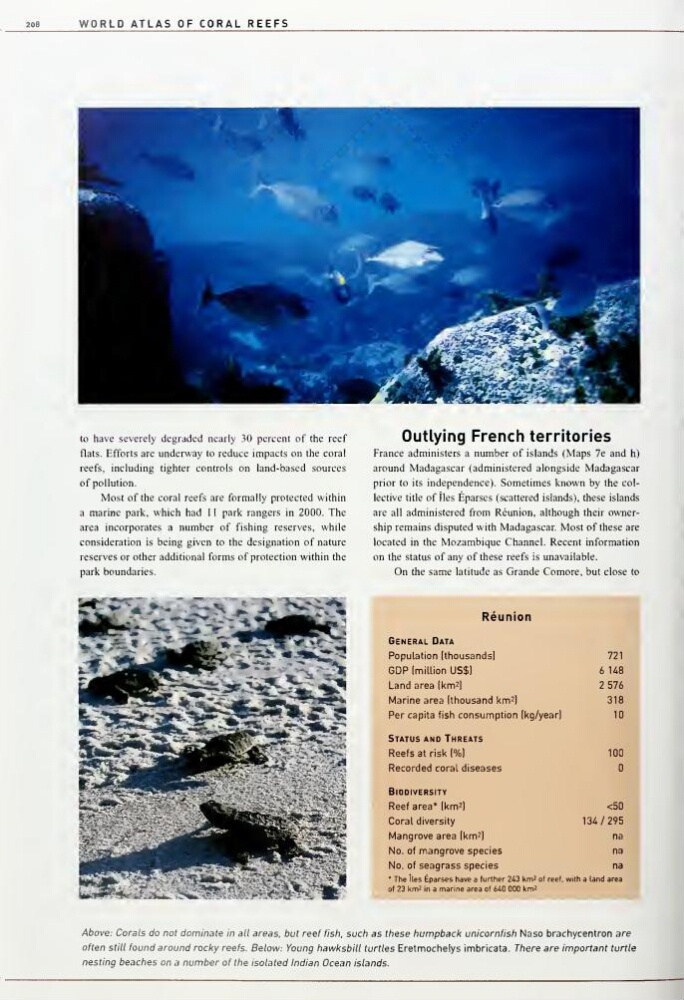
Above: Corals do not dominate in all areas, but reef fish, such as these humpback unicornfish Naso brachycentron are
often still found around rocl
WORLD ATLAS OF CORAL REEFS
to have severely degraded nearly 30 percent of the reef
flats. Efforts are underway to reduce impacts on the coral
reefs, including tighter controls on land-based sources
of pollution.
Most of the coral reefs are formally protected within
a marine park, which had 1 1 park rangers in 2000. The
area incorporates a number of fishing reserves, while
consideration is being given to the designation of nature
reserves or other additional forms of protection within the
park boundaries.
Outlying French territories
France administers a number of islands (Maps 7e and h)
around Madagascar (administered alongside Madagascar
prior to its independence). Sometimes known by the collective title of lies Eparses (scattered islands), these islands
are all administered from Reunion, although their ownership remains disputed with Madagascar. Most of these are
located in the Mozambique Channel. Recent information
on the status of any of these reefs is unavailable.
On the same latitude as Grande Comore, but close to
Reunion
General Data
Population (thousands)
721
GDP (million US$1
6 U8
Land area Ikm^l
2 576
Marine area (thousand km^j
318
Per capita fish consumption ( kg/yea r|
10
Status and Threats
Reefs at risk (%|
100
Recorded coral diseases
Q
Biodiversity
Reef area* (kmz)
<50
Coral diversity
13^/295
Mangrove area (km^l
na
No. of mangrove species
na
No. of seagrass species
na
• The lies Eparses have a further 243 km^ of reef. with a land area
of 23 km2 in a marine area of 640 000 km'
.
.
_
_._._,. ._.
Above: Corals do not dominate in all areas, but reef fish, such as these humpback unicornfish Naso brachycentron are
often still found around rocl