

Western Indian Ocean
reefs - blast fishing was a problem in the past and anchor
damage continues. Large areas are also affected by crownof-thorns starfish, which have undergone population
explosions since the early 1980s. Tourism is a critical
sector of the economy, and Mauritms had 487 000 arrivals
in 1996. Coastal development to cater for this industry has
added significant impacts, notably through pollution, but
also through coral and shell collection for sale to tourists
as well as direct diver impacts.
By contrast the island of Rodrigues remains relatively
undeveloped, with a small human population. Fisheries
are an important industry and there is a well developed
octopus fishery which exports to Mauritius. Tourism is a
small, but growing, sector of the economy, with some 26 000
visitors in 1997. Soil erosion and sedimentation are still a
problem around this island, but overall the reefs, which are
further offshore, remain in relatively healthy condition.
Mauritius holds jurisdiction over a string of islands
and reefs running north along the Mascarene Ridge - the
northernmost island is Albatross, although there are reef
communities on the Nazareth Bank some 240 kilometers
further north (and still within Mauritian waters). The main
group of islands and reefs in this area lie on a long reef
structure on the Cargados Carajos Bank. These include St.
Brandon (North Island), St. Raphael, He Perle, ile Fregate
and lie Paul, plus a chain of over a dozen islands in the
south. There is little published information about these
reefs, however they are thought to include a broad reef flat
and possibly the largest continuous algal ridge in the
Indian Ocean. There are large and important seabird
colonies on a number of islands. The islands are leased to
a private fishing company which is based, along with a
meteorological station, on St. Raphael.
Also administered by Mauritius is the isolated
Agelaga, a complex of two islands (North and South
Island) and a substantial reef area. Again there is very
little published literature describing this island.
Reunion
Reunion, a territory of France, only has a few fringing reef
communities restricted to its leeward western shores,
although corals are found growing directly on volcanic
substrates in the southeast. Although not extensive, these
reefs have been well studied. An estimated 1 000 species
offish occur in the surrounding waters, including 250-300
reef-associated species, and 149 recorded coral species.
The 1998 coral bleaching had some impact, particularly
where corals were already stressed by other factors, but
recovery was good in almost all areas. Coral cover at a
number of survey sites on the outer reef slopes and
lagoons was at 30-50 percent after the bleaching.
The majority of the people of Reunion live close
to the coast and have had a major impact on it. There were
some 641 registered commercial fishers in 1996, most of
whom were operating in nearshore areas. Overexploitation
of coastal fishes has been occurring for some time, and
destructive fishing practices have been reported.
Tourism is the main source of income on Reunion.
There were 347 000 visitors in 1996 and, although diving
and snorkelling are not the major attractions, over 50
percent of hotel bookings are on the west coast, close to
the coral reefs. The impacts of overfishing and coastal
development together with sewage pollution are reported
!
^H
'
General Data
'
"
Population Ithousandsl
1
179
GDP (million US$1
3 5U
Land area (km^l
2 035
Marine area (thousand km^l
1 291
Per capita fish consumption [kg/yearl
21
Status and Threats
Reefs at risk (%1
81
Recorded coral diseases
Biodiversity
Reef area (km^l
870
Coral diversity
161 /29i
Mangrove area (km^l
na
No. of mangrove species
2
No. of seagrass species
7
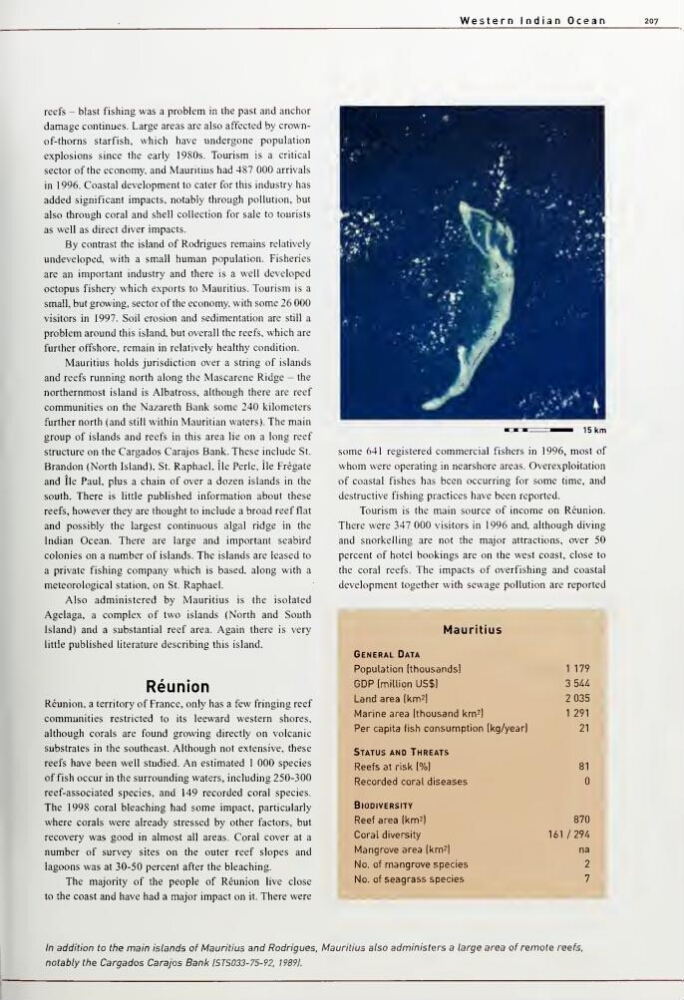
In addition to the main Islands of Mauritius and Rodrigues, Mauritius also administers a large area of remote reefs,
notably the Cargados Carajos Bank ISTS033-75-92, 19891.
reefs - blast fishing was a problem in the past and anchor
damage continues. Large areas are also affected by crownof-thorns starfish, which have undergone population
explosions since the early 1980s. Tourism is a critical
sector of the economy, and Mauritms had 487 000 arrivals
in 1996. Coastal development to cater for this industry has
added significant impacts, notably through pollution, but
also through coral and shell collection for sale to tourists
as well as direct diver impacts.
By contrast the island of Rodrigues remains relatively
undeveloped, with a small human population. Fisheries
are an important industry and there is a well developed
octopus fishery which exports to Mauritius. Tourism is a
small, but growing, sector of the economy, with some 26 000
visitors in 1997. Soil erosion and sedimentation are still a
problem around this island, but overall the reefs, which are
further offshore, remain in relatively healthy condition.
Mauritius holds jurisdiction over a string of islands
and reefs running north along the Mascarene Ridge - the
northernmost island is Albatross, although there are reef
communities on the Nazareth Bank some 240 kilometers
further north (and still within Mauritian waters). The main
group of islands and reefs in this area lie on a long reef
structure on the Cargados Carajos Bank. These include St.
Brandon (North Island), St. Raphael, He Perle, ile Fregate
and lie Paul, plus a chain of over a dozen islands in the
south. There is little published information about these
reefs, however they are thought to include a broad reef flat
and possibly the largest continuous algal ridge in the
Indian Ocean. There are large and important seabird
colonies on a number of islands. The islands are leased to
a private fishing company which is based, along with a
meteorological station, on St. Raphael.
Also administered by Mauritius is the isolated
Agelaga, a complex of two islands (North and South
Island) and a substantial reef area. Again there is very
little published literature describing this island.
Reunion
Reunion, a territory of France, only has a few fringing reef
communities restricted to its leeward western shores,
although corals are found growing directly on volcanic
substrates in the southeast. Although not extensive, these
reefs have been well studied. An estimated 1 000 species
offish occur in the surrounding waters, including 250-300
reef-associated species, and 149 recorded coral species.
The 1998 coral bleaching had some impact, particularly
where corals were already stressed by other factors, but
recovery was good in almost all areas. Coral cover at a
number of survey sites on the outer reef slopes and
lagoons was at 30-50 percent after the bleaching.
The majority of the people of Reunion live close
to the coast and have had a major impact on it. There were
some 641 registered commercial fishers in 1996, most of
whom were operating in nearshore areas. Overexploitation
of coastal fishes has been occurring for some time, and
destructive fishing practices have been reported.
Tourism is the main source of income on Reunion.
There were 347 000 visitors in 1996 and, although diving
and snorkelling are not the major attractions, over 50
percent of hotel bookings are on the west coast, close to
the coral reefs. The impacts of overfishing and coastal
development together with sewage pollution are reported
!
^H
'
General Data
'
"
Population Ithousandsl
1
179
GDP (million US$1
3 5U
Land area (km^l
2 035
Marine area (thousand km^l
1 291
Per capita fish consumption [kg/yearl
21
Status and Threats
Reefs at risk (%1
81
Recorded coral diseases
Biodiversity
Reef area (km^l
870
Coral diversity
161 /29i
Mangrove area (km^l
na
No. of mangrove species
2
No. of seagrass species
7
In addition to the main Islands of Mauritius and Rodrigues, Mauritius also administers a large area of remote reefs,
notably the Cargados Carajos Bank ISTS033-75-92, 19891.