

The World of Coral Reefs
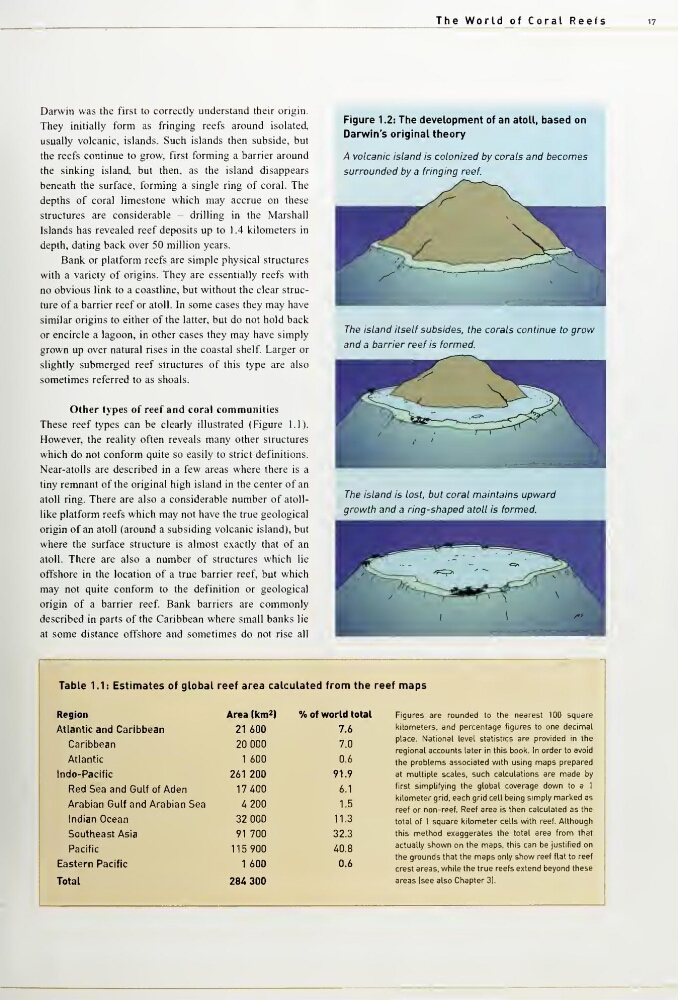
Darwin was the first to correctly understand their origin.
They initially form as fringing reefs around isolated
usually volcanic, islands. Such islands then subside, but
the reefs continue to grow, first forming a barrier around
the sinking island, but then, as the island disappears
beneath the surface, forming a single ring of coral. The
depths of coral limestone which may accrue on these
structures are considerable - drilling in the Marshall
Islands has revealed reef deposits up to 1.4 kilometers in
depth, dating back over 50 million years.
Bank or platform reefs are simple physical structures
with a variety of origins. They are essentially reefs with
no obvious link to a coastline, but without the clear structure of a barrier reef or atoll. In some cases they may have
similar origins to either of the latter, but do not hold back
or encircle a lagoon, in other cases they may have simply
grown up over natural rises in the coastal shelf Larger or
slightly submerged reef structures of this type are also
sometimes referred to as shoals.
Other types of reef and coral communities
These reef types can be clearly illustrated (Figure 1.1).
However, the reality often reveals many other structures
which do not conform quite so easily to strict definitions.
Near-atolls are described in a few areas where there is a
tiny remnant of the original high island in the center of an
atoll ring. There are also a considerable number of atolllike platform reefs which may not have the true geological
origin of an atoll (around a subsiding volcanic island), but
where the surface structure is almost exactly that of an
atoll. There are also a number of structures which lie
offshore in the location of a true barrier reef, but which
may not quite conform to the definition or geological
origin of a barrier reef Bank barriers are commonly
described in parts of the Caribbean where small banks lie
at some distance offshore and sometimes do not rise all
Figure 1 .2: The development of an atoll, based on
Darwin's original theory
A volcanic island is colonized by corals and becomes
surrounded by a fringing reef.
The island itself subsides, the corals continue to grow
and a barrier reef is formed.
The island is lost, but coral maintains upward
growth and a ring-shaped atoll is formed.
Table 1.1: Estimates of global reef area calculated from the reef maps
Region
Area (km^)
% of world total
Atlantic and Caribbean
21 600
7.6
Caribbean
20 000
7.0
Atlantic
1
600
0.6
Indo-Pacific
261 200
91.9
Red Sea and Gulf of Aden
llAOO
6.1
Arabian Gulf and Arabian Sea
/,200
1.5
Indian Ocean
32 000
11.3
Southeast Asia
91 700
32.3
Pacific
115 900
40.8
Eastern Pacific
1 600
0.6
Total
ZBi 300
Figures are rounded to the nearest 100 square
kilometers, and percentage figures to one decimal
place. National level statistics are provided in the
regional accounts later in this book. In order to avoid
the problems associated with using maps prepared
at multiple scales, such calculations are made by
first simplifying the global coverage dov^^n to a 1
kilometer grid, each grid cell being simply marked as
reef or non-reef. Reef area is then calculated as the
total of 1 square kilometer cells with reef. Although
this method exaggerates the total area from that
actually shown on the maps, this can be justified on
the grounds that the maps only show reef flat to reef
crest areas, while the true reefs extend beyond these
areas Isee also Chapter 31.
Darwin was the first to correctly understand their origin.
They initially form as fringing reefs around isolated
usually volcanic, islands. Such islands then subside, but
the reefs continue to grow, first forming a barrier around
the sinking island, but then, as the island disappears
beneath the surface, forming a single ring of coral. The
depths of coral limestone which may accrue on these
structures are considerable - drilling in the Marshall
Islands has revealed reef deposits up to 1.4 kilometers in
depth, dating back over 50 million years.
Bank or platform reefs are simple physical structures
with a variety of origins. They are essentially reefs with
no obvious link to a coastline, but without the clear structure of a barrier reef or atoll. In some cases they may have
similar origins to either of the latter, but do not hold back
or encircle a lagoon, in other cases they may have simply
grown up over natural rises in the coastal shelf Larger or
slightly submerged reef structures of this type are also
sometimes referred to as shoals.
Other types of reef and coral communities
These reef types can be clearly illustrated (Figure 1.1).
However, the reality often reveals many other structures
which do not conform quite so easily to strict definitions.
Near-atolls are described in a few areas where there is a
tiny remnant of the original high island in the center of an
atoll ring. There are also a considerable number of atolllike platform reefs which may not have the true geological
origin of an atoll (around a subsiding volcanic island), but
where the surface structure is almost exactly that of an
atoll. There are also a number of structures which lie
offshore in the location of a true barrier reef, but which
may not quite conform to the definition or geological
origin of a barrier reef Bank barriers are commonly
described in parts of the Caribbean where small banks lie
at some distance offshore and sometimes do not rise all
Figure 1 .2: The development of an atoll, based on
Darwin's original theory
A volcanic island is colonized by corals and becomes
surrounded by a fringing reef.
The island itself subsides, the corals continue to grow
and a barrier reef is formed.
The island is lost, but coral maintains upward
growth and a ring-shaped atoll is formed.
Table 1.1: Estimates of global reef area calculated from the reef maps
Region
Area (km^)
% of world total
Atlantic and Caribbean
21 600
7.6
Caribbean
20 000
7.0
Atlantic
1
600
0.6
Indo-Pacific
261 200
91.9
Red Sea and Gulf of Aden
llAOO
6.1
Arabian Gulf and Arabian Sea
/,200
1.5
Indian Ocean
32 000
11.3
Southeast Asia
91 700
32.3
Pacific
115 900
40.8
Eastern Pacific
1 600
0.6
Total
ZBi 300
Figures are rounded to the nearest 100 square
kilometers, and percentage figures to one decimal
place. National level statistics are provided in the
regional accounts later in this book. In order to avoid
the problems associated with using maps prepared
at multiple scales, such calculations are made by
first simplifying the global coverage dov^^n to a 1
kilometer grid, each grid cell being simply marked as
reef or non-reef. Reef area is then calculated as the
total of 1 square kilometer cells with reef. Although
this method exaggerates the total area from that
actually shown on the maps, this can be justified on
the grounds that the maps only show reef flat to reef
crest areas, while the true reefs extend beyond these
areas Isee also Chapter 31.