

WORLD ATLAS OF CORAL REEFS
more normal. In fact the majority of reef structures that
exist today are not the result of continuous growth, but of
pulses of growth interspersed with quiescent periods, or
even periods of erosion, when the reefs might be defined
as fossil or non-living reefs. Sea levels in the oceans have
varied dramatically, particularly during the recent ice
ages, and many reefs have intermittently become dry land,
or have been flooded by waters too deep to allow corals to
grow. Between these extremes, however, some of these
fossil structures become recolonized by corals and reef
development recommences.
Over shorter time scales, the division between an
actively growing coral reef and a fossil reef is, in many
areas, unclear No reef is in a constant state of growth.
During major tropical storm events, all reefs undergo
losses in coral cover and often considerable erosion of
their physical structure. Over years or decades, the extent
of actively growing coral cover also varies considerably.
Recently observed events, including coral disease, coral
bleaching, outbreaks of the coral-feeding crown-of-thorns
starfish, or the die-off of important grazers such as the
long-spined sea urchin (see page 61), have all produced
considerable losses of live coral cover to some reefs.
Recovery from such events points to a natural resilience,
but also shows that any understanding of a "reef" measured
from only one particular moment in time will be limited.
Takmg such points into consideration, a coral reef can
thus be more rigorously defined as a physical structure
which has been built up, and continues to grow over
decadal time scales, as a result of the accumulation of
calcium carbonate laid down by hermatypic corals and
other organisms. The manner in which such structures
develop has led to the recognition of a number of types of
reef, while there are also many other communities which,
while not as obviously covered by these definitions, are
clearly related and equally important.
Types of reef
Corals can only grow in warm, well lit waters and require
a solid surface on which to settle. These factors restrict the
initial appearance of hermatypic corals to shallow rocky
substrates in the tropics. As corals proliferate, their
skeletons provide a solid substrate for the appearance and
settlement of more corals and other organisms. The
upward growth of a physical reef structure can also allow
corals to continue to grow in shallow well lit waters, even
if the basement on which they are growing subsides or sea
levels rise.
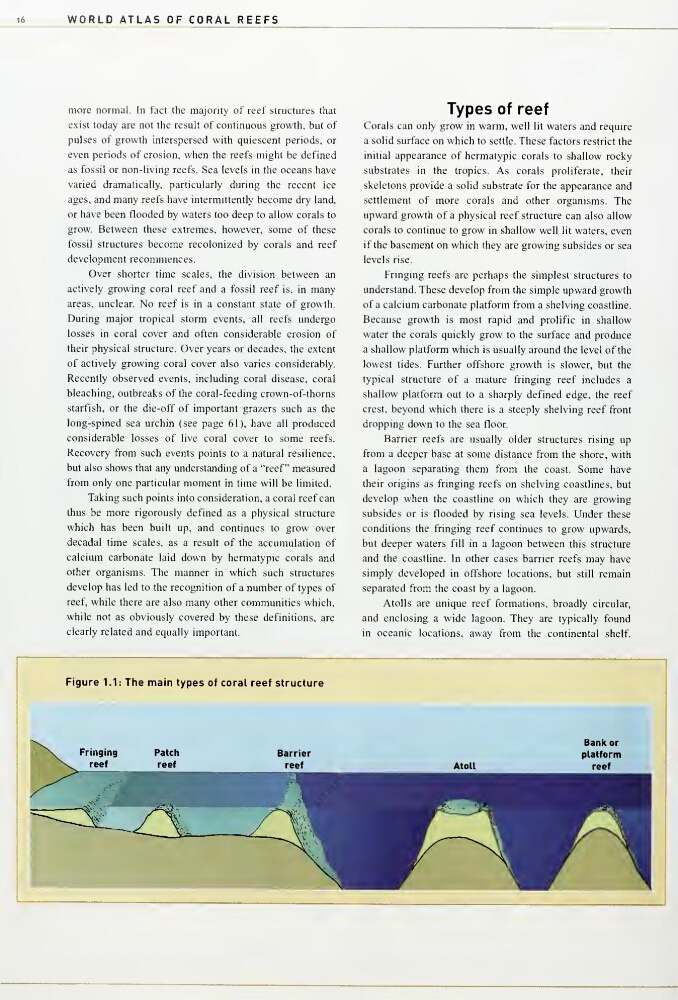
Fringing reefs are perhaps the simplest structures to
understand. These develop from the simple upward growth
of a calcium carbonate platform from a shelving coastline.
Because growth is most rapid and prolific in shallow
water the corals quickly grow to the surface and produce
a shallow platform which is usually around the level of the
lowest tides. Further offshore growth is slower, but the
typical structure of a mature fringing reef includes a
shallow platform out to a sharply defined edge, the reef
crest, beyond which there is a steeply shelving reef front
dropping down to the sea floor.
Barrier reefs are usually older structures rising up
from a deeper base at some distance from the shore, with
a lagoon separating them from the coast. Some have
their origins as fringing reefs on shelving coastlines, but
develop when the coastline on which they are growing
subsides or is flooded by rising sea levels. Under these
conditions the fringing reef continues to grow upwards,
but deeper waters fill in a lagoon between this structure
and the coastline. In other cases barrier reefs may have
simply developed in offshore locations, but still remain
separated from the coast by a lagoon.
Atolls are unique reef formations, broadly circular,
and enclosing a wide lagoon. They are typically found
in oceanic locations, away from the continental shelf
Figure 1.1: The main types of coral reef structure
Barrier
reel
Bank or
platform
reef
more normal. In fact the majority of reef structures that
exist today are not the result of continuous growth, but of
pulses of growth interspersed with quiescent periods, or
even periods of erosion, when the reefs might be defined
as fossil or non-living reefs. Sea levels in the oceans have
varied dramatically, particularly during the recent ice
ages, and many reefs have intermittently become dry land,
or have been flooded by waters too deep to allow corals to
grow. Between these extremes, however, some of these
fossil structures become recolonized by corals and reef
development recommences.
Over shorter time scales, the division between an
actively growing coral reef and a fossil reef is, in many
areas, unclear No reef is in a constant state of growth.
During major tropical storm events, all reefs undergo
losses in coral cover and often considerable erosion of
their physical structure. Over years or decades, the extent
of actively growing coral cover also varies considerably.
Recently observed events, including coral disease, coral
bleaching, outbreaks of the coral-feeding crown-of-thorns
starfish, or the die-off of important grazers such as the
long-spined sea urchin (see page 61), have all produced
considerable losses of live coral cover to some reefs.
Recovery from such events points to a natural resilience,
but also shows that any understanding of a "reef" measured
from only one particular moment in time will be limited.
Takmg such points into consideration, a coral reef can
thus be more rigorously defined as a physical structure
which has been built up, and continues to grow over
decadal time scales, as a result of the accumulation of
calcium carbonate laid down by hermatypic corals and
other organisms. The manner in which such structures
develop has led to the recognition of a number of types of
reef, while there are also many other communities which,
while not as obviously covered by these definitions, are
clearly related and equally important.
Types of reef
Corals can only grow in warm, well lit waters and require
a solid surface on which to settle. These factors restrict the
initial appearance of hermatypic corals to shallow rocky
substrates in the tropics. As corals proliferate, their
skeletons provide a solid substrate for the appearance and
settlement of more corals and other organisms. The
upward growth of a physical reef structure can also allow
corals to continue to grow in shallow well lit waters, even
if the basement on which they are growing subsides or sea
levels rise.
Fringing reefs are perhaps the simplest structures to
understand. These develop from the simple upward growth
of a calcium carbonate platform from a shelving coastline.
Because growth is most rapid and prolific in shallow
water the corals quickly grow to the surface and produce
a shallow platform which is usually around the level of the
lowest tides. Further offshore growth is slower, but the
typical structure of a mature fringing reef includes a
shallow platform out to a sharply defined edge, the reef
crest, beyond which there is a steeply shelving reef front
dropping down to the sea floor.
Barrier reefs are usually older structures rising up
from a deeper base at some distance from the shore, with
a lagoon separating them from the coast. Some have
their origins as fringing reefs on shelving coastlines, but
develop when the coastline on which they are growing
subsides or is flooded by rising sea levels. Under these
conditions the fringing reef continues to grow upwards,
but deeper waters fill in a lagoon between this structure
and the coastline. In other cases barrier reefs may have
simply developed in offshore locations, but still remain
separated from the coast by a lagoon.
Atolls are unique reef formations, broadly circular,
and enclosing a wide lagoon. They are typically found
in oceanic locations, away from the continental shelf
Figure 1.1: The main types of coral reef structure
Barrier
reel
Bank or
platform
reef