

Western Indian Ocean
189
Protected areas with coral reefs
P Site name
Designation
Abbreviation
lUCN »i.
Size ikin'i
Year
Tanzania
Bongoyo Island
Marine Reserve
MR
II
na
1975
Chumbe Island Coral Park
Marine Sanctuary
MS
II
0.30
1994
Fungu Yasini
Marine Reserve
MR
II
na
1975
Mafia Island
Marine Park
MP
VI
822.00
1995
Maziwi Island
Marine Reserve
MR
II
na
1981
Mbudya
Marine Reserve
MR
II
na
1975
Menai Bay
Conservation Area
CA
VI
470.00
1997
Misali Island
Conservation Area
CA
VI
21.58
1998
Mnazi Bay
Marine Park
MP
VI
650.00
2000
Mnemba
Conservation Area
CA
VI
0.15
1997
Pangavini
Marine Reserve
MR
II
na
1975
extreme degradation of coral reefs and other coastal
communities along large sectors of the coast. Fishing is a
critical activity, providing a major protem source for much
of the coastal population. Overfishing is a problem on
most reefs, and has been exacerbated by destructive fishing
practices. Most notable among these are various seine-net
fishing techniques in which a small mesh (2-8 centimeters)
net with a weighted foot rope is dragged through the
benthos, either onto the beach or directly into a boat. Some
techniques additionally involve beating the substrate with
poles to frighten fish into the net and/or use of a very
small mesh scoop to haul fish from the water Dynamite
fishing was also once widespread, but its use has been
reduced drastically throughout the country following a
nationwide campaign in 1996-97. This involved major
community-driven action which included naming culprits,
but also an amnesty for all those who surrendered their
dynamite and made a public statement not to re-offend.
Coral mining is another highly destructive activity which is
also widespread along the entire coast. In 2000 it was
estimated that 1 500 tons of coral were being mined every
year from the Mikindani Bay area in southern Tanzania
alone. Some 12 percent of Tanga's reefs are believed to be
totally destroyed, largely through destructive fishing, and a
further 64 percent are in poor to moderate condition.
There is only primary sewage treatment in Zanzibar
Town, and little or no treatment on any of the mainland
coast. Tourism is a growing and important sector of the
economy, but there are few environmental controls and
there may be increasing impacts on the reefs. Nonetheless,
tourism is also providing impetus for further reef protection measures in a number of areas. The Chumbe Island
Coral Park provides the best example of "low impact"
tourism in the region, and tourism here provides support
not only for reef management, but also for an important
education program with schools and local communities in
Zanzibar. One further coastal activity that has grown
rapidly since 1989 is commercial seaweed farming, now
practiced along the majority of the coastline of Zanzibar
and increasing on Mafia, Pemba and the mainland coast.
This activity is low technology and hence is being taken
up at the community and individual family level and may
be reducing pressure on fish resources.
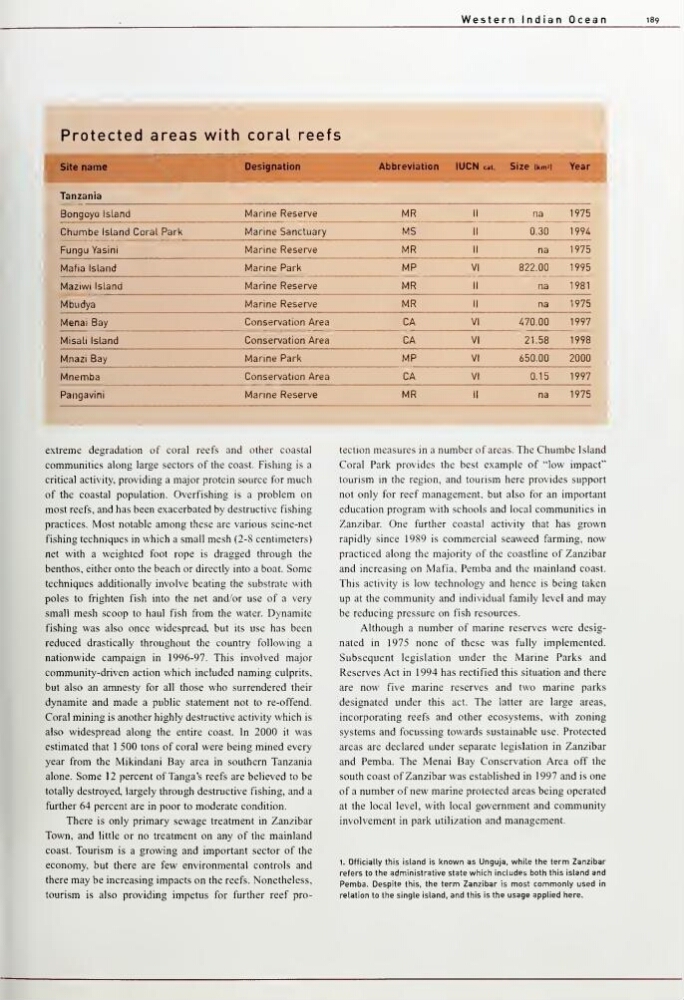
Although a number of marine reserves were designated in 1975 none of these was fully implemented.
Subsequent legislation under the Marine Parks and
Reserves Act in 1994 has rectified this situation and there
are now five marine reserves and two marine parks
designated under this act. The latter are large areas,
incorporating reefs and other ecosystems, with zoning
systems and focussing towards sustainable use. Protected
areas are declared under separate legislation in Zanzibar
and Pemba. The Menai Bay Conservation Area off the
south coast of Zanzibar was established in 1997 and is one
of a number of new marine protected areas being operated
at the local level, with local government and community
involvement in park utilization and management.
1. Officially this island is known as Unguja, while the term Zanzibar
refers to the administrative state which includes both this island and
Pemba. Despite this, the term Zanzibar is most commonly used in
relation to the single island, and this is the usage applied here.
189
Protected areas with coral reefs
P Site name
Designation
Abbreviation
lUCN »i.
Size ikin'i
Year
Tanzania
Bongoyo Island
Marine Reserve
MR
II
na
1975
Chumbe Island Coral Park
Marine Sanctuary
MS
II
0.30
1994
Fungu Yasini
Marine Reserve
MR
II
na
1975
Mafia Island
Marine Park
MP
VI
822.00
1995
Maziwi Island
Marine Reserve
MR
II
na
1981
Mbudya
Marine Reserve
MR
II
na
1975
Menai Bay
Conservation Area
CA
VI
470.00
1997
Misali Island
Conservation Area
CA
VI
21.58
1998
Mnazi Bay
Marine Park
MP
VI
650.00
2000
Mnemba
Conservation Area
CA
VI
0.15
1997
Pangavini
Marine Reserve
MR
II
na
1975
extreme degradation of coral reefs and other coastal
communities along large sectors of the coast. Fishing is a
critical activity, providing a major protem source for much
of the coastal population. Overfishing is a problem on
most reefs, and has been exacerbated by destructive fishing
practices. Most notable among these are various seine-net
fishing techniques in which a small mesh (2-8 centimeters)
net with a weighted foot rope is dragged through the
benthos, either onto the beach or directly into a boat. Some
techniques additionally involve beating the substrate with
poles to frighten fish into the net and/or use of a very
small mesh scoop to haul fish from the water Dynamite
fishing was also once widespread, but its use has been
reduced drastically throughout the country following a
nationwide campaign in 1996-97. This involved major
community-driven action which included naming culprits,
but also an amnesty for all those who surrendered their
dynamite and made a public statement not to re-offend.
Coral mining is another highly destructive activity which is
also widespread along the entire coast. In 2000 it was
estimated that 1 500 tons of coral were being mined every
year from the Mikindani Bay area in southern Tanzania
alone. Some 12 percent of Tanga's reefs are believed to be
totally destroyed, largely through destructive fishing, and a
further 64 percent are in poor to moderate condition.
There is only primary sewage treatment in Zanzibar
Town, and little or no treatment on any of the mainland
coast. Tourism is a growing and important sector of the
economy, but there are few environmental controls and
there may be increasing impacts on the reefs. Nonetheless,
tourism is also providing impetus for further reef protection measures in a number of areas. The Chumbe Island
Coral Park provides the best example of "low impact"
tourism in the region, and tourism here provides support
not only for reef management, but also for an important
education program with schools and local communities in
Zanzibar. One further coastal activity that has grown
rapidly since 1989 is commercial seaweed farming, now
practiced along the majority of the coastline of Zanzibar
and increasing on Mafia, Pemba and the mainland coast.
This activity is low technology and hence is being taken
up at the community and individual family level and may
be reducing pressure on fish resources.
Although a number of marine reserves were designated in 1975 none of these was fully implemented.
Subsequent legislation under the Marine Parks and
Reserves Act in 1994 has rectified this situation and there
are now five marine reserves and two marine parks
designated under this act. The latter are large areas,
incorporating reefs and other ecosystems, with zoning
systems and focussing towards sustainable use. Protected
areas are declared under separate legislation in Zanzibar
and Pemba. The Menai Bay Conservation Area off the
south coast of Zanzibar was established in 1997 and is one
of a number of new marine protected areas being operated
at the local level, with local government and community
involvement in park utilization and management.
1. Officially this island is known as Unguja, while the term Zanzibar
refers to the administrative state which includes both this island and
Pemba. Despite this, the term Zanzibar is most commonly used in
relation to the single island, and this is the usage applied here.