

WORLD ATLAS OF CORAL REEFS
larger islands, probably due to the very high wave energies
which impact these coasts. Misali Island, just west of
Pemba, has been singled out for having some of the
highest recorded coral cover, and high species diversity
with 40 genera of coral and 350 fish species. Chumbe and
Mnemba islands off Zanzibar have been similarly singled
out as offshore islands with diverse and well protected
reefs. It is possible that similar diversity may be recorded
from other reefs, many of which have yet to receive
detailed scientific attention. Mafia Island has extensive
reefs, particularly in the south, many of which remain in
good condition. Some 380 fish species and 45 coral
genera have been recorded from this area. Likewise there
are many important reefs around the Songo Songo
Archipelago, with the slightly deeper reefs, and those
furthest from the mainland, remaining in good condition.
Finally, Latham Island (Fungu Kisimkasi) is a tiny island
with an associated fringing reef system lying off the
continental shelf some 80-100 kilometers east of the
mainland south of Dar es Salaam. There are no detailed
descriptions of the reefs but the island has some very
important bird colonies.
Mangroves are well developed in most river mouths,
and seagrass ecosystems are widespread, particularly in
the shallow waters around the Mafia and Songo Songo
Archipelagos. The 1998 coral bleaching event had a
significant impact on most reefs, although this was far
from uniform. Around Mafia Island reefs dominated by
Acropora suffered 70-90 percent mortality, but those
with less Acropora were far less affected. Similar local
variation in the degree of impact between reefs was noted
in Zanzibar.
The coastal population in Tanzania is very large,
mostly concentrated in Tanga, Zanzibar, Dar es Salaam and
Mtwara. Rapid population growth along the coasts,
combined with poverty and poor management and understanding of coastal resources, has led to the rapid and
Tanzania
General Data
Population Ithousandsl
35 306
GDP (million US$i
na
Land area (km^j
9a 983
Marine area (thousand km^j
241
Per capita fish consumption (kg/year)
10
Status and Threats
Reefs at risk (%|
99
Recorded coral diseases
Biodiversity
Reef area (km^j
3 580
Coral diversity*
na/3U
Ivlangrove area (km'l
1
155
No. of mangrove species
10
No. of seagrass species
10
• The higher coral diversity figure is an estimate for fvl ozambique
and Tanzania combined
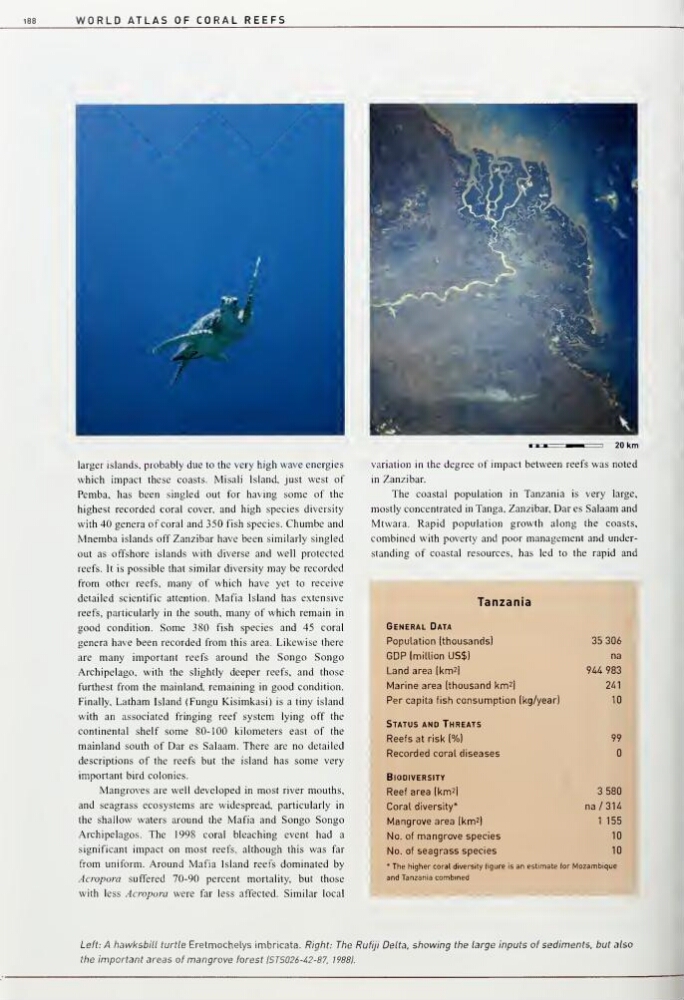
Left: A hawksbili turtle Eretmochelys imbricata. Right: The Rufiji Delta, showing the large inputs of sediments, but also
the important areas of mangrove forest ISTS026-42-87. 19881.
larger islands, probably due to the very high wave energies
which impact these coasts. Misali Island, just west of
Pemba, has been singled out for having some of the
highest recorded coral cover, and high species diversity
with 40 genera of coral and 350 fish species. Chumbe and
Mnemba islands off Zanzibar have been similarly singled
out as offshore islands with diverse and well protected
reefs. It is possible that similar diversity may be recorded
from other reefs, many of which have yet to receive
detailed scientific attention. Mafia Island has extensive
reefs, particularly in the south, many of which remain in
good condition. Some 380 fish species and 45 coral
genera have been recorded from this area. Likewise there
are many important reefs around the Songo Songo
Archipelago, with the slightly deeper reefs, and those
furthest from the mainland, remaining in good condition.
Finally, Latham Island (Fungu Kisimkasi) is a tiny island
with an associated fringing reef system lying off the
continental shelf some 80-100 kilometers east of the
mainland south of Dar es Salaam. There are no detailed
descriptions of the reefs but the island has some very
important bird colonies.
Mangroves are well developed in most river mouths,
and seagrass ecosystems are widespread, particularly in
the shallow waters around the Mafia and Songo Songo
Archipelagos. The 1998 coral bleaching event had a
significant impact on most reefs, although this was far
from uniform. Around Mafia Island reefs dominated by
Acropora suffered 70-90 percent mortality, but those
with less Acropora were far less affected. Similar local
variation in the degree of impact between reefs was noted
in Zanzibar.
The coastal population in Tanzania is very large,
mostly concentrated in Tanga, Zanzibar, Dar es Salaam and
Mtwara. Rapid population growth along the coasts,
combined with poverty and poor management and understanding of coastal resources, has led to the rapid and
Tanzania
General Data
Population Ithousandsl
35 306
GDP (million US$i
na
Land area (km^j
9a 983
Marine area (thousand km^j
241
Per capita fish consumption (kg/year)
10
Status and Threats
Reefs at risk (%|
99
Recorded coral diseases
Biodiversity
Reef area (km^j
3 580
Coral diversity*
na/3U
Ivlangrove area (km'l
1
155
No. of mangrove species
10
No. of seagrass species
10
• The higher coral diversity figure is an estimate for fvl ozambique
and Tanzania combined
Left: A hawksbili turtle Eretmochelys imbricata. Right: The Rufiji Delta, showing the large inputs of sediments, but also
the important areas of mangrove forest ISTS026-42-87. 19881.