

186
WORLD ATLAS OF CORAL REEFS
Tanzania
MAP 7b
The
Tanzanian coastline runs approximately northsouth and is dominated by three large offshore
islands, those of Pemba, Zanzibar' and Mafia. Of
these. Zanzibar and Mafia, together with most of the
mainland coast and numerous smaller islands and islets,
are largely formed by raised Pleistocene reef platforms,
providing a low-lying coastal plain occasionally broken by
alluvial deposits associated with the major rivers. The
continental shelf is relatively narrow, typically 8-10
kilometers wide, but extending to a little over 40
kilometers around Zanzibar and Mafia. Pemba Island is
also limestone, but dates back to the Miocene. Pemba is
separated from the mainland continental shelf by the
Pemba Channel which reaches over 800 meters in depth.
There are fringing reef systems along much of the
mainland coast and the offshore islands, although these
are broken around some of the bays and estuaries, most
notably around the Rufiji Delta and northwards where
there are considerable inputs of riverine sediments. The
coastline is swept by the northwards flowing East African
Coastal Current throughout the year, though this is at its
most powerful during the Southeast Monsoon (AprilOctober), and is reduced by northeasterly winds during
the Northeast Monsoon (December-MarchJ.
20 km
Coral reefs are well developed in many places. Close
to the mainland there are fringing and patch reefs along
much of the coast to the north of the Pangani River, with
a wide lagoon with only occasional patch reefs fiirther
south around Dar es Salaam. Coral cover is highly varied,
with estimates on different patch reefs varying between
1
and 80 percent. Clearly in some areas reefs are not
actively developing, and represent little more than
occasional coral growth on Pleistocene reef deposits.
Coral diversity increases with distance from the coast,
and up to 39 genera of coral have been reported from
individual patch reefs off the Tanga coast. Fringing reefs
begin again off the mainland coast south of the Rufiji
Delta and are very well developed, with deep spur and
groove formations on outer slopes. These are particularly
well represented in the areas around and to the south of
Mtwara where undamaged reefs, especially those further
offshore, often show over 50 percent live coral cover.
Offshore reefs are highly developed around the main
three islands, their associated islets, and the Songo Songo
Archipelago in the south. Reefs around parts of Pemba are
prolific, with corals recorded to 64 meters, and cover on
western reef slopes at 21-60 percent. Cover tends to be
low (rarely above 15 percent) on eastern shores of all the
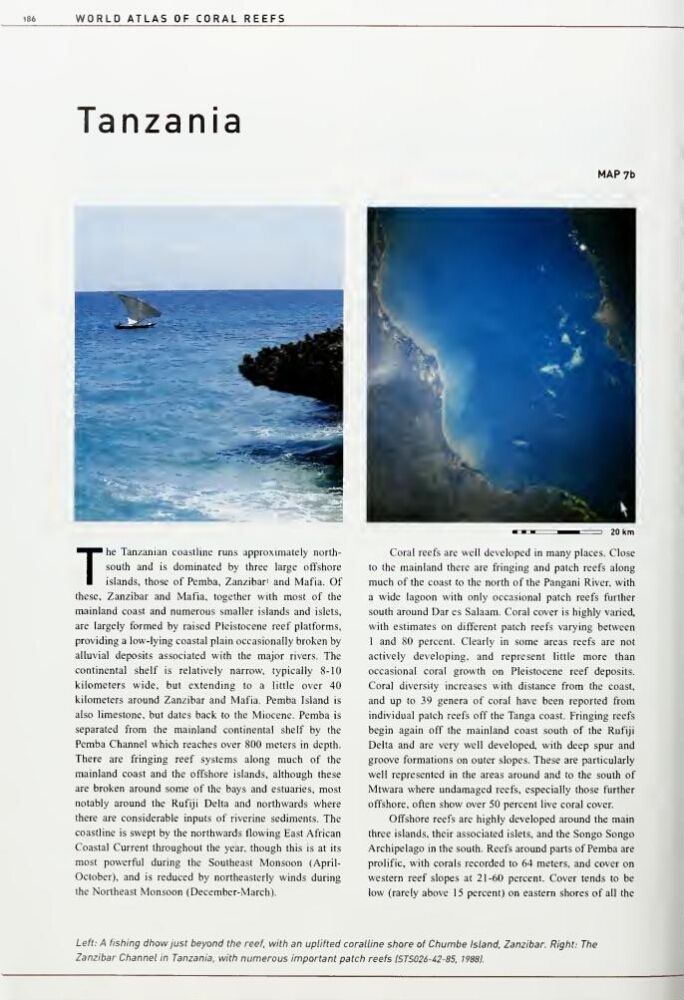
Left: A fishing dhow just beyond the reef, with an uplifted coralline shore of Chumbe Island, Zanzibar Right: The
Zanzibar Channel in Tanzania, with numerous important patch reefs ISTS026-42-85. 19881.
WORLD ATLAS OF CORAL REEFS
Tanzania
MAP 7b
The
Tanzanian coastline runs approximately northsouth and is dominated by three large offshore
islands, those of Pemba, Zanzibar' and Mafia. Of
these. Zanzibar and Mafia, together with most of the
mainland coast and numerous smaller islands and islets,
are largely formed by raised Pleistocene reef platforms,
providing a low-lying coastal plain occasionally broken by
alluvial deposits associated with the major rivers. The
continental shelf is relatively narrow, typically 8-10
kilometers wide, but extending to a little over 40
kilometers around Zanzibar and Mafia. Pemba Island is
also limestone, but dates back to the Miocene. Pemba is
separated from the mainland continental shelf by the
Pemba Channel which reaches over 800 meters in depth.
There are fringing reef systems along much of the
mainland coast and the offshore islands, although these
are broken around some of the bays and estuaries, most
notably around the Rufiji Delta and northwards where
there are considerable inputs of riverine sediments. The
coastline is swept by the northwards flowing East African
Coastal Current throughout the year, though this is at its
most powerful during the Southeast Monsoon (AprilOctober), and is reduced by northeasterly winds during
the Northeast Monsoon (December-MarchJ.
20 km
Coral reefs are well developed in many places. Close
to the mainland there are fringing and patch reefs along
much of the coast to the north of the Pangani River, with
a wide lagoon with only occasional patch reefs fiirther
south around Dar es Salaam. Coral cover is highly varied,
with estimates on different patch reefs varying between
1
and 80 percent. Clearly in some areas reefs are not
actively developing, and represent little more than
occasional coral growth on Pleistocene reef deposits.
Coral diversity increases with distance from the coast,
and up to 39 genera of coral have been reported from
individual patch reefs off the Tanga coast. Fringing reefs
begin again off the mainland coast south of the Rufiji
Delta and are very well developed, with deep spur and
groove formations on outer slopes. These are particularly
well represented in the areas around and to the south of
Mtwara where undamaged reefs, especially those further
offshore, often show over 50 percent live coral cover.
Offshore reefs are highly developed around the main
three islands, their associated islets, and the Songo Songo
Archipelago in the south. Reefs around parts of Pemba are
prolific, with corals recorded to 64 meters, and cover on
western reef slopes at 21-60 percent. Cover tends to be
low (rarely above 15 percent) on eastern shores of all the
Left: A fishing dhow just beyond the reef, with an uplifted coralline shore of Chumbe Island, Zanzibar Right: The
Zanzibar Channel in Tanzania, with numerous important patch reefs ISTS026-42-85. 19881.