

Eastern Caribbean and Atlantic
I
Protected areas with coral reefs
Site name^^^^^^^^^^_
Designation
Brazil
Abbreviation
lUCN cat.
Size ikm^i
Yeai
Abrolhos
Marine National Park
MNP
II
913.00
1983
Atol das Rocas
Biological Reserve
BiR
la
362.49
1979
Fernando de Noronha
Marine National Parl<
MNP
II
112.70
1988
Parcel Manoel Luis
State Marine Parl<
SMP
II
452.37
1991
k
Recite de Fora
Parque Estadual Marinho
DO Parcel Manoel Luis
State Marine Park
SMP
IV
Ramsar Site
17.00
A52.37
2000
This warm, low salinity water is a permanent feature of
the Grain Coast and the Bight of Biafra. and a seasonal
feature of the whole coast from Mauritania to Angola.
Outside this region the marine waters are generally much
colder, the result of currents or upwellings. These oceanographic factors combine to restrict significant coral
growth to shallow protected bays, outside which the
number of species and size of coral colonies rapidly
decrease. In open water, hermatypic corals are generally
temperature limited to depths shallower than 20 meters
with some exceptions in the offshore archipelagos.
Two different types of coral community have been
described. The more common one comprises Millepoia
alciconiis and three species of Forties, two species of
Sideraslrea, Favia and Madracis. as well as Monlastrea
cavernosa, with three species of ahermatypic scleractinian coral (Phyllangia americana, Tubastrea sp. and
Dendroplnilia dilaiala). This type of community is found
mainly in the islands, though it also occurs in more
brackish coastal waters. The second community type
consists of colonies of the monospecifc genus Schizoculina
which is endemic to the Gulf of Guinea. Various theories
exist as to the evolutionary origin of the West African
coral communities. It has been proposed that they have
developed either as a result of long distance dispersion
from the Caribbean via Bermuda and the Azores, or from
Brazil, or even that they could include some relict species
from the ancient Mediterranean-Tethys Sea. Very little is
known about sub-tidal benthic communities over wide
areas of West Africa, and it is quite possible that there are
important and diverse coral communities in a number of
areas which are yet to be documented.
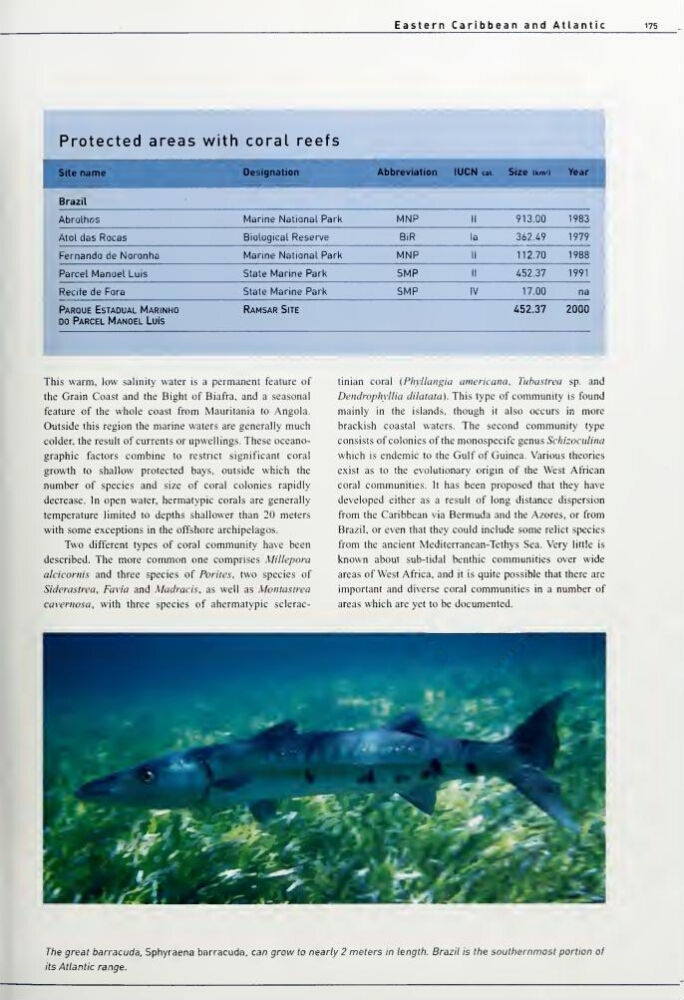
The great barracuda, Sphyraena barracuda, can grow to nearly 2 meters in length. Brazil is the southernmost portion of
its Atlantic range.
I
Protected areas with coral reefs
Site name^^^^^^^^^^_
Designation
Brazil
Abbreviation
lUCN cat.
Size ikm^i
Yeai
Abrolhos
Marine National Park
MNP
II
913.00
1983
Atol das Rocas
Biological Reserve
BiR
la
362.49
1979
Fernando de Noronha
Marine National Parl<
MNP
II
112.70
1988
Parcel Manoel Luis
State Marine Parl<
SMP
II
452.37
1991
k
Recite de Fora
Parque Estadual Marinho
DO Parcel Manoel Luis
State Marine Park
SMP
IV
Ramsar Site
17.00
A52.37
2000
This warm, low salinity water is a permanent feature of
the Grain Coast and the Bight of Biafra. and a seasonal
feature of the whole coast from Mauritania to Angola.
Outside this region the marine waters are generally much
colder, the result of currents or upwellings. These oceanographic factors combine to restrict significant coral
growth to shallow protected bays, outside which the
number of species and size of coral colonies rapidly
decrease. In open water, hermatypic corals are generally
temperature limited to depths shallower than 20 meters
with some exceptions in the offshore archipelagos.
Two different types of coral community have been
described. The more common one comprises Millepoia
alciconiis and three species of Forties, two species of
Sideraslrea, Favia and Madracis. as well as Monlastrea
cavernosa, with three species of ahermatypic scleractinian coral (Phyllangia americana, Tubastrea sp. and
Dendroplnilia dilaiala). This type of community is found
mainly in the islands, though it also occurs in more
brackish coastal waters. The second community type
consists of colonies of the monospecifc genus Schizoculina
which is endemic to the Gulf of Guinea. Various theories
exist as to the evolutionary origin of the West African
coral communities. It has been proposed that they have
developed either as a result of long distance dispersion
from the Caribbean via Bermuda and the Azores, or from
Brazil, or even that they could include some relict species
from the ancient Mediterranean-Tethys Sea. Very little is
known about sub-tidal benthic communities over wide
areas of West Africa, and it is quite possible that there are
important and diverse coral communities in a number of
areas which are yet to be documented.
The great barracuda, Sphyraena barracuda, can grow to nearly 2 meters in length. Brazil is the southernmost portion of
its Atlantic range.