

174
WORLD ATLAS OF CORAL REEFS
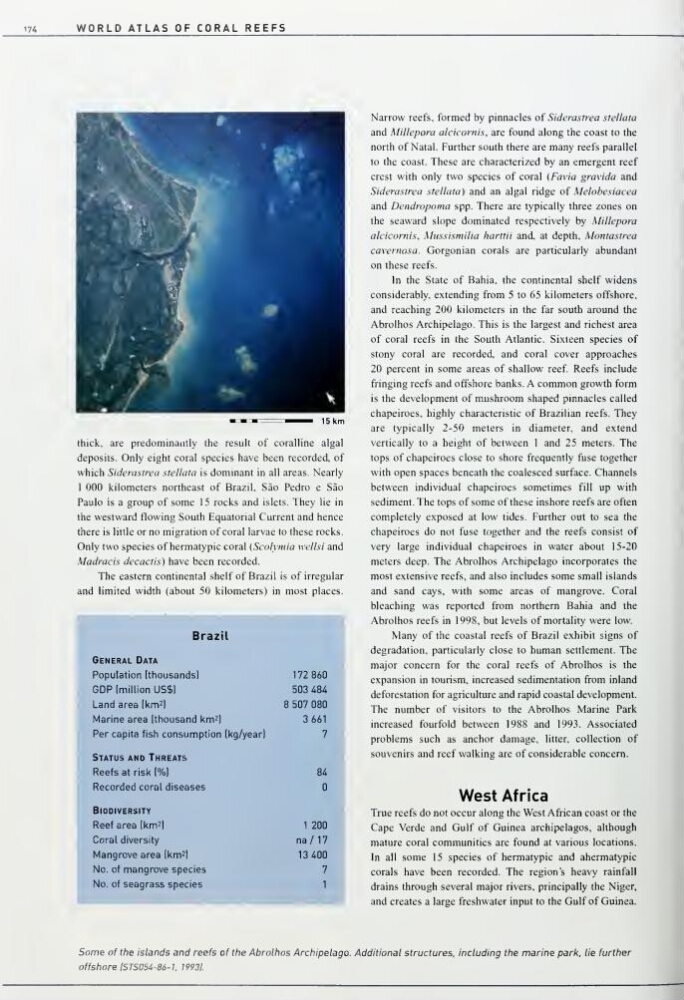
15 km
thick, are predominantly the result of coralline algal
deposits. Only eight coral species have been recorded of
which Siderastrea slellala is dominant in all areas. Nearly
1 000 kilometers northeast of Brazil, Sao Pedro e Sao
Paulo is a group of some 15 rocks and islets. They lie in
the westward flowing South Equatorial Current and hence
there is little or no migration of coral larvae to these rocks.
Only two species of hermatypic coral (Scolymia wellsi and
Madracis decactis) have been recorded.
The eastern continental shelf of Brazil is of irregular
and limited width (about 50 kilometers) in most places.
^^^^B
il
"m
General Data
Population Ithousands)
172 860
j
GDP (million US$)
503 484
Land area (km^j
8 507 Q80
Marine area (thousand km^l
3 661
Per capita fish consumption (kg/year)
7
Status and Threats
Reefs at risk (%l
84
Recorded coral diseases
Biodiversity
Reef area [km2|
1 200
Coral diversity
na/17
Mangrove area (km^l
13 400
No. of mangrove species
7
No. of seagrass species
1
mi--^i^-:;'\
jBHHEE...
Narrow reefs, formed by pinnacles oi Siderastrea stellata
and Millepora alcicornis, are found along the coast to the
north of Natal. Further south there are many reefs parallel
to the coast. These are characterized by an emergent reef
crest with only two species of coral (Favia gravida and
Siderastrea stellata) and an algal ridge of Melobesiacea
and Dendropoma spp. There are typically three zones on
the seaward slope dominated respectively by Millepora
alcicornis, Mussismilia harttii and, at depth, Montastrea
cavernosa. Gorgonian corals are particularly abundant
on these reefs.
In the State of Bahia, the continental shelf widens
considerably, extending from 5 to 65 kilometers offshore,
and reaching 200 kilometers in the far south around the
Abrolhos Archipelago. This is the largest and richest area
of coral reefs in the South Atlantic. Sixteen species of
stony coral are recorded, and coral cover approaches
20 percent in some areas of shallow reef Reefs include
fringing reefs and offshore banks. A common growth form
is the development of mushroom shaped pinnacles called
chapeiroes, highly characteristic of Brazilian reefs. They
are typically 2-50 meters in diameter, and extend
vertically to a height of between 1 and 25 meters. The
tops of chapeiroes close to shore frequently fuse together
with open spaces beneath the coalesced surface. Channels
between individual chapeiroes sometimes fill up with
sediment. The tops of some of these inshore reefs are often
completely exposed at low tides. Further out to sea the
chapeiroes do not fuse together and the reefs consist of
very large individual chapeiroes in water about 15-20
meters deep. The Abrolhos Archipelago incorporates the
most extensive reefs, and also includes some small islands
and sand cays, with some areas of mangrove. Coral
bleaching was reported from northern Bahia and the
Abrolhos reefs in 1998, but levels of mortality were low.
Many of the coastal reefs of Brazil exhibit signs of
degradation, particularly close to human settlement. The
major concern for the coral reefs of Abrolhos is the
expansion in tourism, increased sedimentation from inland
deforestation for agriculture and rapid coastal development.
The number of visitors to the Abrolhos Marine Park
increased fourfold between 1988 and 1993. Associated
problems such as anchor damage, litter, collection of
souvenirs and reef walking are of considerable concern.
West Africa
True reefs do not occur along the West African coast or the
Cape Verde and Gulf of Guinea archipelagos, although
mature coral communities are found at various locations.
In all some 15 species of hermatypic and ahermatypic
corals have been recorded. The region's heavy rainfall
drains through several major rivers, principally the Niger,
and creates a large freshwater input to the Gulf of Guinea.
Some of the islands and reefs of the Abrolhos Archipelago. Additional structures, including the marine parif, lie further
offshore lSTS05i-86-l 19931.
WORLD ATLAS OF CORAL REEFS
15 km
thick, are predominantly the result of coralline algal
deposits. Only eight coral species have been recorded of
which Siderastrea slellala is dominant in all areas. Nearly
1 000 kilometers northeast of Brazil, Sao Pedro e Sao
Paulo is a group of some 15 rocks and islets. They lie in
the westward flowing South Equatorial Current and hence
there is little or no migration of coral larvae to these rocks.
Only two species of hermatypic coral (Scolymia wellsi and
Madracis decactis) have been recorded.
The eastern continental shelf of Brazil is of irregular
and limited width (about 50 kilometers) in most places.
^^^^B
il
"m
General Data
Population Ithousands)
172 860
j
GDP (million US$)
503 484
Land area (km^j
8 507 Q80
Marine area (thousand km^l
3 661
Per capita fish consumption (kg/year)
7
Status and Threats
Reefs at risk (%l
84
Recorded coral diseases
Biodiversity
Reef area [km2|
1 200
Coral diversity
na/17
Mangrove area (km^l
13 400
No. of mangrove species
7
No. of seagrass species
1
mi--^i^-:;'\
jBHHEE...
Narrow reefs, formed by pinnacles oi Siderastrea stellata
and Millepora alcicornis, are found along the coast to the
north of Natal. Further south there are many reefs parallel
to the coast. These are characterized by an emergent reef
crest with only two species of coral (Favia gravida and
Siderastrea stellata) and an algal ridge of Melobesiacea
and Dendropoma spp. There are typically three zones on
the seaward slope dominated respectively by Millepora
alcicornis, Mussismilia harttii and, at depth, Montastrea
cavernosa. Gorgonian corals are particularly abundant
on these reefs.
In the State of Bahia, the continental shelf widens
considerably, extending from 5 to 65 kilometers offshore,
and reaching 200 kilometers in the far south around the
Abrolhos Archipelago. This is the largest and richest area
of coral reefs in the South Atlantic. Sixteen species of
stony coral are recorded, and coral cover approaches
20 percent in some areas of shallow reef Reefs include
fringing reefs and offshore banks. A common growth form
is the development of mushroom shaped pinnacles called
chapeiroes, highly characteristic of Brazilian reefs. They
are typically 2-50 meters in diameter, and extend
vertically to a height of between 1 and 25 meters. The
tops of chapeiroes close to shore frequently fuse together
with open spaces beneath the coalesced surface. Channels
between individual chapeiroes sometimes fill up with
sediment. The tops of some of these inshore reefs are often
completely exposed at low tides. Further out to sea the
chapeiroes do not fuse together and the reefs consist of
very large individual chapeiroes in water about 15-20
meters deep. The Abrolhos Archipelago incorporates the
most extensive reefs, and also includes some small islands
and sand cays, with some areas of mangrove. Coral
bleaching was reported from northern Bahia and the
Abrolhos reefs in 1998, but levels of mortality were low.
Many of the coastal reefs of Brazil exhibit signs of
degradation, particularly close to human settlement. The
major concern for the coral reefs of Abrolhos is the
expansion in tourism, increased sedimentation from inland
deforestation for agriculture and rapid coastal development.
The number of visitors to the Abrolhos Marine Park
increased fourfold between 1988 and 1993. Associated
problems such as anchor damage, litter, collection of
souvenirs and reef walking are of considerable concern.
West Africa
True reefs do not occur along the West African coast or the
Cape Verde and Gulf of Guinea archipelagos, although
mature coral communities are found at various locations.
In all some 15 species of hermatypic and ahermatypic
corals have been recorded. The region's heavy rainfall
drains through several major rivers, principally the Niger,
and creates a large freshwater input to the Gulf of Guinea.
Some of the islands and reefs of the Abrolhos Archipelago. Additional structures, including the marine parif, lie further
offshore lSTS05i-86-l 19931.