

Eastern Caribbean and Atlantic
Protected areas with coral reefs
Bsite name ^^^^^^^^^^^^^^.Designatiot
Abbreviation
lUCN cai.
Size ikm>i
Yean
Netherlands Antilles (Leeward)
Bonaire
Marine Parl<
MP
26.00
1979^
Curacao
Underwater Parl<
UP
na
10.36
1983
Klein Bonaire Isund and
adjacent sea
Ramsar Site
6.00
1980
Venezuela
Archipielago Los Roques
National Parl<
NP
II
2 211.20
1972
Mochima
National Park
NP
II
949.35
1973
Morrocoy
National Parl<
NP
II
320.90
1974
San Esteban
National Parl<
NP
II
A35.00
2 132.20
1987
Archipielago Los Roques
Ramsar Site
1996
CUARE
Ramsar Site
99.68
1988
leeward and windward sides of these islands. The reef
profile of Bonaire and Curasao is generally similar: a
submarine terrace extending between 50 and 100 meters
offshore, and ending in a drop-off at a depth of 8-12
meters which slopes steeply to 50-60 meters. There is a
second drop-off at 80-100 meters ending in a sandy plain.
Prolific coral growth occurs across this terrace and on
the shallower slope. Conspicuous spur and grooves are a
feature of the Bonaire reef slope, especially along the
northwestern shore. Along the eastern windward shore
there is little coral growth in any water less than 12 meters
in depth. Shallower waters harbor an abundance of crustose coralline algae and dense Sargassum platycarpum
though in places these also grow down to a depth of 40
meters. Being located on the continental shelf Aruba does
not have sharply sloping underwater relief
Coral cover at depths of 10-20 meters at four sites on
Curagao and Bonaire decreased from 50-55 percent to
25-30 percent between 1973 and 1992, but was mostly
unchanged at a 30-40 meter depth. Bonaire is widely cited
as one of the regions best examples of a self-financing
marine park. Divers are charged a fee of US$10 per year
to dive on the reefs, contributing about 60 percent of the
running costs of the park, with a significant proportion of
the remainder being generated from the sale of souvenirs.
Studies have shown that the user fee is seen as a positive
thing by the majority of visitors, raising awareness of
conservation issues while giving them some sense of
participation or ownership. The deterioration in coral
cover around this island is linked to the Caribbeanwide declines, perhaps slightly exacerbated by tourism
development. This pressure is increasing: 57 000 visitors
arrived in 1994 (25 000 of whom were divers), rising to
70 000 in 1999. Despite this pressure, direct physical
damage to the coral by divers remains low, with less than
3 percent of colonies affected.
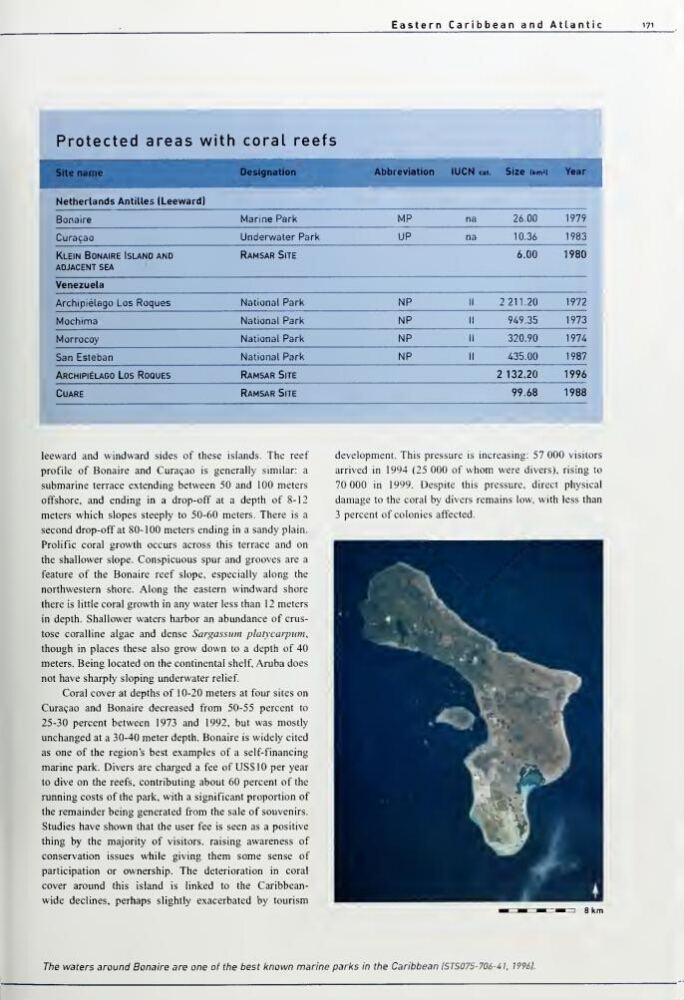
The waters around Bonaire are one of the best known marine parks in ttie Caribbean ISTS075-706-4I. 19961.
Protected areas with coral reefs
Bsite name ^^^^^^^^^^^^^^.Designatiot
Abbreviation
lUCN cai.
Size ikm>i
Yean
Netherlands Antilles (Leeward)
Bonaire
Marine Parl<
MP
26.00
1979^
Curacao
Underwater Parl<
UP
na
10.36
1983
Klein Bonaire Isund and
adjacent sea
Ramsar Site
6.00
1980
Venezuela
Archipielago Los Roques
National Parl<
NP
II
2 211.20
1972
Mochima
National Park
NP
II
949.35
1973
Morrocoy
National Parl<
NP
II
320.90
1974
San Esteban
National Parl<
NP
II
A35.00
2 132.20
1987
Archipielago Los Roques
Ramsar Site
1996
CUARE
Ramsar Site
99.68
1988
leeward and windward sides of these islands. The reef
profile of Bonaire and Curasao is generally similar: a
submarine terrace extending between 50 and 100 meters
offshore, and ending in a drop-off at a depth of 8-12
meters which slopes steeply to 50-60 meters. There is a
second drop-off at 80-100 meters ending in a sandy plain.
Prolific coral growth occurs across this terrace and on
the shallower slope. Conspicuous spur and grooves are a
feature of the Bonaire reef slope, especially along the
northwestern shore. Along the eastern windward shore
there is little coral growth in any water less than 12 meters
in depth. Shallower waters harbor an abundance of crustose coralline algae and dense Sargassum platycarpum
though in places these also grow down to a depth of 40
meters. Being located on the continental shelf Aruba does
not have sharply sloping underwater relief
Coral cover at depths of 10-20 meters at four sites on
Curagao and Bonaire decreased from 50-55 percent to
25-30 percent between 1973 and 1992, but was mostly
unchanged at a 30-40 meter depth. Bonaire is widely cited
as one of the regions best examples of a self-financing
marine park. Divers are charged a fee of US$10 per year
to dive on the reefs, contributing about 60 percent of the
running costs of the park, with a significant proportion of
the remainder being generated from the sale of souvenirs.
Studies have shown that the user fee is seen as a positive
thing by the majority of visitors, raising awareness of
conservation issues while giving them some sense of
participation or ownership. The deterioration in coral
cover around this island is linked to the Caribbeanwide declines, perhaps slightly exacerbated by tourism
development. This pressure is increasing: 57 000 visitors
arrived in 1994 (25 000 of whom were divers), rising to
70 000 in 1999. Despite this pressure, direct physical
damage to the coral by divers remains low, with less than
3 percent of colonies affected.
The waters around Bonaire are one of the best known marine parks in ttie Caribbean ISTS075-706-4I. 19961.