

WORLD ATLAS OF CORAL REEFS
Protected areas with coral reefs
Site name
Designation
Abbreviation
lUCN cat.
Size (km^i
Year
Dominican Republic
Del Este
National Park
MP
11
808.00
1975
Marine Mammal
Sanctuary
S
na
38 000.00
1996
Jaragua
National Park
NP
II
1 374.00
1983
Literal Sur (Santo Domingo)
National Park
MP
Unassigned
10.75
1968
Montecristi
National Park
NP
II
1 309.50
1983
Parque Submarino La Caleta
National Park
NP
II
10.10
1986
in sediments (from upland deforestation, wetland removal,
soil erosion and coastal construction for the tourist
industry), nutrients (from fertilizers as well as domestic
wastewater) and pesticides (in agricultural runofO. Coral
disease and the Diadema die-off have undoubtedly
exacerbated the effects of these direct human impacts.
Reefs in the southeast and southwest have generally
suffered less. There is an important artisanal fishery in the
country, with catches estimated at 13 000 tons in 1998,
Overfishing, particularly of conch and lobster, is a
problem, although there may now be a reduction in pressure as some fishers are turning to work in tourism, while
the use of fish aggregating devices is directing the focus
of a number of fishers towards pelagic fisheries.
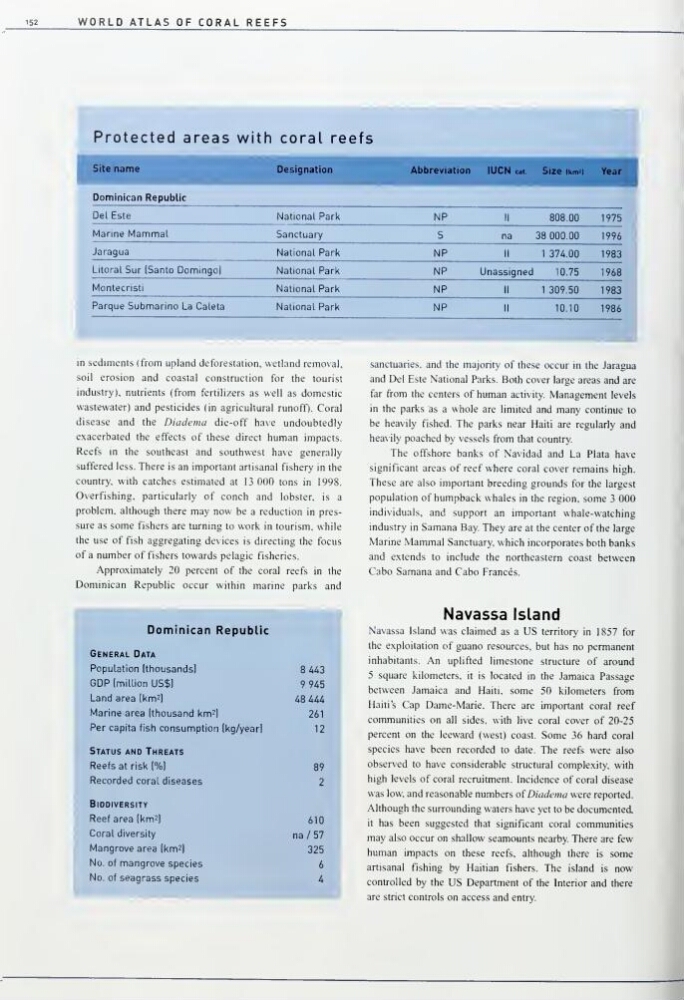
Approximately 20 percent of the coral reefs in the
Dominican Republic occur within marine parks and
^^^^^^^
/7T l^^Hi
^ uommican Republic
'
General Data
'
Population (thousands)
8 4«
GDP (million US$1
9 945
Land area (km^)
48 444
Marine area (thousand km )
261
Per capita tish consumption (kg/year)
12
Status and Threats
j
Reefs at risk (%)
89
j
Recorded coral diseases
2
Biodiversity
Reef area (km^)
610
Coral diversity
na/57
Mangrove area (km^)
325
No. of mangrove species
6
No. of seagrass species
4
»
sanctuaries, and the majority of these occur in the Jaragua
and Del Este National Parks. Both cover large areas and are
far from the centers of human activity. Management levels
in the parks as a whole are limited and many continue to
be heavily fished. The parks near Haiti are regularly and
heavily poached by vessels from that country.
The offshore banks of Navidad and La Plata have
significant areas of reef where coral cover remains high.
These are also important breeding grounds for the largest
population of humpback whales in the region, some 3 000
individuals, and support an important whale-watching
industry in Samana Bay. They are at the center of the large
Marine Mammal Sanctuary, which incorporates both banks
and extends to include the northeastern coast between
Cabo Samana and Cabo Frances.
Navassa Island
Navassa Island was claimed as a US terntory in 1857 for
the exploitation of guano resources, but has no permanent
inhabitants. An uplifted limestone structure of around
5 square kilometers, it is located in the Jamaica Passage
between Jamaica and Haiti, some 50 kilometers from
Haiti's Cap Dame-Marie. There are important coral reef
communities on all sides, with live coral cover of 20-25
percent on the leeward (west) coast. Some 36 hard coral
species have been recorded to date. The reefs were also
observed to have considerable structural complexity, with
high levels of coral recruitment. Incidence of coral disease
was low, and reasonable numbers oi Diadema were reported.
Although the surrounding waters have yet to be documented,
it has been suggested that significant coral communities
may also occur on shallow seamounts nearby. There are few
human impacts on these reefs, although there is some
artisanal fishing by Haitian fishers. The island is now
controlled by the US Department of the Interior and there
are strict controls on access and entry.
Protected areas with coral reefs
Site name
Designation
Abbreviation
lUCN cat.
Size (km^i
Year
Dominican Republic
Del Este
National Park
MP
11
808.00
1975
Marine Mammal
Sanctuary
S
na
38 000.00
1996
Jaragua
National Park
NP
II
1 374.00
1983
Literal Sur (Santo Domingo)
National Park
MP
Unassigned
10.75
1968
Montecristi
National Park
NP
II
1 309.50
1983
Parque Submarino La Caleta
National Park
NP
II
10.10
1986
in sediments (from upland deforestation, wetland removal,
soil erosion and coastal construction for the tourist
industry), nutrients (from fertilizers as well as domestic
wastewater) and pesticides (in agricultural runofO. Coral
disease and the Diadema die-off have undoubtedly
exacerbated the effects of these direct human impacts.
Reefs in the southeast and southwest have generally
suffered less. There is an important artisanal fishery in the
country, with catches estimated at 13 000 tons in 1998,
Overfishing, particularly of conch and lobster, is a
problem, although there may now be a reduction in pressure as some fishers are turning to work in tourism, while
the use of fish aggregating devices is directing the focus
of a number of fishers towards pelagic fisheries.
Approximately 20 percent of the coral reefs in the
Dominican Republic occur within marine parks and
^^^^^^^
/7T l^^Hi
^ uommican Republic
'
General Data
'
Population (thousands)
8 4«
GDP (million US$1
9 945
Land area (km^)
48 444
Marine area (thousand km )
261
Per capita tish consumption (kg/year)
12
Status and Threats
j
Reefs at risk (%)
89
j
Recorded coral diseases
2
Biodiversity
Reef area (km^)
610
Coral diversity
na/57
Mangrove area (km^)
325
No. of mangrove species
6
No. of seagrass species
4
»
sanctuaries, and the majority of these occur in the Jaragua
and Del Este National Parks. Both cover large areas and are
far from the centers of human activity. Management levels
in the parks as a whole are limited and many continue to
be heavily fished. The parks near Haiti are regularly and
heavily poached by vessels from that country.
The offshore banks of Navidad and La Plata have
significant areas of reef where coral cover remains high.
These are also important breeding grounds for the largest
population of humpback whales in the region, some 3 000
individuals, and support an important whale-watching
industry in Samana Bay. They are at the center of the large
Marine Mammal Sanctuary, which incorporates both banks
and extends to include the northeastern coast between
Cabo Samana and Cabo Frances.
Navassa Island
Navassa Island was claimed as a US terntory in 1857 for
the exploitation of guano resources, but has no permanent
inhabitants. An uplifted limestone structure of around
5 square kilometers, it is located in the Jamaica Passage
between Jamaica and Haiti, some 50 kilometers from
Haiti's Cap Dame-Marie. There are important coral reef
communities on all sides, with live coral cover of 20-25
percent on the leeward (west) coast. Some 36 hard coral
species have been recorded to date. The reefs were also
observed to have considerable structural complexity, with
high levels of coral recruitment. Incidence of coral disease
was low, and reasonable numbers oi Diadema were reported.
Although the surrounding waters have yet to be documented,
it has been suggested that significant coral communities
may also occur on shallow seamounts nearby. There are few
human impacts on these reefs, although there is some
artisanal fishing by Haitian fishers. The island is now
controlled by the US Department of the Interior and there
are strict controls on access and entry.