

WORLD ATLAS OF CORAL REEFS
Haiti
General Data
Population (thousands)
6 868
GDP (million US$1
2 183
Land area (km^l
27 156
Marine area (thousand km^l
127
Per capita fish consumption (kg/yearl
3
Status and Threats
Reefs at risk (%l
100
Recorded coral diseases
Biodiversity
Reef area (km^l
^50
Coral diversity
na/57
Mangrove area (km^l
13A
No. of mangrove species
na
No. of seagrass species
na
Baie de Port-au-Prince. This bay is also severely polluted
with oil. industrial chemicals and solid waste. Although a
monitoring station has been established there by the
Fondation pour la Protection de la Biodiversite Marine, it
is yet to implement a full monitoring protocol. There are
currently no marine protected areas in Haiti, although a
park including Les Arcadins was proposed in 1989.
Dominican Republic
The Dominican Republic makes up the larger, eastern
part of the island of Hispaniola. Like Haiti, it too is
mountainous, with considerable riverine runoff. Fringmg
reefs and small barrier reefs are scattered along some 170
kilometers of its coastline, and there are important reef
communities on the offshore banks of Navidad and La
Plata (Silver Bank), which lie to the north of the country.
The best developed reefs include a small barrier reef in
Montecristi in the northwest, some narrow fringing communities along the central north coast and a further barriertype development in the far east. Reef development is less
extensive on the south coast, but there is some in the east
on the mainland and the neighboring Isla Saona. Around
Santo Domingo there are small reefs on narrow platforms,
while there are also some in the far south of the country
around Jaragua National Park.
Coral cover has declined considerably in most nearshore areas, and algae have proliferated at the expense of
reef corals at many localities. High coral cover is now
largely restricted to deeper reefs, and to those lying further
otTshore. In 2000, average coral cover was 35 percent on
the Montecristi barrier reef and 40 percent on parts of the
offshore banks. In the Del Este National Park the diversity
of the main reef groups is high, with 22 octocorals, 26
scleractinians and 36 sponges on the shallow spur and
groove formations. Here most of the algae are calcareous,
although Dicnola is also abundant. Reef flat communities
occur on low-relief consolidated carbonate platforms
which are exposed to strong wave action from the Mona
Passage. Algae (36 species) provide the dominant cover
(over 70 percent in some cases), but 14 species of corals
also occur, principally Acropora palmata, Diploria clivosa.
Pontes asteroides and P. pontes. Closer to shore, patch
reefs occur in amongst seagrass beds. Algae again are
dominant, some 21 species accounting for more than 50
percent of the benthic cover Information on the status of
coral reefs in the Jaragua National Park is more scarce,
but this park protects many different coastal ecosystems.
There are large and regionally important populations of
manatees, crocodiles, turtles (leatherback, green, hawksbill
and loggerhead turtles all nest there) and flamingos.
Many of the reefs in the north and around Santo
Domingo have been severely affected by a variety of
human impacts. Degradation is probably due to increases
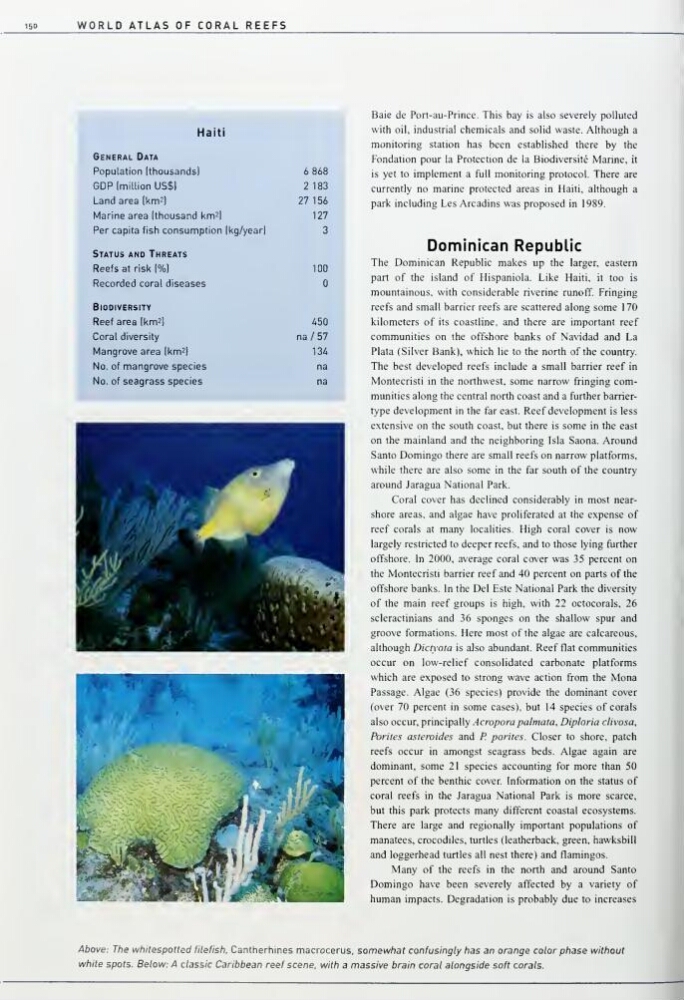
Above: The whitespotted fitefish, Cantfierhines macrocerus, somewhat confusingly has an orange color phase without
white spots. Below: A classic Caribbean reef scene, with a massive brain coral alongside soft corals.
Haiti
General Data
Population (thousands)
6 868
GDP (million US$1
2 183
Land area (km^l
27 156
Marine area (thousand km^l
127
Per capita fish consumption (kg/yearl
3
Status and Threats
Reefs at risk (%l
100
Recorded coral diseases
Biodiversity
Reef area (km^l
^50
Coral diversity
na/57
Mangrove area (km^l
13A
No. of mangrove species
na
No. of seagrass species
na
Baie de Port-au-Prince. This bay is also severely polluted
with oil. industrial chemicals and solid waste. Although a
monitoring station has been established there by the
Fondation pour la Protection de la Biodiversite Marine, it
is yet to implement a full monitoring protocol. There are
currently no marine protected areas in Haiti, although a
park including Les Arcadins was proposed in 1989.
Dominican Republic
The Dominican Republic makes up the larger, eastern
part of the island of Hispaniola. Like Haiti, it too is
mountainous, with considerable riverine runoff. Fringmg
reefs and small barrier reefs are scattered along some 170
kilometers of its coastline, and there are important reef
communities on the offshore banks of Navidad and La
Plata (Silver Bank), which lie to the north of the country.
The best developed reefs include a small barrier reef in
Montecristi in the northwest, some narrow fringing communities along the central north coast and a further barriertype development in the far east. Reef development is less
extensive on the south coast, but there is some in the east
on the mainland and the neighboring Isla Saona. Around
Santo Domingo there are small reefs on narrow platforms,
while there are also some in the far south of the country
around Jaragua National Park.
Coral cover has declined considerably in most nearshore areas, and algae have proliferated at the expense of
reef corals at many localities. High coral cover is now
largely restricted to deeper reefs, and to those lying further
otTshore. In 2000, average coral cover was 35 percent on
the Montecristi barrier reef and 40 percent on parts of the
offshore banks. In the Del Este National Park the diversity
of the main reef groups is high, with 22 octocorals, 26
scleractinians and 36 sponges on the shallow spur and
groove formations. Here most of the algae are calcareous,
although Dicnola is also abundant. Reef flat communities
occur on low-relief consolidated carbonate platforms
which are exposed to strong wave action from the Mona
Passage. Algae (36 species) provide the dominant cover
(over 70 percent in some cases), but 14 species of corals
also occur, principally Acropora palmata, Diploria clivosa.
Pontes asteroides and P. pontes. Closer to shore, patch
reefs occur in amongst seagrass beds. Algae again are
dominant, some 21 species accounting for more than 50
percent of the benthic cover Information on the status of
coral reefs in the Jaragua National Park is more scarce,
but this park protects many different coastal ecosystems.
There are large and regionally important populations of
manatees, crocodiles, turtles (leatherback, green, hawksbill
and loggerhead turtles all nest there) and flamingos.
Many of the reefs in the north and around Santo
Domingo have been severely affected by a variety of
human impacts. Degradation is probably due to increases
Above: The whitespotted fitefish, Cantfierhines macrocerus, somewhat confusingly has an orange color phase without
white spots. Below: A classic Caribbean reef scene, with a massive brain coral alongside soft corals.