

Eastern Caribbean and Atlantic
H9
Haitip the Dominican
Republic and Navassa Island
MAP 6a
H3ltl
makes up the western part of the island
of Hispaniola, the second largest island in the
Caribbean. It is a mountainous country with a
central plain enclosed by mountain ranges to the north and
south which extend out into two long peninsulas enclosing
the Golfe de la Gonave. Offshore there are a number of
islands, including the large lie de la Tortue in the north
and the central lie de la Gonave. Very little indeed is
known about the coral reefs in Haiti. What information
exists is largely for the area round the capital Port-auPrince and Les Arcadins islands. Coral reefs are also
known to occur all around lie de la Gonave: on the
Rochelois Bank and Les lies Cayemites; around lie a
Vache on the south coast; and also on the north coast
between Cap Haitien and the border with the Dominican
Republic. Marine benthic surveys were carried out in Les
Arcadins in the 1980s. The reef profile was found to be
similar to other Caribbean fringing reefs: a reef crest dominated by Millepora complanata, an Acropora palmata
zone (with 100 percent live cover in 1989) and a shallow
fore reef dominated by Monlastrea annularis. Extensive
seagrass beds occur here - shallow beds (2-4 meters)
generally have more algae species with a higher biomass,
whereas the deeper beds (12-14 meters) are more sparsely
10 km
populated with algae. In total, 35 species of scleractinian
coral have been recorded in Les Arcadins, as well as 12
gorgonians and 54 species of sponges. There are two
unusual aspects to these reefs. Firstly the soft coral
kitlogorgia spp.. which normally occurs in cryptic
habitats or deeper water elsewhere, is common in the open
shallow waters of Les Arcadins. Secondly, the sponge
Niphates digitalis, which rarely exhibits gigantism in
shallow water elsewhere in the Caribbean, does so here.
Haiti is the most impoverished country in the western
hemisphere, so the reef resources, although poorly
documented, are likely to be under intense pressure.
Perhaps less than 1 percent of the native terrestrial
vegetation remains intact. The steep relief and high rainfall
have caused widespread and severe soil erosion, which is
likely to have placed a high sediment load on coastal reefs.
About 75 percent of the population live in poverty and
so almost all fishing activities are carried out at the
subsistence level, and anecdotal reports suggest that this is
so intense that few fish reach reproductive size. There are
no sewage treatment plants or sanitary landfills and the
levels of nutrients flowing from settlements into coastal
waters are probably high. This has been linked to an
abundance of fleshy algae in the reefs off Les Irois and the
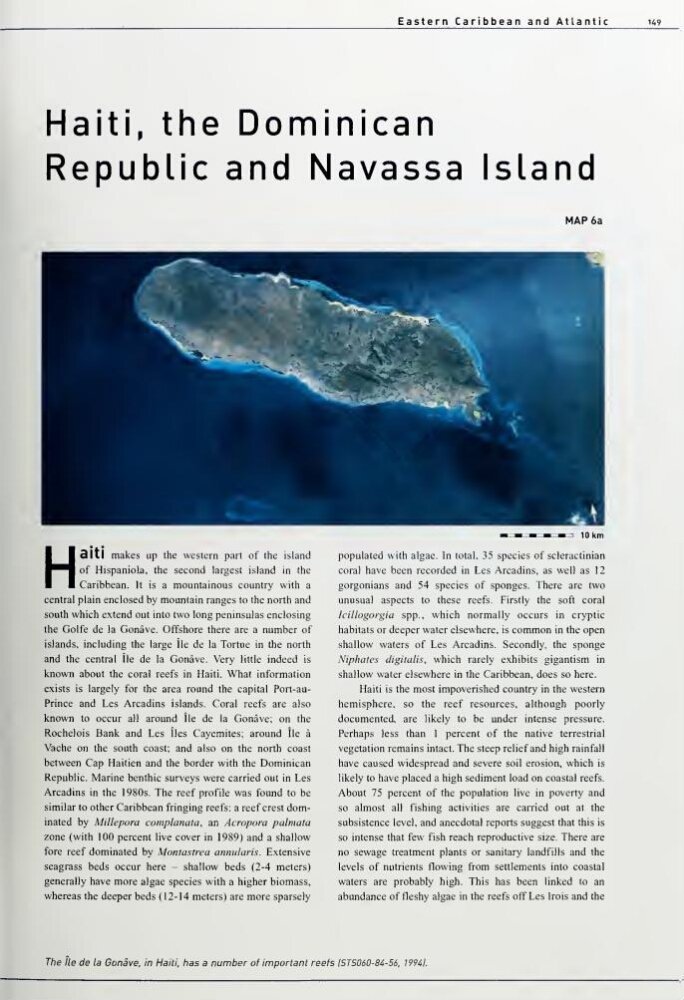
The he de la Gonave, in Haiti, has a number of important reefs ISTS060-84-56. I99il.
H9
Haitip the Dominican
Republic and Navassa Island
MAP 6a
H3ltl
makes up the western part of the island
of Hispaniola, the second largest island in the
Caribbean. It is a mountainous country with a
central plain enclosed by mountain ranges to the north and
south which extend out into two long peninsulas enclosing
the Golfe de la Gonave. Offshore there are a number of
islands, including the large lie de la Tortue in the north
and the central lie de la Gonave. Very little indeed is
known about the coral reefs in Haiti. What information
exists is largely for the area round the capital Port-auPrince and Les Arcadins islands. Coral reefs are also
known to occur all around lie de la Gonave: on the
Rochelois Bank and Les lies Cayemites; around lie a
Vache on the south coast; and also on the north coast
between Cap Haitien and the border with the Dominican
Republic. Marine benthic surveys were carried out in Les
Arcadins in the 1980s. The reef profile was found to be
similar to other Caribbean fringing reefs: a reef crest dominated by Millepora complanata, an Acropora palmata
zone (with 100 percent live cover in 1989) and a shallow
fore reef dominated by Monlastrea annularis. Extensive
seagrass beds occur here - shallow beds (2-4 meters)
generally have more algae species with a higher biomass,
whereas the deeper beds (12-14 meters) are more sparsely
10 km
populated with algae. In total, 35 species of scleractinian
coral have been recorded in Les Arcadins, as well as 12
gorgonians and 54 species of sponges. There are two
unusual aspects to these reefs. Firstly the soft coral
kitlogorgia spp.. which normally occurs in cryptic
habitats or deeper water elsewhere, is common in the open
shallow waters of Les Arcadins. Secondly, the sponge
Niphates digitalis, which rarely exhibits gigantism in
shallow water elsewhere in the Caribbean, does so here.
Haiti is the most impoverished country in the western
hemisphere, so the reef resources, although poorly
documented, are likely to be under intense pressure.
Perhaps less than 1 percent of the native terrestrial
vegetation remains intact. The steep relief and high rainfall
have caused widespread and severe soil erosion, which is
likely to have placed a high sediment load on coastal reefs.
About 75 percent of the population live in poverty and
so almost all fishing activities are carried out at the
subsistence level, and anecdotal reports suggest that this is
so intense that few fish reach reproductive size. There are
no sewage treatment plants or sanitary landfills and the
levels of nutrients flowing from settlements into coastal
waters are probably high. This has been linked to an
abundance of fleshy algae in the reefs off Les Irois and the
The he de la Gonave, in Haiti, has a number of important reefs ISTS060-84-56. I99il.