

136
WORLD ATLAS OF CORAL REEFS
Cuba
General Data
Population Ithousandsl
11 U2
GDP (million US$)
U69i
Land area (km^l
110/137
Marine area (thousand km^]
3/15
Per capita fish consumption |kg/year|
13
Status and Threats
Reefs at risk (%l
Ub
Recorded coral diseases
1
Biodiversity
Reef area (km2|
3 020
Coral diversity
29/57
Mangrove area (km^)
7 8/i8
No. of mangrove species
5
No. of seagrass species
4
Fishing plays a very important role in the Cuban
economy, both as a generator of foreign exchange and as a
source of protein. In general, catches rose systematically
during 1960-75, leading to the overfishing of species such
as the lane snapper Lutjanus symigris in the Gulf of
Batabano, the Nassau grouper Epinephelus striatus and
queen conch Strombiis gigas across the whole Cuban shelf,
and shrimps (Penaeus spp.) on the southern shelf The
decline in lane snappers led to their replacement by grunts
m the Gulf of Batabano, which are of lower food quality
and commercial value. The proliferation of grunts subsequently prevented recuperation of the lane snapper stocks,
in spite of the imposition of severe administrative and
protective measures. The overfishing of queen conch was
based mainly on the illegal extraction of the meat as bait
(with a rough estimate of more than 1 500 tons per year),
or for selling the shells as curios. Closed seasons during
the breeding period (April-September), the prohibition of
catching juveniles, and quotas have all been implemented.
Two assessments suggested a slight recovery in the south
of Cuba stock in Cabo Cruz in 1990. and another in the
south of the Gulf of Batabano in 1991. The spiny lobster
Panulirus argus is another resource closely linked to coral
reefs and since 1 978 catches have \aried between 1 1 000
and 13 000 tons per year However, this harvest is mainly
based on lobsters in the seagrass beds in the Gulf of
Batabano rather than in the reefs themselves, where an
important reproductive population remains. Annual lobster
exports were valued at US$100 million in the late 1990s.
The collection of black coral for ornamental jewellery
has continued for four decades and, as a consequence,
stocks have been depleted in some places, especially the
shallower waters along the north of Pinar del Rio Province,
in Matanzas Bay, Puerto de Sagua and Cazones Gulf
The Cuban government announced in 1995 that
gross domestic product had declined by 35 percent during
1989-93, a decline closely related to the loss of aid from
the former USSR and economic sanctions imposed by the
USA. Although there has been some economic growth
since then, living standards remain at a depressed level
compared with 1990. Fluctuations in the price of nickel and
sugar have compelled the state to open up areas for tourism
development, and this industry now plays a key role in
generating foreign currency earnings. However, regulations
for the protection of coral reefs directed at both tourists and
tour guides are not yet fully implemented. Physical damage
and the extraction of stony corals and other organisms
are degrading the reefs in some tourist areas, such as the
reefs of Rincon de Guanabo and Puerto Escondido to
the northeast of Havana Province. The effects of coastal
construction are generally unmonitored. At the end of the
1 990s the tourist industry largely catered for the European
market, but enormous expansion is to be expected if the
political situation between Cuba and the USA changes.
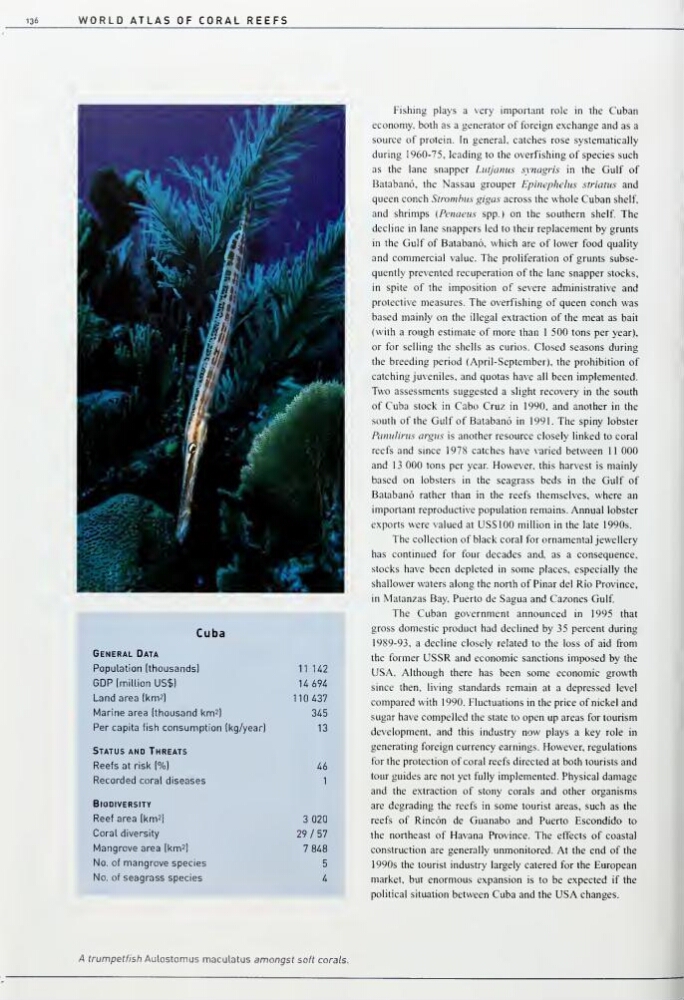
A trumpetfish Aulostomus maculatus amongst soft corals.
WORLD ATLAS OF CORAL REEFS
Cuba
General Data
Population Ithousandsl
11 U2
GDP (million US$)
U69i
Land area (km^l
110/137
Marine area (thousand km^]
3/15
Per capita fish consumption |kg/year|
13
Status and Threats
Reefs at risk (%l
Ub
Recorded coral diseases
1
Biodiversity
Reef area (km2|
3 020
Coral diversity
29/57
Mangrove area (km^)
7 8/i8
No. of mangrove species
5
No. of seagrass species
4
Fishing plays a very important role in the Cuban
economy, both as a generator of foreign exchange and as a
source of protein. In general, catches rose systematically
during 1960-75, leading to the overfishing of species such
as the lane snapper Lutjanus symigris in the Gulf of
Batabano, the Nassau grouper Epinephelus striatus and
queen conch Strombiis gigas across the whole Cuban shelf,
and shrimps (Penaeus spp.) on the southern shelf The
decline in lane snappers led to their replacement by grunts
m the Gulf of Batabano, which are of lower food quality
and commercial value. The proliferation of grunts subsequently prevented recuperation of the lane snapper stocks,
in spite of the imposition of severe administrative and
protective measures. The overfishing of queen conch was
based mainly on the illegal extraction of the meat as bait
(with a rough estimate of more than 1 500 tons per year),
or for selling the shells as curios. Closed seasons during
the breeding period (April-September), the prohibition of
catching juveniles, and quotas have all been implemented.
Two assessments suggested a slight recovery in the south
of Cuba stock in Cabo Cruz in 1990. and another in the
south of the Gulf of Batabano in 1991. The spiny lobster
Panulirus argus is another resource closely linked to coral
reefs and since 1 978 catches have \aried between 1 1 000
and 13 000 tons per year However, this harvest is mainly
based on lobsters in the seagrass beds in the Gulf of
Batabano rather than in the reefs themselves, where an
important reproductive population remains. Annual lobster
exports were valued at US$100 million in the late 1990s.
The collection of black coral for ornamental jewellery
has continued for four decades and, as a consequence,
stocks have been depleted in some places, especially the
shallower waters along the north of Pinar del Rio Province,
in Matanzas Bay, Puerto de Sagua and Cazones Gulf
The Cuban government announced in 1995 that
gross domestic product had declined by 35 percent during
1989-93, a decline closely related to the loss of aid from
the former USSR and economic sanctions imposed by the
USA. Although there has been some economic growth
since then, living standards remain at a depressed level
compared with 1990. Fluctuations in the price of nickel and
sugar have compelled the state to open up areas for tourism
development, and this industry now plays a key role in
generating foreign currency earnings. However, regulations
for the protection of coral reefs directed at both tourists and
tour guides are not yet fully implemented. Physical damage
and the extraction of stony corals and other organisms
are degrading the reefs in some tourist areas, such as the
reefs of Rincon de Guanabo and Puerto Escondido to
the northeast of Havana Province. The effects of coastal
construction are generally unmonitored. At the end of the
1 990s the tourist industry largely catered for the European
market, but enormous expansion is to be expected if the
political situation between Cuba and the USA changes.
A trumpetfish Aulostomus maculatus amongst soft corals.