

Western Caribbean
135
Cuba
MAPsg
'
-
^-,._^--S»jlPL -^ll|bB-S. ^-^•r^'^'^.i^^.^^;^
^5^
i
......
r-" »
.•iil)^**.. .^^.^ *i: ,*»;^''"*'^*: >' >^. ^x
Cuba
is the largest of the Caribbean islands, with a
long, complex coastline and considerable chains of
offshore islands and coral cays. Coral reefs stretch
along virtually the entire border of the Cuban shelf The
majority of these lie offshore in long tracts which resemble
barrier reefs, separated from the main island by broad
lagoons. The longest runs for some 400 kilometers along
the north coast from the Archipielago de Sabana to the
Archipielago de Camaguey. On the south coast a similar reef
tract stretches for over 350 kilometers from Trinidad to Cabo
Cruz. Unlike true barrier reefs, the lagoons behind these
reef tracts are very shallow. In most cases these wide
lagoons, together with the long archipelagos of small coral
cays which lie on their outer edges, have protected the reefs
from adverse anthropogenic impacts. Hurricanes are more
frequent in the south and west where the reef communities
are dominated by species resistant to sedimentation and
water movement, especially in the Gulf of Batabano.
Only short stretches of coast have been heavily
urbanized or industrialized. For these reasons, pollution
tends to be localized: less than 3 percent of reefs in Cuba are
believed to be affected by a significant degree of organic
pollution. Many of the reefs appear to have shown a general increase in algal cover, probably associated with the
Diadema die-off which has affected the rest of the region.
Populations of the urchin in Cuba show no signs of
recovery, so algal species such as Cladophora catenata,
Microdictyon marinum, Lohophora variegata. Diclyota
spp., Sargassum spp. and Halimeda spp. achieve biomass
figures as high as 3 kilos per square meter This occurs on
reefs which are far from sources of organic pollution and
may indicate that the changes are part of the Caribbean- wide
impacts of Diadema die-off and loss of Acropora spp. to
disease, rather than a result of direct anthropogenic impacts.
In terms of reef fish, Cuban populations have higher
biomass. species richness and average size than many other
countries in the region, but these parameters were declining
in the 1980s and 1990s due to overfishing. In 1998, coral
bleaching was reported to have been severe on all coasts,
although bleaching-related mortality was low.
Levels of sewage, organic and inorganic pollution are
high in Havana Bay and this has caused the diversity
of scleractinians, sponges and gorgonians to decline
severely. These reefs are now dominated by just a few
species of scleractinian corals, mainly Sideraslrea radians,
by the sponges Clathria venosa and lotrochota birolulata,
and by the gorgonians Plexaura homomalla, P. flexuosa or
Pseudoplexawa spp.
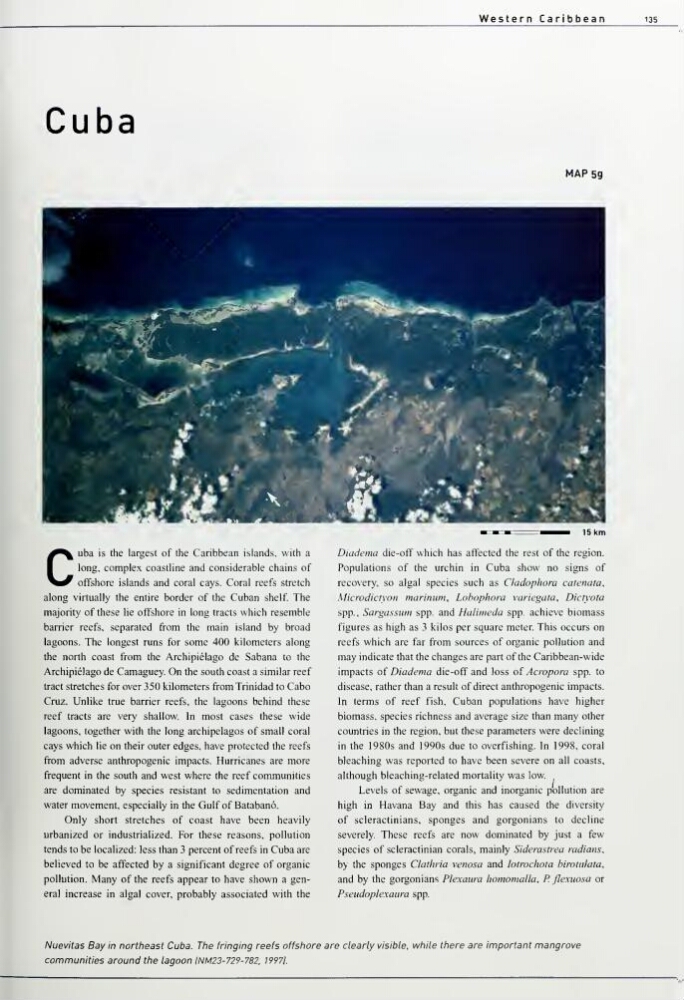
Nuevitas Bay In northeast Cuba. The fringing reefs offshore are clearly visible, while there are important mangrove
communities around the lagoon INM23-729-782, 19971
135
Cuba
MAPsg
'
-
^-,._^--S»jlPL -^ll|bB-S. ^-^•r^'^'^.i^^.^^;^
^5^
i
......
r-" »
.•iil)^**.. .^^.^ *i: ,*»;^''"*'^*: >' >^. ^x
Cuba
is the largest of the Caribbean islands, with a
long, complex coastline and considerable chains of
offshore islands and coral cays. Coral reefs stretch
along virtually the entire border of the Cuban shelf The
majority of these lie offshore in long tracts which resemble
barrier reefs, separated from the main island by broad
lagoons. The longest runs for some 400 kilometers along
the north coast from the Archipielago de Sabana to the
Archipielago de Camaguey. On the south coast a similar reef
tract stretches for over 350 kilometers from Trinidad to Cabo
Cruz. Unlike true barrier reefs, the lagoons behind these
reef tracts are very shallow. In most cases these wide
lagoons, together with the long archipelagos of small coral
cays which lie on their outer edges, have protected the reefs
from adverse anthropogenic impacts. Hurricanes are more
frequent in the south and west where the reef communities
are dominated by species resistant to sedimentation and
water movement, especially in the Gulf of Batabano.
Only short stretches of coast have been heavily
urbanized or industrialized. For these reasons, pollution
tends to be localized: less than 3 percent of reefs in Cuba are
believed to be affected by a significant degree of organic
pollution. Many of the reefs appear to have shown a general increase in algal cover, probably associated with the
Diadema die-off which has affected the rest of the region.
Populations of the urchin in Cuba show no signs of
recovery, so algal species such as Cladophora catenata,
Microdictyon marinum, Lohophora variegata. Diclyota
spp., Sargassum spp. and Halimeda spp. achieve biomass
figures as high as 3 kilos per square meter This occurs on
reefs which are far from sources of organic pollution and
may indicate that the changes are part of the Caribbean- wide
impacts of Diadema die-off and loss of Acropora spp. to
disease, rather than a result of direct anthropogenic impacts.
In terms of reef fish, Cuban populations have higher
biomass. species richness and average size than many other
countries in the region, but these parameters were declining
in the 1980s and 1990s due to overfishing. In 1998, coral
bleaching was reported to have been severe on all coasts,
although bleaching-related mortality was low.
Levels of sewage, organic and inorganic pollution are
high in Havana Bay and this has caused the diversity
of scleractinians, sponges and gorgonians to decline
severely. These reefs are now dominated by just a few
species of scleractinian corals, mainly Sideraslrea radians,
by the sponges Clathria venosa and lotrochota birolulata,
and by the gorgonians Plexaura homomalla, P. flexuosa or
Pseudoplexawa spp.
Nuevitas Bay In northeast Cuba. The fringing reefs offshore are clearly visible, while there are important mangrove
communities around the lagoon INM23-729-782, 19971