

128
WORLD ATLAS OF CORAL REEFS
some of these. Despite the apparently healthy picture
overall, there have been dramatic reductions in coral cover,
with equally dramatic increases in algae. In decline since
the early 1970s, coral cover at various monitoring stations
averaged 40 percent in 1983, and by 1997 had dropped
to below 15 percent. Wide areas of Agaricia spp., which
dominated many patch reefs, have died, and Acropora
cen'icornis and A. palmata have more or less vanished
everywhere. The shallow inner reefs of the Golfo de San
Bias, which were once formed by extensive mounds of
Porites pontes, have also shown considerable declines.
Although there is some tourism to these islands, diving
is not common.
Eastern Pacific
The Pacific coastlme of both Costa Rica and Panama is
strongly affected by extremes of water temperature
associated with warm El Niiio (~33°C) events and more
frequent cool upwelling episodes (~15°C). These restrict
offshore reef development in many areas, while terrestrial
runoff greatly restricts reef development on mainland
coasts. In general, reef development is sporadic and
mostly at point locations around offshore islands. Most
reefs in this region consist of shallow (less than 10 meters)
sub-tidal Pocillopora banks bound together with calcareous algae, while Porites lobata is also a major reef
builder in Costa Rica. Species diversity is low, but 23
species of hermatypic corals have been recorded on the
Pacific side of Panama, and 18 in Costa Rica. Despite
their simple community structure and low diversity, coral
cover on these small reefs can be very high, reaching over
Panama
1
General Data
^
Population Ithousands)
2 808
GDPlmiUion US$1
7 1U
Land area (km'l
7i697
Marine area (thousand km^l
332
Per capita fish consumption 1 kg/yea r|
U
Status and Threats
Reefs at risk (%1
65
Recorded coral diseases
2
Biodiversity
Reef area (km^j
720
Coral diversity
52/84
Mangrove area (km')
1 8U
No. of mangrove species
12
No. of seagrass species
3
90 percent on healthy reefs. Cores through these reefs
have shown carbonate accretions up to 10-12 meters
thick, suggesting vertical accretion rates similar to many
reefs in the Indo-Pacific. The Pacific reefs were severely
impacted by the 1982-83 El Nino event, which drove
mass bleaching and mortality in all areas. In Costa Rica
recovery has generally been good and, despite repeated
bleaching in 1992 and 1997-98. coral cover remains high
in most areas. By contrast, recovery on many reefs in
Panama has not been great.
In Costa Rica the main areas with coral communities
or partial reef development are near Santa Elena, Bahia
Culebra, Isla del Caiio and Golfo Dulce. Golfo Dulce, in
eastern Costa Rica, has largely escaped the impacts of El
Niiio events, although the reefs here have been severely
affected by sedimentation from deforestation, mining
and road construction. In 1993 live coral cover was less
than 2 percent. From the surface to a depth of 1 meter
the substrate consisted almost entirely of a mesh of
dead Pocillopora damicornis and Psammocora stellata.
Severely bio-eroded colonies of Porites lobata. a species
which is especially resistant to sedimentation, covered
the fore reef slope to a depth of about 12 meters. Bahia
Culebra has the most diverse coral reefs on mainland
Costa Rica, and here coral cover is much higher - some
20-50 percent - with Pocillopora elegans, Pavona clavus
and Leptoseris payracea being the dominant species.
Reefs on Isla del Cano are reported to be in a phase of
recovery, with high levels of new coral recruitment.
Recreational diving and unplanned tourism are the main
threats in Costa Rica, although damage from commercial
fishing nets and the collection of aquarium organisms has
also been reported.
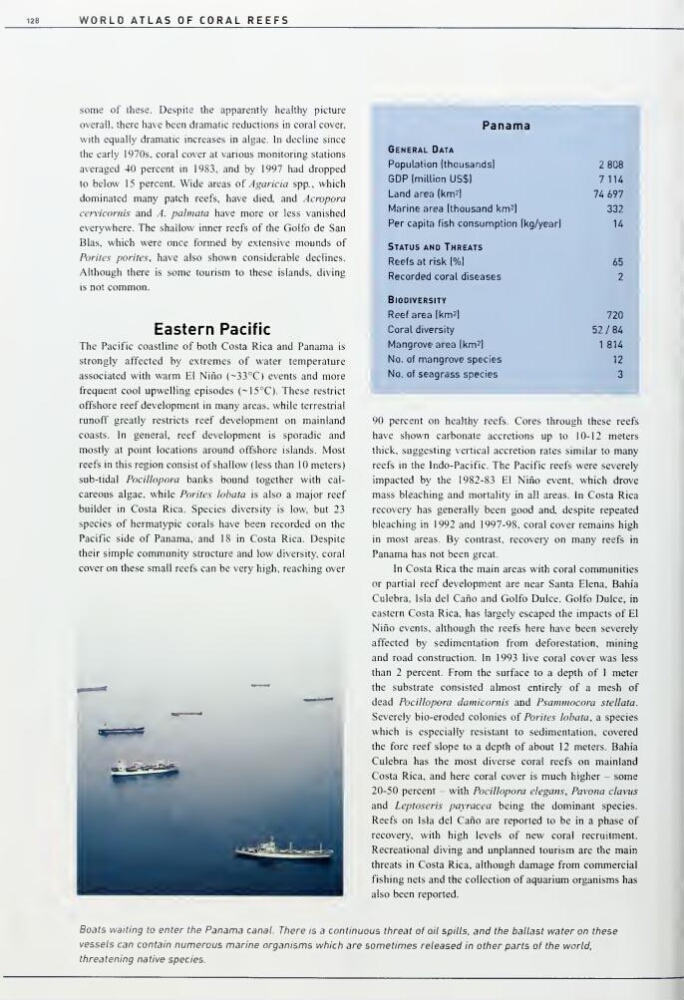
Boats waiting to enter the Panama canal. There is a continuous threat of oil spills, and the ballast water on these
vessels can contain numerous marine organisms which are sometimes released in other parts of the world,
threatening native species.
(
I
WORLD ATLAS OF CORAL REEFS
some of these. Despite the apparently healthy picture
overall, there have been dramatic reductions in coral cover,
with equally dramatic increases in algae. In decline since
the early 1970s, coral cover at various monitoring stations
averaged 40 percent in 1983, and by 1997 had dropped
to below 15 percent. Wide areas of Agaricia spp., which
dominated many patch reefs, have died, and Acropora
cen'icornis and A. palmata have more or less vanished
everywhere. The shallow inner reefs of the Golfo de San
Bias, which were once formed by extensive mounds of
Porites pontes, have also shown considerable declines.
Although there is some tourism to these islands, diving
is not common.
Eastern Pacific
The Pacific coastlme of both Costa Rica and Panama is
strongly affected by extremes of water temperature
associated with warm El Niiio (~33°C) events and more
frequent cool upwelling episodes (~15°C). These restrict
offshore reef development in many areas, while terrestrial
runoff greatly restricts reef development on mainland
coasts. In general, reef development is sporadic and
mostly at point locations around offshore islands. Most
reefs in this region consist of shallow (less than 10 meters)
sub-tidal Pocillopora banks bound together with calcareous algae, while Porites lobata is also a major reef
builder in Costa Rica. Species diversity is low, but 23
species of hermatypic corals have been recorded on the
Pacific side of Panama, and 18 in Costa Rica. Despite
their simple community structure and low diversity, coral
cover on these small reefs can be very high, reaching over
Panama
1
General Data
^
Population Ithousands)
2 808
GDPlmiUion US$1
7 1U
Land area (km'l
7i697
Marine area (thousand km^l
332
Per capita fish consumption 1 kg/yea r|
U
Status and Threats
Reefs at risk (%1
65
Recorded coral diseases
2
Biodiversity
Reef area (km^j
720
Coral diversity
52/84
Mangrove area (km')
1 8U
No. of mangrove species
12
No. of seagrass species
3
90 percent on healthy reefs. Cores through these reefs
have shown carbonate accretions up to 10-12 meters
thick, suggesting vertical accretion rates similar to many
reefs in the Indo-Pacific. The Pacific reefs were severely
impacted by the 1982-83 El Nino event, which drove
mass bleaching and mortality in all areas. In Costa Rica
recovery has generally been good and, despite repeated
bleaching in 1992 and 1997-98. coral cover remains high
in most areas. By contrast, recovery on many reefs in
Panama has not been great.
In Costa Rica the main areas with coral communities
or partial reef development are near Santa Elena, Bahia
Culebra, Isla del Caiio and Golfo Dulce. Golfo Dulce, in
eastern Costa Rica, has largely escaped the impacts of El
Niiio events, although the reefs here have been severely
affected by sedimentation from deforestation, mining
and road construction. In 1993 live coral cover was less
than 2 percent. From the surface to a depth of 1 meter
the substrate consisted almost entirely of a mesh of
dead Pocillopora damicornis and Psammocora stellata.
Severely bio-eroded colonies of Porites lobata. a species
which is especially resistant to sedimentation, covered
the fore reef slope to a depth of about 12 meters. Bahia
Culebra has the most diverse coral reefs on mainland
Costa Rica, and here coral cover is much higher - some
20-50 percent - with Pocillopora elegans, Pavona clavus
and Leptoseris payracea being the dominant species.
Reefs on Isla del Cano are reported to be in a phase of
recovery, with high levels of new coral recruitment.
Recreational diving and unplanned tourism are the main
threats in Costa Rica, although damage from commercial
fishing nets and the collection of aquarium organisms has
also been reported.
Boats waiting to enter the Panama canal. There is a continuous threat of oil spills, and the ballast water on these
vessels can contain numerous marine organisms which are sometimes released in other parts of the world,
threatening native species.
(
I