

Western Caribbean
127
due to intense sedimentation smothering coral recruits as
they settle onto the substrate.
In Panama, some 64 hard coral species have been
recorded off the Caribbean coastline. The mshore reefs at
Bocas del Toro receive a high sediment load, rich in pesticides and fertilizers, from mainland banana plantations.
Reef development is less heavily impacted further
offshore and live coral cover in these areas remains at
about 25 percent, reaching as high as 70 percent in some
places. The Laguna de Chiriqui is lined with extensive
mangroves and the beaches of the area are still important
rookeries for hawksbill and loggerhead turtles. Further
east the reefs near Cristobal and at Punta Galeta have
experienced little disturbance as they were within a US
military reservation until the return of the Panama Canal
to the Panamanian government in 1999. Punta Galeta has
an emergent reef with a shallow fore reef pavement and a
substantial coral boulder reef flat which is dominated by
foliose and crustose algae. During calm weather and low
tides it is exposed for long periods, up to 30-40 times a
year, from 1 to 14 hours at a stretch. In the central region,
proximity to the Panama Canal presents a real and
continuing threat of oil pollution. A major spill in 1987
entered into mangrove communities and has continued to
leach out into the surrounding waters where studies have
shown significant declines in coral cover and diversity.
Some of the best developed reefs occur along the San
Bias coastline. A number of islands and reefs lie on the
outer edge of the continental shelf as patch reefs or
fringing reefs around coral cays in a barrier-type structure.
Further east, the reefs and islands are mostly located closer
to the shore. Fifty-seven species of scleractinian coral have
been recorded. This is an area which has better protection
K^^^^^
Costa R ica
m
General Data
m
Population (thousands)
3 711
GDP (million US$)
7 130
Land area (km^)
51 608
Marine area (thousand km^j
566
Per capita fish consumption (kg/year)
i
Status and Threats
Reefs at risk (%1
93
Recorded coral diseases
2
Biodiversity
970
25 / 83
Reef area Ikm^)
Coral diversity
Mangrove area (km^l
370
No. of mangrove species
ll
No. of seagrass species
id
than many other reefs in the Caribbean, being an autonomous region run by the Kuna Indians. The mainland coast
remains heavily forested and so there is little sediment
runoff. The Kuna have tightly packed villages on 41 of the
offshore islands, and while all waste from these villages
passes straight into the surrounding waters, there appears
to be sufficient dilution in most areas. Growing population
numbers have led to expansion of some islands by
reclamation, destroying the reefs in the immediate vicinity.
Most fishing is subsistence level, but there is some export
of spiny lobster, conch, spider crab and octopus, and there
IS evidence of significant target species overfishing for
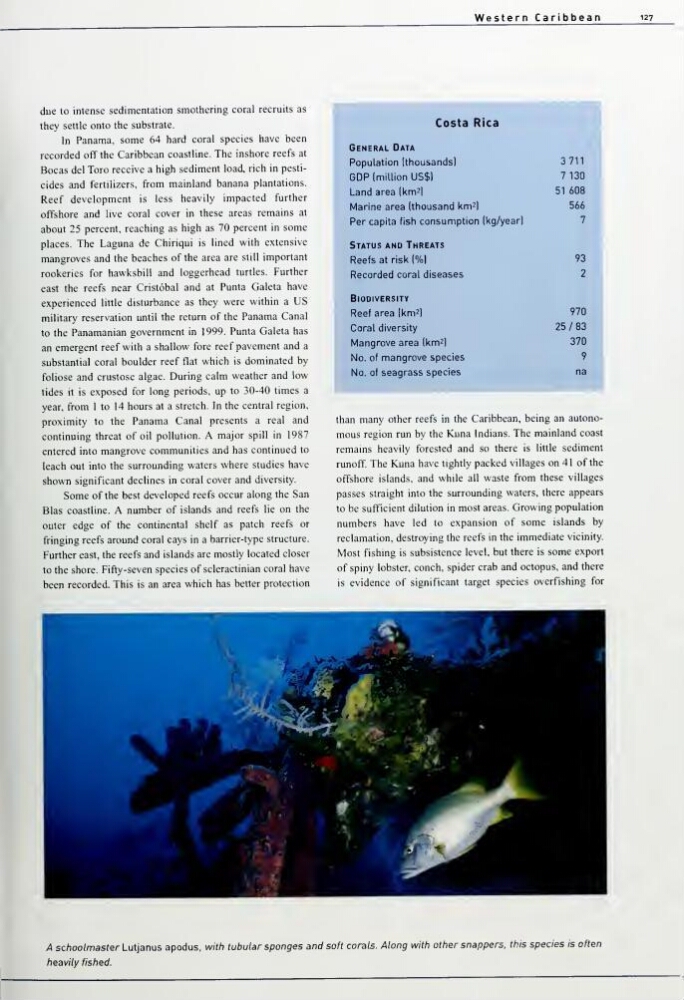
A schoolmaster Lutjanus apodus, with tubular sponges and soft corals. Along with other snappers, this species is often
heavily fished.
127
due to intense sedimentation smothering coral recruits as
they settle onto the substrate.
In Panama, some 64 hard coral species have been
recorded off the Caribbean coastline. The mshore reefs at
Bocas del Toro receive a high sediment load, rich in pesticides and fertilizers, from mainland banana plantations.
Reef development is less heavily impacted further
offshore and live coral cover in these areas remains at
about 25 percent, reaching as high as 70 percent in some
places. The Laguna de Chiriqui is lined with extensive
mangroves and the beaches of the area are still important
rookeries for hawksbill and loggerhead turtles. Further
east the reefs near Cristobal and at Punta Galeta have
experienced little disturbance as they were within a US
military reservation until the return of the Panama Canal
to the Panamanian government in 1999. Punta Galeta has
an emergent reef with a shallow fore reef pavement and a
substantial coral boulder reef flat which is dominated by
foliose and crustose algae. During calm weather and low
tides it is exposed for long periods, up to 30-40 times a
year, from 1 to 14 hours at a stretch. In the central region,
proximity to the Panama Canal presents a real and
continuing threat of oil pollution. A major spill in 1987
entered into mangrove communities and has continued to
leach out into the surrounding waters where studies have
shown significant declines in coral cover and diversity.
Some of the best developed reefs occur along the San
Bias coastline. A number of islands and reefs lie on the
outer edge of the continental shelf as patch reefs or
fringing reefs around coral cays in a barrier-type structure.
Further east, the reefs and islands are mostly located closer
to the shore. Fifty-seven species of scleractinian coral have
been recorded. This is an area which has better protection
K^^^^^
Costa R ica
m
General Data
m
Population (thousands)
3 711
GDP (million US$)
7 130
Land area (km^)
51 608
Marine area (thousand km^j
566
Per capita fish consumption (kg/year)
i
Status and Threats
Reefs at risk (%1
93
Recorded coral diseases
2
Biodiversity
970
25 / 83
Reef area Ikm^)
Coral diversity
Mangrove area (km^l
370
No. of mangrove species
ll
No. of seagrass species
id
than many other reefs in the Caribbean, being an autonomous region run by the Kuna Indians. The mainland coast
remains heavily forested and so there is little sediment
runoff. The Kuna have tightly packed villages on 41 of the
offshore islands, and while all waste from these villages
passes straight into the surrounding waters, there appears
to be sufficient dilution in most areas. Growing population
numbers have led to expansion of some islands by
reclamation, destroying the reefs in the immediate vicinity.
Most fishing is subsistence level, but there is some export
of spiny lobster, conch, spider crab and octopus, and there
IS evidence of significant target species overfishing for
A schoolmaster Lutjanus apodus, with tubular sponges and soft corals. Along with other snappers, this species is often
heavily fished.