

WORLD ATLAS OF CORAL REEFS
been recorded. Biogeographically the islands appear to
be more closely linked with Clipperton Atoll than the
Mexican mainland and up to three of the hermatypic coral
species found on the islands may be endemic to these two
areas. Additionally, six molluscs and 12 reef fish have
been found to be endemic to the islands.
In the Gulf of Mexico reefs occur in the south, and
are mostly located along the edge of the continental shelf,
both around Veracruz and on the Campeche Bank, which
follows the western and northern edges of the Yucatan
Peninsula. The majority of the Veracruz reefs are platform
reefs, some with emergent parts, as in Isia Lobos,
although patch reefs do exist in El Giote off Anton
Lizardo and at Punta Gorda, Punta Majagua, Hornos and
Punta Mocambo. Sedimentation is very high on reefs
close to the port of Veracruz where the rivers Antigua,
Papaloapan and Alvarado limit coral growth, and diversity
in these areas is low.
The Campeche reefs have ecological and morphological characteristics that distinguish them from the
Caribbean reefs of Mexico, although their fauna is similar.
Both emergent (eg Cayos Areas, Cayos Arenas and
Arrecife Triangulos) and submerged (eg Banco Nuevo,
Banco Ingles, Bajo Serpiente. Madagascar and Sisal) reefs
are present. All are platforms rising from a pre-Holocene
base located at a depth of 50-60 meters. Arrecife
Alacranes is an atoll.
The most extensive reef development in the country
is in the state of Quintana Roo on the east coast of the
Yucatan Peninsula. Here the continental shelf is very
narrow, in many places less than 2 kilometers wide. There
are partly submerged fringmg reefs along much of this
coastline, while from Xcalak southwards there is a fully
developed fringing reef which continues to Ambergris
Key in Belize, and then extends into the Belize Barrier
Reef Extensive spur and groove systems have developed
m the center and south. This coastline is noted for its lack
of rivers but numerous limestone sink holes result in an
outflow of freshwater at various points. Offshore are two
further important features: Cozumel Island, a relatively
large island in the north with a number of reefs on both
windward and leeward shores; and close to the Belize
border the large atoll of Banco Chinchorro, which is
separated from the mainland by a 1 000 meter deep
channel. The reefs are well developed on the eastern
(windward) side of this atoll: coral cover is lower in the
shallow waters, and a spur and groove system has
developed. The lagoon is generally sandy, with extensive
seagrass cover and some patch reefs. Both Banco
Chinchorro and Cozumel modify the northerly flow of
water in the Caribbean Current. South of Cozumel. part of
the current is funnelled into the channel and accelerates
up to 4 knots to form the Yucatan Current. Its speed is
believed to influence sedimentation rates and possibly
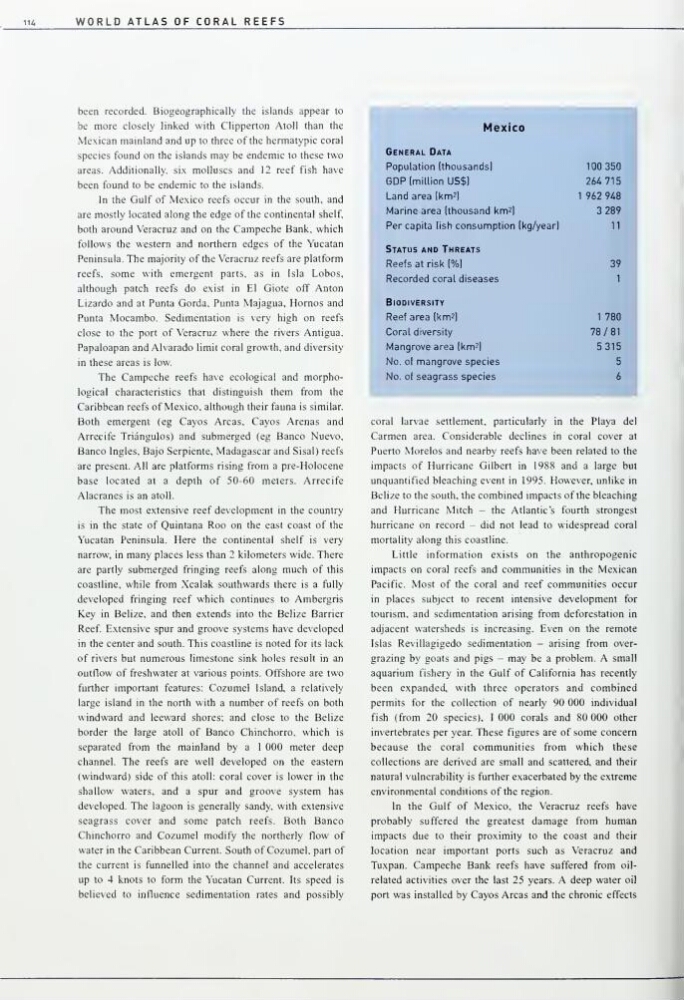
Mexico
General Data
Population (thousandsl
100 350
GDP Imillion US$1
26A715
Land area (km^l
1 962 9/18
Marine area Ithousand km?)
3 289
Per capita fish consumption (kg/yearl
11
Status and Threats
Reefs at risk (%|
39
Recorded coral diseases
1
Biodiversity
Reef area Ikm^j
1
780
Coral diversity
78/81
tvlangrove area Ikm^l
5315
No. of mangrove species
5
No. of seagrass species
6
coral larvae settlement, particularly in the Playa del
Carmen area. Considerable declines in coral cover at
Puerto Morelos and nearby reefs have been related to the
impacts of Hurricane Gilbert in 1988 and a large but
unquantified bleaching event in 1995. However, unlike in
Belize to the south, the combined impacts of the bleaching
and Hurricane Mitch - the Atlantic's fourth strongest
hurricane on record - did not lead to widespread coral
mortality along this coastline.
Little information exists on the anthropogenic
impacts on coral reefs and communities in the Mexican
Pacific. Most of the coral and reef communities occur
in places subject to recent intensive development for
tourism, and sedimentation arising from deforestation in
adjacent watersheds is increasing. Even on the remote
Islas Revillagigedo sedimentation - arising from overgrazing by goats and pigs - may be a problem. A small
aquarium fishery in the Gulf of California has recently
been expanded, with three operators and combined
permits for the collection of nearly 90 000 individual
fish (from 20 species), 1 000 corals and 80 000 other
invertebrates per year. These figures are of some concern
because the coral communities from which these
collections are derived are small and scattered, and their
natural vulnerability is further exacerbated by the extreme
environmental conditions of the region.
In the Gulf of Mexico, the Veracruz reefs have
probably suffered the greatest damage from human
impacts due to their proximity to the coast and their
location near important ports such as Veracruz and
Tuxpan. Campeche Bank reefs have suffered from oilrelated activities over the last 25 years. A deep water oil
port was installed by Cayos Areas and the chronic effects
been recorded. Biogeographically the islands appear to
be more closely linked with Clipperton Atoll than the
Mexican mainland and up to three of the hermatypic coral
species found on the islands may be endemic to these two
areas. Additionally, six molluscs and 12 reef fish have
been found to be endemic to the islands.
In the Gulf of Mexico reefs occur in the south, and
are mostly located along the edge of the continental shelf,
both around Veracruz and on the Campeche Bank, which
follows the western and northern edges of the Yucatan
Peninsula. The majority of the Veracruz reefs are platform
reefs, some with emergent parts, as in Isia Lobos,
although patch reefs do exist in El Giote off Anton
Lizardo and at Punta Gorda, Punta Majagua, Hornos and
Punta Mocambo. Sedimentation is very high on reefs
close to the port of Veracruz where the rivers Antigua,
Papaloapan and Alvarado limit coral growth, and diversity
in these areas is low.
The Campeche reefs have ecological and morphological characteristics that distinguish them from the
Caribbean reefs of Mexico, although their fauna is similar.
Both emergent (eg Cayos Areas, Cayos Arenas and
Arrecife Triangulos) and submerged (eg Banco Nuevo,
Banco Ingles, Bajo Serpiente. Madagascar and Sisal) reefs
are present. All are platforms rising from a pre-Holocene
base located at a depth of 50-60 meters. Arrecife
Alacranes is an atoll.
The most extensive reef development in the country
is in the state of Quintana Roo on the east coast of the
Yucatan Peninsula. Here the continental shelf is very
narrow, in many places less than 2 kilometers wide. There
are partly submerged fringmg reefs along much of this
coastline, while from Xcalak southwards there is a fully
developed fringing reef which continues to Ambergris
Key in Belize, and then extends into the Belize Barrier
Reef Extensive spur and groove systems have developed
m the center and south. This coastline is noted for its lack
of rivers but numerous limestone sink holes result in an
outflow of freshwater at various points. Offshore are two
further important features: Cozumel Island, a relatively
large island in the north with a number of reefs on both
windward and leeward shores; and close to the Belize
border the large atoll of Banco Chinchorro, which is
separated from the mainland by a 1 000 meter deep
channel. The reefs are well developed on the eastern
(windward) side of this atoll: coral cover is lower in the
shallow waters, and a spur and groove system has
developed. The lagoon is generally sandy, with extensive
seagrass cover and some patch reefs. Both Banco
Chinchorro and Cozumel modify the northerly flow of
water in the Caribbean Current. South of Cozumel. part of
the current is funnelled into the channel and accelerates
up to 4 knots to form the Yucatan Current. Its speed is
believed to influence sedimentation rates and possibly
Mexico
General Data
Population (thousandsl
100 350
GDP Imillion US$1
26A715
Land area (km^l
1 962 9/18
Marine area Ithousand km?)
3 289
Per capita fish consumption (kg/yearl
11
Status and Threats
Reefs at risk (%|
39
Recorded coral diseases
1
Biodiversity
Reef area Ikm^j
1
780
Coral diversity
78/81
tvlangrove area Ikm^l
5315
No. of mangrove species
5
No. of seagrass species
6
coral larvae settlement, particularly in the Playa del
Carmen area. Considerable declines in coral cover at
Puerto Morelos and nearby reefs have been related to the
impacts of Hurricane Gilbert in 1988 and a large but
unquantified bleaching event in 1995. However, unlike in
Belize to the south, the combined impacts of the bleaching
and Hurricane Mitch - the Atlantic's fourth strongest
hurricane on record - did not lead to widespread coral
mortality along this coastline.
Little information exists on the anthropogenic
impacts on coral reefs and communities in the Mexican
Pacific. Most of the coral and reef communities occur
in places subject to recent intensive development for
tourism, and sedimentation arising from deforestation in
adjacent watersheds is increasing. Even on the remote
Islas Revillagigedo sedimentation - arising from overgrazing by goats and pigs - may be a problem. A small
aquarium fishery in the Gulf of California has recently
been expanded, with three operators and combined
permits for the collection of nearly 90 000 individual
fish (from 20 species), 1 000 corals and 80 000 other
invertebrates per year. These figures are of some concern
because the coral communities from which these
collections are derived are small and scattered, and their
natural vulnerability is further exacerbated by the extreme
environmental conditions of the region.
In the Gulf of Mexico, the Veracruz reefs have
probably suffered the greatest damage from human
impacts due to their proximity to the coast and their
location near important ports such as Veracruz and
Tuxpan. Campeche Bank reefs have suffered from oilrelated activities over the last 25 years. A deep water oil
port was installed by Cayos Areas and the chronic effects