

Western Caribbean
113
Mexico
MAPS 5a and b
Coral
reefs and communities occur throughout
Mexico but are concentrated in four main areas:
the Gulf of California and Pacific Coast; the
nearshore reefs between Tampico and Veracruz in the
western Bahia de Campeche; the more distant offshore
reefs of the Campeche Bank; and the fringing reef and
atolls of the Caribbean Sea.
Hermatypic corals were originally considered to be
rare in the Mexican Pacific, but recent research has
described abundant coral populations in these reefs,
despite their small size (mostly a few hectares or less)
and their discontinuous occurrence. True reefs with an
elevated structure occur at Cabo Pulmo, Ensenada Grande
on Isla Espiritu Santo, Punto Chileno, Islas Marias and at
scattered locations along the southern coast of Oaxaca.
Coral communities, sometimes with abundant coral
growth but little net accretion, are present in the central
Gulf of California from Isla Angel de la Guardia to Bahia
Concepcion. They consist of just two species - Pontes
panamensis and P. sverdnipi - which are tolerant of the
low temperatures of the upper gulf The latter is an
endemic species believed to be a relict from the Pliocene
undergoing a natural process of extinction. Other communities occur all along the Pacific coast, occupying
rocky areas at 0-15 meters in depth. The communities
at Isla Jaltemba, Huatulco Bays, east of Puerto Angel,
Puerto Angelito and Carrizalillo are particularly well
developed but are composed of only a few species, mainly
Pocillopora spp., Pnriles spp., Parana spp., Psammocora
spp. and Fungia spp. The latest El Nino and post-El Nifio
events in 1997 and 1998 caused considerable bleaching
and mortality around Bahia Banderas and Huatulco, but
had considerably less impact at some other localities.
Some 200 kilometers south of Baja California and
600 kilometers west of mainland Mexico, lies a small
but important group of four volcanic islands, the Islas
Revillagigedo. They lie in deep oceanic water and are
broadly impacted by a westward flowing North Equatorial
Current, which is fed by the cold California Current and
the warmer Costa Rica Coastal Current. These relatively
harsh conditions are exacerbated by regular tropical
storms. Despite this, the islands harbor the most diverse
fish and coral communities in the Mexican Pacific. Reef
development is limited, but there are some true reef
structures, notably in the more sheltered bays. Twenty
hennatypic coral species have been recorded around these
islands, dominated by Pocillopora spp., as well as Pontes
lobata and P. lichen. Many gorgonian species have also
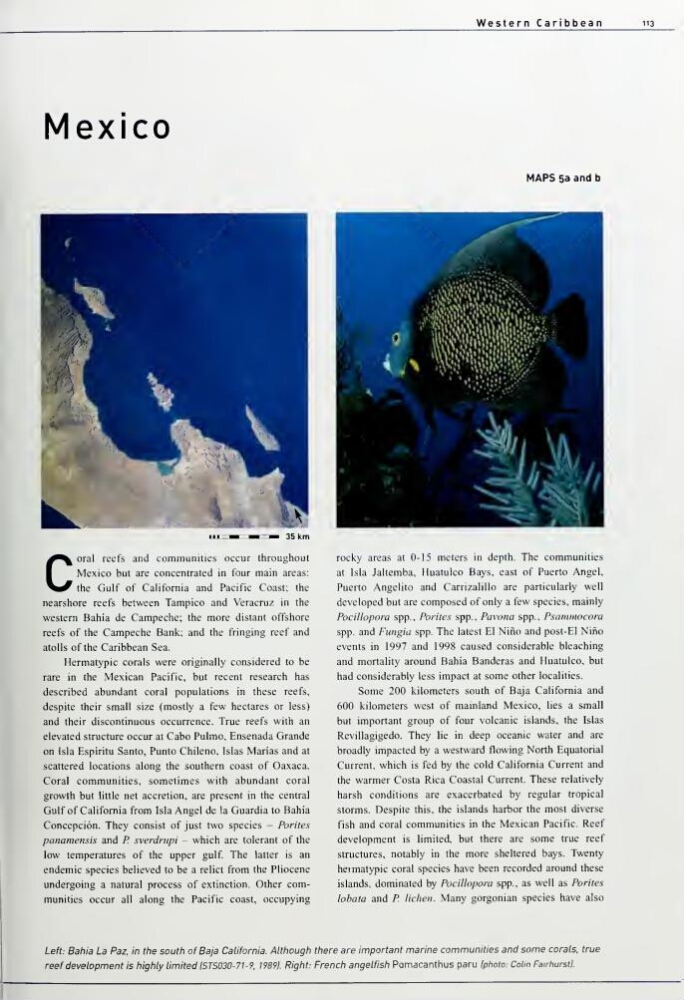
Left: Bahia La Paz, in tt)e soutt) of Baja California. Atthiougli tfiere are important marine communities and some corals, true
reef development is fiigfily limited ISTS030-71 -9. 19891. Rigfit: Frencf) angelfish Pomacanthus paru Iplioto: Colin Fairiiurstl.
113
Mexico
MAPS 5a and b
Coral
reefs and communities occur throughout
Mexico but are concentrated in four main areas:
the Gulf of California and Pacific Coast; the
nearshore reefs between Tampico and Veracruz in the
western Bahia de Campeche; the more distant offshore
reefs of the Campeche Bank; and the fringing reef and
atolls of the Caribbean Sea.
Hermatypic corals were originally considered to be
rare in the Mexican Pacific, but recent research has
described abundant coral populations in these reefs,
despite their small size (mostly a few hectares or less)
and their discontinuous occurrence. True reefs with an
elevated structure occur at Cabo Pulmo, Ensenada Grande
on Isla Espiritu Santo, Punto Chileno, Islas Marias and at
scattered locations along the southern coast of Oaxaca.
Coral communities, sometimes with abundant coral
growth but little net accretion, are present in the central
Gulf of California from Isla Angel de la Guardia to Bahia
Concepcion. They consist of just two species - Pontes
panamensis and P. sverdnipi - which are tolerant of the
low temperatures of the upper gulf The latter is an
endemic species believed to be a relict from the Pliocene
undergoing a natural process of extinction. Other communities occur all along the Pacific coast, occupying
rocky areas at 0-15 meters in depth. The communities
at Isla Jaltemba, Huatulco Bays, east of Puerto Angel,
Puerto Angelito and Carrizalillo are particularly well
developed but are composed of only a few species, mainly
Pocillopora spp., Pnriles spp., Parana spp., Psammocora
spp. and Fungia spp. The latest El Nino and post-El Nifio
events in 1997 and 1998 caused considerable bleaching
and mortality around Bahia Banderas and Huatulco, but
had considerably less impact at some other localities.
Some 200 kilometers south of Baja California and
600 kilometers west of mainland Mexico, lies a small
but important group of four volcanic islands, the Islas
Revillagigedo. They lie in deep oceanic water and are
broadly impacted by a westward flowing North Equatorial
Current, which is fed by the cold California Current and
the warmer Costa Rica Coastal Current. These relatively
harsh conditions are exacerbated by regular tropical
storms. Despite this, the islands harbor the most diverse
fish and coral communities in the Mexican Pacific. Reef
development is limited, but there are some true reef
structures, notably in the more sheltered bays. Twenty
hennatypic coral species have been recorded around these
islands, dominated by Pocillopora spp., as well as Pontes
lobata and P. lichen. Many gorgonian species have also
Left: Bahia La Paz, in tt)e soutt) of Baja California. Atthiougli tfiere are important marine communities and some corals, true
reef development is fiigfily limited ISTS030-71 -9. 19891. Rigfit: Frencf) angelfish Pomacanthus paru Iplioto: Colin Fairiiurstl.