

The crystallographic transformation of biogenic calcite decomposition after calcination showed that the calcite is stable up to 600 °C [34].
Beyond, this thermic threshold, CaO is formed due to the CaCO 3 decomposition to CaO [34]. Finally, at temperature > 800 °C, calcite is
completely decarbonized and forms CaO and CO 2 , which is in agreement with our results. When calcite surfaces are successfully coated
with TiO 2 layer, the CAL-based materials revealed a higher thermal
stability compared to the raw material ‘CAL’. TiO 2 particles showed a
higher thermal stability against temperatures.
3.6. Photocatalytic activity of CAL/TiO 2 system
The ability of degradation toward organic pollutant constitutes the
prime importance of any photolytic materials development. The kinetic
study could be useful to investigate and understand the mechanisms of
pollutant degradation. As generally observed, many photocatalytic
systems follow a pseudo-first-order kinetic model, which is also the case
of CAL/TiO 2 system. The rate constants k (min
−1
) were calculated from
the straight-line portion of the first-order plots as a function of reaction
time. Accordingly, the photocatalytic efficiency is expressed in term of
the rate constant k, the rate r (=k×C eq ) and taking in consideration the
concentration of the pollutant at equilibrium (C eq ). The data of the
adsorption equilibrium is provided for CAL30 as an example and, as
observed, the equilibrium is reached at around 30 min (Fig. 7). Therefore, 60 min is then a sufficient period of time to consider the equilibrium. Accordingly, all the catalysts are maintained in darkness for
60 min before starting photocatalytic process.
3.6.1. Effect of composites composition
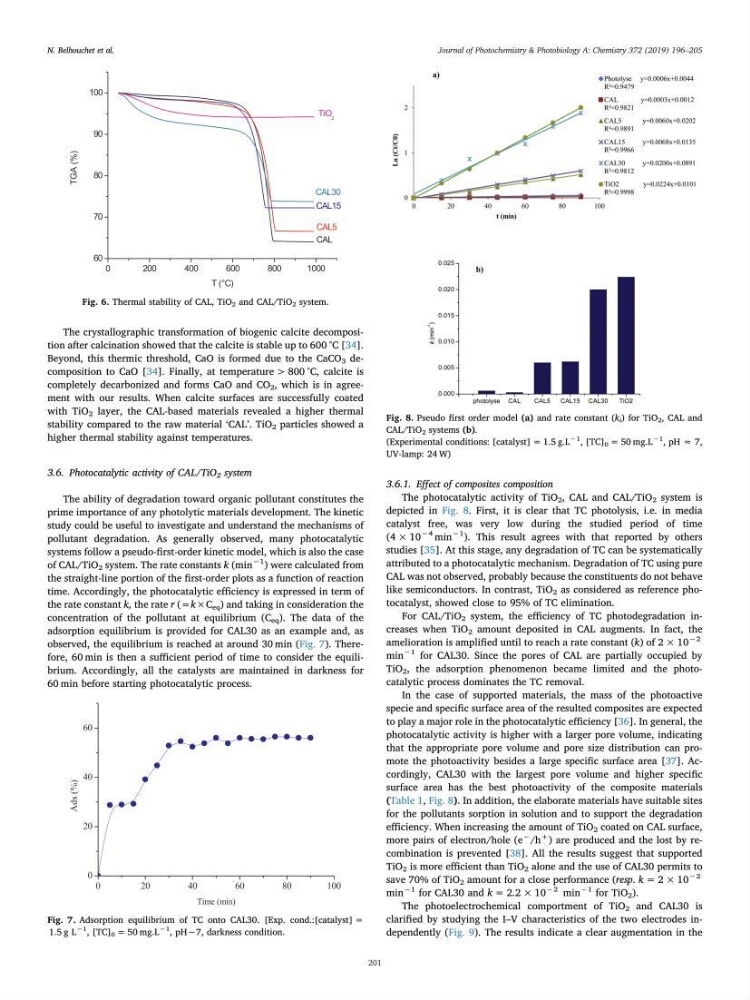
The photocatalytic activity of TiO 2 , CAL and CAL/TiO 2 system is
depicted in Fig. 8. First, it is clear that TC photolysis, i.e. in media
catalyst free, was very low during the studied period of time
(4 × 10
−4 min
−1
). This result agrees with that reported by others
studies [35]. At this stage, any degradation of TC can be systematically
attributed to a photocatalytic mechanism. Degradation of TC using pure
CAL was not observed, probably because the constituents do not behave
like semiconductors. In contrast, TiO 2 as considered as reference photocatalyst, showed close to 95% of TC elimination.
For CAL/TiO 2 system, the efficiency of TC photodegradation increases when TiO 2 amount deposited in CAL augments. In fact, the
amelioration is amplified until to reach a rate constant (k) of 2 × 10
−2
min
−1 for CAL30. Since the pores of CAL are partially occupied by
TiO 2 , the adsorption phenomenon became limited and the photocatalytic process dominates the TC removal.
In the case of supported materials, the mass of the photoactive
specie and specific surface area of the resulted composites are expected
to play a major role in the photocatalytic efficiency [36]. In general, the
photocatalytic activity is higher with a larger pore volume, indicating
that the appropriate pore volume and pore size distribution can promote the photoactivity besides a large specific surface area [37]. Accordingly, CAL30 with the largest pore volume and higher specific
surface area has the best photoactivity of the composite materials
(Table 1, Fig. 8). In addition, the elaborate materials have suitable sites
for the pollutants sorption in solution and to support the degradation
efficiency. When increasing the amount of TiO 2 coated on CAL surface,
more pairs of electron/hole (e
−
/h
+ ) are produced and the lost by recombination is prevented [38]. All the results suggest that supported
TiO 2 is more efficient than TiO 2 alone and the use of CAL30 permits to
save 70% of TiO 2 amount for a close performance (resp. k = 2 × 10
−2
min
−1 for CAL30 and k = 2.2 × 10
−2 min
−1 for TiO 2 ).
The photoelectrochemical comportment of TiO 2 and CAL30 is
clarified by studying the I–V characteristics of the two electrodes independently (Fig. 9). The results indicate a clear augmentation in the
Fig. 6. Thermal stability of CAL, TiO 2 and CAL/TiO 2 system.
Fig. 7. Adsorption equilibrium of TC onto CAL30. [Exp. cond.:[catalyst] =
1.5 g L
−1
, [TC] 0 = 50 mg.L
−1
, pH∼7, darkness condition.
Fig. 8. Pseudo first order model (a) and rate constant (k i ) for TiO 2 , CAL and
CAL/TiO 2 systems (b).
(Experimental conditions: [catalyst] = 1.5 g.L
−1 , [TC] 0 = 50 mg.L
−1 , pH ≈ 7,
UV-lamp: 24 W)
N. Belhouchet et al.
Journal of Photochemistry & Photobiology A: Chemistry 372 (2019) 196–205
201
Beyond, this thermic threshold, CaO is formed due to the CaCO 3 decomposition to CaO [34]. Finally, at temperature > 800 °C, calcite is
completely decarbonized and forms CaO and CO 2 , which is in agreement with our results. When calcite surfaces are successfully coated
with TiO 2 layer, the CAL-based materials revealed a higher thermal
stability compared to the raw material ‘CAL’. TiO 2 particles showed a
higher thermal stability against temperatures.
3.6. Photocatalytic activity of CAL/TiO 2 system
The ability of degradation toward organic pollutant constitutes the
prime importance of any photolytic materials development. The kinetic
study could be useful to investigate and understand the mechanisms of
pollutant degradation. As generally observed, many photocatalytic
systems follow a pseudo-first-order kinetic model, which is also the case
of CAL/TiO 2 system. The rate constants k (min
−1
) were calculated from
the straight-line portion of the first-order plots as a function of reaction
time. Accordingly, the photocatalytic efficiency is expressed in term of
the rate constant k, the rate r (=k×C eq ) and taking in consideration the
concentration of the pollutant at equilibrium (C eq ). The data of the
adsorption equilibrium is provided for CAL30 as an example and, as
observed, the equilibrium is reached at around 30 min (Fig. 7). Therefore, 60 min is then a sufficient period of time to consider the equilibrium. Accordingly, all the catalysts are maintained in darkness for
60 min before starting photocatalytic process.
3.6.1. Effect of composites composition
The photocatalytic activity of TiO 2 , CAL and CAL/TiO 2 system is
depicted in Fig. 8. First, it is clear that TC photolysis, i.e. in media
catalyst free, was very low during the studied period of time
(4 × 10
−4 min
−1
). This result agrees with that reported by others
studies [35]. At this stage, any degradation of TC can be systematically
attributed to a photocatalytic mechanism. Degradation of TC using pure
CAL was not observed, probably because the constituents do not behave
like semiconductors. In contrast, TiO 2 as considered as reference photocatalyst, showed close to 95% of TC elimination.
For CAL/TiO 2 system, the efficiency of TC photodegradation increases when TiO 2 amount deposited in CAL augments. In fact, the
amelioration is amplified until to reach a rate constant (k) of 2 × 10
−2
min
−1 for CAL30. Since the pores of CAL are partially occupied by
TiO 2 , the adsorption phenomenon became limited and the photocatalytic process dominates the TC removal.
In the case of supported materials, the mass of the photoactive
specie and specific surface area of the resulted composites are expected
to play a major role in the photocatalytic efficiency [36]. In general, the
photocatalytic activity is higher with a larger pore volume, indicating
that the appropriate pore volume and pore size distribution can promote the photoactivity besides a large specific surface area [37]. Accordingly, CAL30 with the largest pore volume and higher specific
surface area has the best photoactivity of the composite materials
(Table 1, Fig. 8). In addition, the elaborate materials have suitable sites
for the pollutants sorption in solution and to support the degradation
efficiency. When increasing the amount of TiO 2 coated on CAL surface,
more pairs of electron/hole (e
−
/h
+ ) are produced and the lost by recombination is prevented [38]. All the results suggest that supported
TiO 2 is more efficient than TiO 2 alone and the use of CAL30 permits to
save 70% of TiO 2 amount for a close performance (resp. k = 2 × 10
−2
min
−1 for CAL30 and k = 2.2 × 10
−2 min
−1 for TiO 2 ).
The photoelectrochemical comportment of TiO 2 and CAL30 is
clarified by studying the I–V characteristics of the two electrodes independently (Fig. 9). The results indicate a clear augmentation in the
Fig. 6. Thermal stability of CAL, TiO 2 and CAL/TiO 2 system.
Fig. 7. Adsorption equilibrium of TC onto CAL30. [Exp. cond.:[catalyst] =
1.5 g L
−1
, [TC] 0 = 50 mg.L
−1
, pH∼7, darkness condition.
Fig. 8. Pseudo first order model (a) and rate constant (k i ) for TiO 2 , CAL and
CAL/TiO 2 systems (b).
(Experimental conditions: [catalyst] = 1.5 g.L
−1 , [TC] 0 = 50 mg.L
−1 , pH ≈ 7,
UV-lamp: 24 W)
N. Belhouchet et al.
Journal of Photochemistry & Photobiology A: Chemistry 372 (2019) 196–205
201