

Preface
The
of
species. There are 3 000 species of cypriniforms which make up the second
most
important group after perciforms (7 000 species) and the most important
freshwater species.
Cyprinid species have colonized a very wide variety of biotopes, but
only in fresh water. Cyprinids feed at all levels of the trophic chain:
phytoplankton, macro and micro—zooplankton, benthos, macrophytes and even
fish. Their modes of reproduction are varied; they mate in pairs or are
polyandric, and they lay eggs on many different substrates, even on other
animals
(mussed in the case of bitterling) or in running water (demresal
eggs of phytophagous carp). Cyprinids are found in very diverse habitats
(e.g. streams, rivers, 1akes, ponds) and have a wide geographic distribution
due to
the
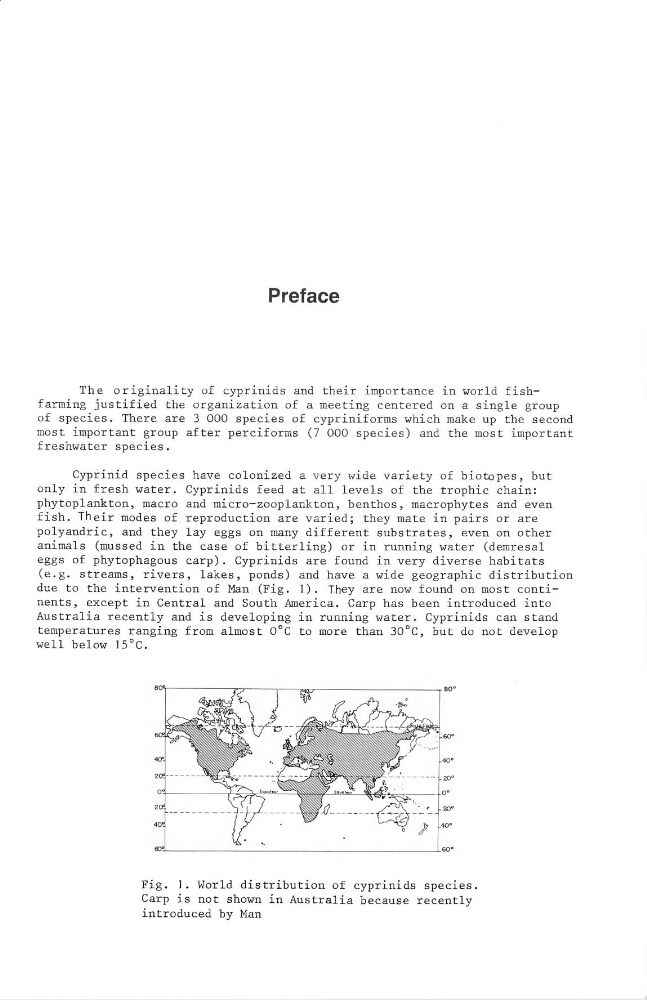
intervention of Man (Fig. 1). They are now found on most conti—
nents, except in Central and South America. Carp has been introduced into
Australia recently and is developing in running water. Cyprinids can stand
temperatures ranging from almost O°C to more than 30°C, but do not develop
well below
15°C.
80°
“__—“
“_”
@“
________
_
_____
_â________
:‘_-'_ 20°
.
_
°
Fig. 1. World distribution of cyprinids species.
Carp is not shown in Australia because recently
introduced by Man
The
of
species. There are 3 000 species of cypriniforms which make up the second
most
important group after perciforms (7 000 species) and the most important
freshwater species.
Cyprinid species have colonized a very wide variety of biotopes, but
only in fresh water. Cyprinids feed at all levels of the trophic chain:
phytoplankton, macro and micro—zooplankton, benthos, macrophytes and even
fish. Their modes of reproduction are varied; they mate in pairs or are
polyandric, and they lay eggs on many different substrates, even on other
animals
(mussed in the case of bitterling) or in running water (demresal
eggs of phytophagous carp). Cyprinids are found in very diverse habitats
(e.g. streams, rivers, 1akes, ponds) and have a wide geographic distribution
due to
the
intervention of Man (Fig. 1). They are now found on most conti—
nents, except in Central and South America. Carp has been introduced into
Australia recently and is developing in running water. Cyprinids can stand
temperatures ranging from almost O°C to more than 30°C, but do not develop
well below
15°C.
80°
“__—“
“_”
@“
________
_
_____
_â________
:‘_-'_ 20°
.
_
°
Fig. 1. World distribution of cyprinids species.
Carp is not shown in Australia because recently
introduced by Man