

60
K. Dabrowski et al.
—f Ë
Other
than these vitamins, carp has shown thiamin deficiency symptoms
r
only when fed a high carbohydrate diet or diet containing an antithiamin
f
(Aoe et al.
1969). Dietary requirements of folio acid, vitamin B 12, D and
'
K have not been established yet, but some of these vitamins can be syntheti—
zed by intestinal microflora in carp and other freshwater fish (Lowell and
2
Linsuwam, 1982). Essentiality of supplemental ascorbic acid in carp is still
controversial because of the ability to synthetize ascorbic acid from D—
glucose and D—glucuronolactone (Ikeda and Sato, 1966). Sato et al. (1978)
conducted feeding trials for 24 and 84 weeks using fish of 0.25 and 35 g, res—
Î
pectively. They concluded from these studies, that ascorbic acid is not es—
sential in the diet of carp.
In other
cyprinid fish, Cirrhina mrigala avita—
minosis C was induced in 240 days experiment. Retarded growth ääâ high morta—
lity was accompanied by vertebrae deformations, lordosis and scoliosis and
Î
hematopathological changes (Agrawal and Mahajan, 1980). An optimum require—
:
ment
of
ascorbic acid for this Indian carp was established to be 650—750 mg/
kg diet (Mahajan and Agrawal, 1980).
C.
Mineral requirements
In freshwater fish are provided with certain minerals by direct absor—
ption through the gills and skin. For instance, dietary Ca requirement of
carp
appear to be none if the water contain C at a level of
14—20 ppm (Ogine
and Takeda,
1976). Quantitative requirements of minerals has to be considered
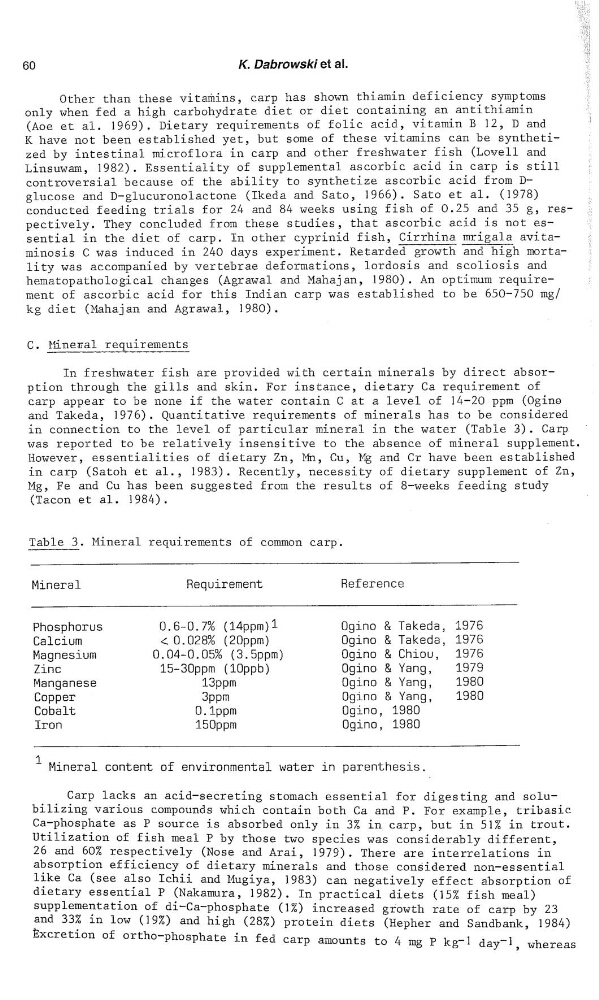
in connection to the level of particular mineral in the water (Table 3). Carp
'
was
reported to be relatively insensitive to the absence of mineral supplement.
However, essentialities of dietary Zn, mn, Cu, Mg and Cr have been established
in carp
(Satoh et al., 1983). Recently, necessity of dietary supplement of Zn,
Mg, Fe and Cu has been suggested from.the results of 8—weeks feeding study
(Tacon et al. 1984).
Table 3. Mineral requirements of common carp.
Mineral
Requirement
Reference
Phosphorus
0.5—0.7% (14ppm)1
Ogino & Takeda, 1976
Calcium
< 0.028% (20ppm)
Ogino & Takeda, 1976
Magnesium
0.04—0.05% (3.5ppm)
Ogino & Chiou,
1976
Zinc
15—30ppm (10ppb)
Ogino & Yang,
1979
Manganese
13ppm
Ogino & Yang,
1980
Copper
3ppm
Ogino & Yang,
1980
Cobalt
0.1ppm
Dgino, 1980
Iron
150ppm
Ogino, 1980
1
Mineral content of environmental water in parenthesis.
Carp lacks an acid—secreting stomach essential for digesting and solu—
bilizing various compounds which contain both Ca and P. For example, tribasic
Ca—phosphate as P source is absorbed only in 3% in carp, but in 51% in trout.
Utilization of fish meal P by those two species was considerably different,
26 and 60% respectivèly (Nose and Arai, 1979). There are interrelations in
absorption efficiency of dietary minerals and those considered non—essential
like
Ca
(see also
Ichii and Mugiya, 1983) can negatively effect absorption of
dietary essential
P
(Nakamura, 1982). In practical diets (15% fish meal)
supplementat10n
of di—Ca—phosphate (1%) increased growth rate of carp by 23
Ënd 33%
in
low (19%) and high (28%) protein diets (Hepher and Sandbank, 1984)
XCÏEt10n °Î °Ïth0“Phosphate in fed carp amounts to 4 mg P kg“1 day—1, whereas
K. Dabrowski et al.
—f Ë
Other
than these vitamins, carp has shown thiamin deficiency symptoms
r
only when fed a high carbohydrate diet or diet containing an antithiamin
f
(Aoe et al.
1969). Dietary requirements of folio acid, vitamin B 12, D and
'
K have not been established yet, but some of these vitamins can be syntheti—
zed by intestinal microflora in carp and other freshwater fish (Lowell and
2
Linsuwam, 1982). Essentiality of supplemental ascorbic acid in carp is still
controversial because of the ability to synthetize ascorbic acid from D—
glucose and D—glucuronolactone (Ikeda and Sato, 1966). Sato et al. (1978)
conducted feeding trials for 24 and 84 weeks using fish of 0.25 and 35 g, res—
Î
pectively. They concluded from these studies, that ascorbic acid is not es—
sential in the diet of carp.
In other
cyprinid fish, Cirrhina mrigala avita—
minosis C was induced in 240 days experiment. Retarded growth ääâ high morta—
lity was accompanied by vertebrae deformations, lordosis and scoliosis and
Î
hematopathological changes (Agrawal and Mahajan, 1980). An optimum require—
:
ment
of
ascorbic acid for this Indian carp was established to be 650—750 mg/
kg diet (Mahajan and Agrawal, 1980).
C.
Mineral requirements
In freshwater fish are provided with certain minerals by direct absor—
ption through the gills and skin. For instance, dietary Ca requirement of
carp
appear to be none if the water contain C at a level of
14—20 ppm (Ogine
and Takeda,
1976). Quantitative requirements of minerals has to be considered
in connection to the level of particular mineral in the water (Table 3). Carp
'
was
reported to be relatively insensitive to the absence of mineral supplement.
However, essentialities of dietary Zn, mn, Cu, Mg and Cr have been established
in carp
(Satoh et al., 1983). Recently, necessity of dietary supplement of Zn,
Mg, Fe and Cu has been suggested from.the results of 8—weeks feeding study
(Tacon et al. 1984).
Table 3. Mineral requirements of common carp.
Mineral
Requirement
Reference
Phosphorus
0.5—0.7% (14ppm)1
Ogino & Takeda, 1976
Calcium
< 0.028% (20ppm)
Ogino & Takeda, 1976
Magnesium
0.04—0.05% (3.5ppm)
Ogino & Chiou,
1976
Zinc
15—30ppm (10ppb)
Ogino & Yang,
1979
Manganese
13ppm
Ogino & Yang,
1980
Copper
3ppm
Ogino & Yang,
1980
Cobalt
0.1ppm
Dgino, 1980
Iron
150ppm
Ogino, 1980
1
Mineral content of environmental water in parenthesis.
Carp lacks an acid—secreting stomach essential for digesting and solu—
bilizing various compounds which contain both Ca and P. For example, tribasic
Ca—phosphate as P source is absorbed only in 3% in carp, but in 51% in trout.
Utilization of fish meal P by those two species was considerably different,
26 and 60% respectivèly (Nose and Arai, 1979). There are interrelations in
absorption efficiency of dietary minerals and those considered non—essential
like
Ca
(see also
Ichii and Mugiya, 1983) can negatively effect absorption of
dietary essential
P
(Nakamura, 1982). In practical diets (15% fish meal)
supplementat10n
of di—Ca—phosphate (1%) increased growth rate of carp by 23
Ënd 33%
in
low (19%) and high (28%) protein diets (Hepher and Sandbank, 1984)
XCÏEt10n °Î °Ïth0“Phosphate in fed carp amounts to 4 mg P kg“1 day—1, whereas