

468
R. Berka
INTRODUCTION
Carp is the most consumed freshwater fish species in the world and, due
to
its high nutritive value, it will play an even more important role in diets
in the
future.
Large quantities of carp are consumed fresh but industrial
processing has given this fish a new image by preserving its freshness (for
example by freezing) and offering healthy odourless and easy to prepare
products. The processing of carp, which opens new markets and enlarges the
present demands, is a new progressive development. The basic aspects of carp
processing are presented in this review.
I.
CHARACTERISÎÏCS OF CARP AS A RAW MATERIAL
The weight composition of carp has been studied by Hamackova (1973),
Svehla
(1974), Steffens (1974) and reviewed by Zaitsev et al. (1969). It has
been demonstrated that weight composition varies little according to sex, age,
strain or rearing conditions. The edible parts of carp, i.e. the body muscles
(usually with skin) and the edible internal organs (primarily gonads), consti—
tute
from 58 to 66 % of the total weight. The Czechoslovak standard assign
an
utility value (muscles + gonads) of 59 % for carp weighing less than 1 kg,
66 % for carp > 1 kg of weight (Svehla, 1974). These values are relevant for
industrial carp processing and have been confirmed by Hamackova (1973).
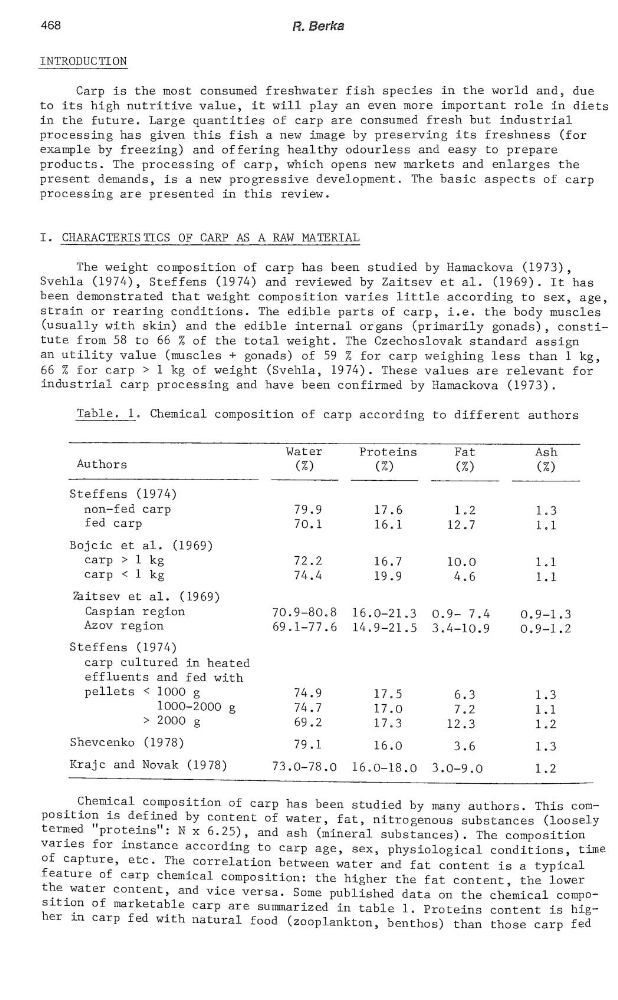
Table.
1.
Chemical composition of carp according to different authors
Water
Proteins
Fat
Ash
Authors
(Z)
(Z)
(Z)
(Z)
Steffens
(1974)
non—fed carp
79.9
17.6
1.2
1.3
fed carp
70.1
16.1
12.7
1.1
Bojcic et al.
(1969)
carp
>
1 kg
72.2
16.7
10.0
1.1
carp
<
1 kg
74.4
19.9
4.6
1.1
Zaitsev et al.
(1969)
Caspian region
70.9—80.8
16.0—21.3
0.9— 7.4
0.9—1.3
Azov region
69.1—77.6
14.9—21.5
3.4—10.9
0.9—1.2
Steffens
(1974)
carp cultured in heated
effluents and fed with
pellets < 1000 g
74.9
17.5
6.3
1.3
1000—2000 g
74.7
17.0
7.2
1.1
>
2000 g
69.2
17.3
12.3
1.2
Shevcenko
(1978)
79.1
16.0
3.6
1.3
Krajc and Novak (1978)
73.0—78.0
16.0—18.0
3.0—9.0
1.2
_______________________________________________________________________
0hemical composition
of carp has been studied by many authors. This com—
p081t10n
is
defined by content of water, fat, nitrogenous substances (loosely
termed proteins
:
N X 6.25), and ash (mineral substances). The composition
varies
for instance according to carp age, sex, phySiological conditions, time
of capture, etc. The correlation between water and fat content is a typical
feature of carp chemical composition: the higher the fat content, the lower
water
content, and vice versa. Some published data on the chemical compoSition
of marketable carp are summarized in table 1. Proteins content is hig—
her
1n
carp fed With natural food
(zooplankton, benthos) than those carp fed
R. Berka
INTRODUCTION
Carp is the most consumed freshwater fish species in the world and, due
to
its high nutritive value, it will play an even more important role in diets
in the
future.
Large quantities of carp are consumed fresh but industrial
processing has given this fish a new image by preserving its freshness (for
example by freezing) and offering healthy odourless and easy to prepare
products. The processing of carp, which opens new markets and enlarges the
present demands, is a new progressive development. The basic aspects of carp
processing are presented in this review.
I.
CHARACTERISÎÏCS OF CARP AS A RAW MATERIAL
The weight composition of carp has been studied by Hamackova (1973),
Svehla
(1974), Steffens (1974) and reviewed by Zaitsev et al. (1969). It has
been demonstrated that weight composition varies little according to sex, age,
strain or rearing conditions. The edible parts of carp, i.e. the body muscles
(usually with skin) and the edible internal organs (primarily gonads), consti—
tute
from 58 to 66 % of the total weight. The Czechoslovak standard assign
an
utility value (muscles + gonads) of 59 % for carp weighing less than 1 kg,
66 % for carp > 1 kg of weight (Svehla, 1974). These values are relevant for
industrial carp processing and have been confirmed by Hamackova (1973).
Table.
1.
Chemical composition of carp according to different authors
Water
Proteins
Fat
Ash
Authors
(Z)
(Z)
(Z)
(Z)
Steffens
(1974)
non—fed carp
79.9
17.6
1.2
1.3
fed carp
70.1
16.1
12.7
1.1
Bojcic et al.
(1969)
carp
>
1 kg
72.2
16.7
10.0
1.1
carp
<
1 kg
74.4
19.9
4.6
1.1
Zaitsev et al.
(1969)
Caspian region
70.9—80.8
16.0—21.3
0.9— 7.4
0.9—1.3
Azov region
69.1—77.6
14.9—21.5
3.4—10.9
0.9—1.2
Steffens
(1974)
carp cultured in heated
effluents and fed with
pellets < 1000 g
74.9
17.5
6.3
1.3
1000—2000 g
74.7
17.0
7.2
1.1
>
2000 g
69.2
17.3
12.3
1.2
Shevcenko
(1978)
79.1
16.0
3.6
1.3
Krajc and Novak (1978)
73.0—78.0
16.0—18.0
3.0—9.0
1.2
_______________________________________________________________________
0hemical composition
of carp has been studied by many authors. This com—
p081t10n
is
defined by content of water, fat, nitrogenous substances (loosely
termed proteins
:
N X 6.25), and ash (mineral substances). The composition
varies
for instance according to carp age, sex, phySiological conditions, time
of capture, etc. The correlation between water and fat content is a typical
feature of carp chemical composition: the higher the fat content, the lower
water
content, and vice versa. Some published data on the chemical compoSition
of marketable carp are summarized in table 1. Proteins content is hig—
her
1n
carp fed With natural food
(zooplankton, benthos) than those carp fed