

298
J.Cah
Optimal manüring rate is the highest amount oforganicnætter
processable in a
pond ecosystem without causing an adverse environmental effect on fish growth
This
rate
was
established
in
a
number
of
experiments
using a proper
Stocking structure and the density discussed above. To collect the data on
these
experiments
carried
out
in
different
countries
with
various
manuring
rates
and
animal
manures,
&
number of conversion
factors
were
elaborated.
The
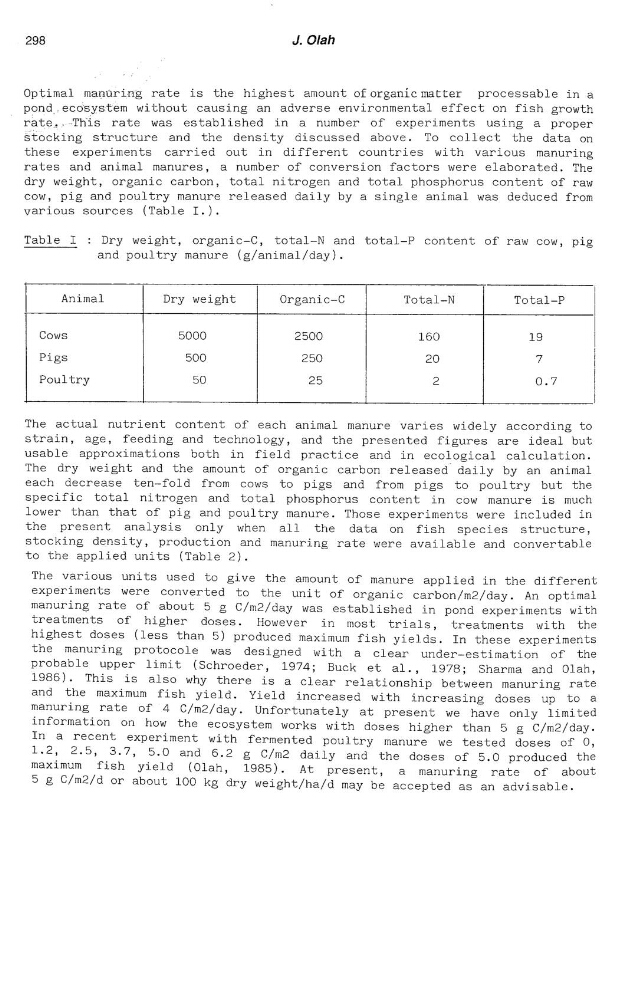
dry weight, organic carbon, total nitrogen and total phosphorus content of raw
cow,
pig and poultry manure released daily by a single animal was deduced from
various sources
(Table I.).
Table
1
:
Dry weight,
organic—C,
total—N
and
total—P
content
of raw cow,
pig
and poultry manure (g/animal/day).
Animal
Dry weight
Organic—C
Total—N
Total—P
‘
Cows
5000
2500
160
19
{
Pigs
500
250
20
7
Poultry
50
25
2
0.7
(
The
actual
nutrient
content
of
each
animal
manure
varies
widely according to
strain,
age,
feeding and technology,
and
the
presented figures are ideal but
usable
approximations
both
in
field
practice
and
in
ecological calculation.
The
dry
weight and the amount of organic carbon released daily by an animal
each
decrease
ten—fold
from
cows
to
pigs
and
from
pigs
to
poultry but the
specific
total
nitrogen and total
phosphorus
content
in
cow
manure
is
much
lower
than
that
of
pig and poultry manure. Those experiments were included in
the
present
analysis
only
when
all
the
data
on
fish
species
structure,
stocking density,
production and manuring rate were available and convertable
to
the
applied units (Table 2).
The
various
units
used
to
give the amount of manure applied in the different
experiments
were
converted
to
the
unit
of
organic carbon/m2/day. An optimal
manuring rate of about 5 g C/m2/day was established in pond experiments with
treatments
of
higher
doses.
However
in
most
trials,
treatments
with
the
highest doses (less than 5) produced maximum fish yields.
In
these
experiments
the
manuring
protocole
was
designed
with.
a
clear
under—estimation
of
the
probable
upper
limit
(Schroeder,
1974;
Buck
et
al.,
1978;
Sharma
and
Olah,
1986).
This
is
also
why there is a clear relationship between manuring rate
and
the
maximum
fish
yield.
Yield
increased
with
increasing doses up
t0
a
manuring
rate
Of
4
C/m2/day. Unfortunately at present we have only limited
information
on
how
the
ecosystem works with doses higher than 5 g C/m2/daYIn
a
recent
experiment
with
fermented
poultry manure we tested doses of 0,
2—5,
3-7,
5.0
and
6.2
g
C/m2
daily and
the
doses
of
5.0
produced the
max1mum
fish
yield
(Olah,
1985).
At
present,
a
manuring
rate
of
about
5 g C/m2/d or about 100 kg dry weight/ha/d may be accepted as an advisable.
J.Cah
Optimal manüring rate is the highest amount oforganicnætter
processable in a
pond ecosystem without causing an adverse environmental effect on fish growth
This
rate
was
established
in
a
number
of
experiments
using a proper
Stocking structure and the density discussed above. To collect the data on
these
experiments
carried
out
in
different
countries
with
various
manuring
rates
and
animal
manures,
&
number of conversion
factors
were
elaborated.
The
dry weight, organic carbon, total nitrogen and total phosphorus content of raw
cow,
pig and poultry manure released daily by a single animal was deduced from
various sources
(Table I.).
Table
1
:
Dry weight,
organic—C,
total—N
and
total—P
content
of raw cow,
pig
and poultry manure (g/animal/day).
Animal
Dry weight
Organic—C
Total—N
Total—P
‘
Cows
5000
2500
160
19
{
Pigs
500
250
20
7
Poultry
50
25
2
0.7
(
The
actual
nutrient
content
of
each
animal
manure
varies
widely according to
strain,
age,
feeding and technology,
and
the
presented figures are ideal but
usable
approximations
both
in
field
practice
and
in
ecological calculation.
The
dry
weight and the amount of organic carbon released daily by an animal
each
decrease
ten—fold
from
cows
to
pigs
and
from
pigs
to
poultry but the
specific
total
nitrogen and total
phosphorus
content
in
cow
manure
is
much
lower
than
that
of
pig and poultry manure. Those experiments were included in
the
present
analysis
only
when
all
the
data
on
fish
species
structure,
stocking density,
production and manuring rate were available and convertable
to
the
applied units (Table 2).
The
various
units
used
to
give the amount of manure applied in the different
experiments
were
converted
to
the
unit
of
organic carbon/m2/day. An optimal
manuring rate of about 5 g C/m2/day was established in pond experiments with
treatments
of
higher
doses.
However
in
most
trials,
treatments
with
the
highest doses (less than 5) produced maximum fish yields.
In
these
experiments
the
manuring
protocole
was
designed
with.
a
clear
under—estimation
of
the
probable
upper
limit
(Schroeder,
1974;
Buck
et
al.,
1978;
Sharma
and
Olah,
1986).
This
is
also
why there is a clear relationship between manuring rate
and
the
maximum
fish
yield.
Yield
increased
with
increasing doses up
t0
a
manuring
rate
Of
4
C/m2/day. Unfortunately at present we have only limited
information
on
how
the
ecosystem works with doses higher than 5 g C/m2/daYIn
a
recent
experiment
with
fermented
poultry manure we tested doses of 0,
2—5,
3-7,
5.0
and
6.2
g
C/m2
daily and
the
doses
of
5.0
produced the
max1mum
fish
yield
(Olah,
1985).
At
present,
a
manuring
rate
of
about
5 g C/m2/d or about 100 kg dry weight/ha/d may be accepted as an advisable.