

Water quaüîy
287
SEDÈ
_
,
.
VEEW
___—_—
WATER
il
—LEVEL
-
:=:
",
—
CÀTWÀLK
PLÀTFORM
I
i
|
,
]
"‘EW
[:
"
i
,
_
\
_
.
l
I
'
6fî
“
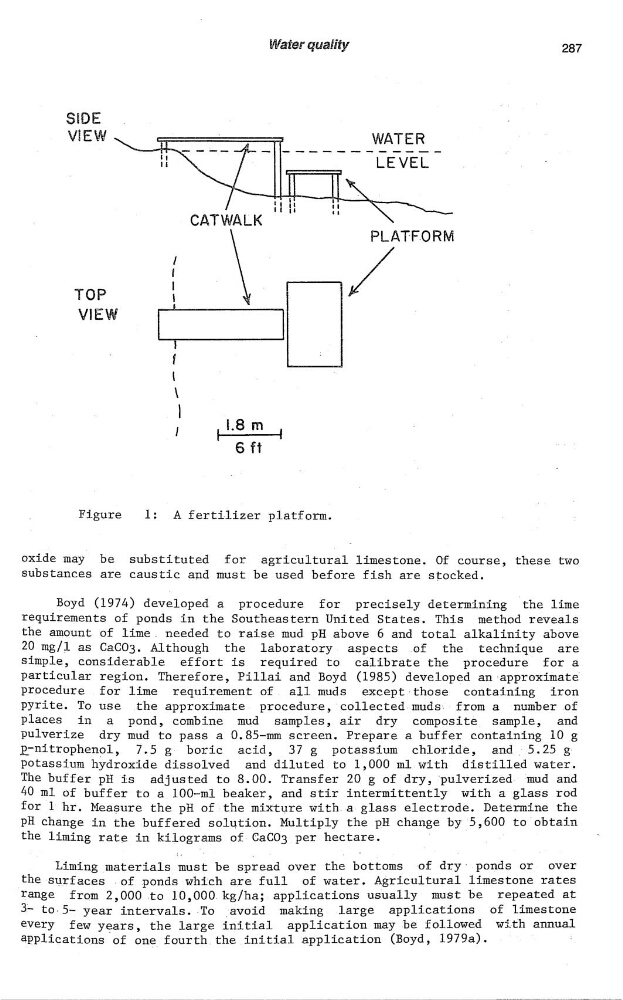
Figure
1:
A.fertilizer platform.
;
oxide may
be
substituted
for
agricultural limestone. Of course, these two
substances are caustic and must be used before fish are stocked.
Boyd (1974) developed a
procedure
for
precisely determining
lime
requirements of ponds in the Southeastern United States. This
method reveals
the amount of lime. needed to raise mud pH above 6 and total alkalinity above
20 mg/l as CaCO3. Although
the
laboratory
aspects
.of
the
technique
are
Simple, considerable
effort is
required to
calibrate the
procedure
for a
particular region. Therefore, Pillai and Boyd (1985) developed an-approximatè
procedure
for lime
requirement of
all muds
except those
containing
iron
pyrite. To use
the approximate
procedure, collected
from a
number of
places
in
a
pond, combine
mud
samples, air
dry
sample,
and
pulverize
dry mud to pass a 0.85—mm screen. Prepare & buffer containing 10 g
7.5 g
boric
acid,
37 g
potassium
chloride,
and_ 5.25 g
potassium hydroxide dissolved
and diluted to 1,000 ml with
distilled water.
The buffer pH is
adjusted to 8.00. Transfer 20 g of dry, pulverized- mud and
40 ml of buffer to a 100—m1 beaker, and stir intermittently
with a glass rod
for 1 hr. Measure the pH of the mixture With a glass electrode. Determine the
pH change in the buffered solution. Multiply the pH change by 5,600 to obtain
the liming rate in kilograms of CaCO3 per hectare.
‘
Liming materials must be spread over the bottoms
dry- ponds or
over
the Surfaces
ponds which are full
of water. Agricultural limest0ne rates
range
from
10,000 kg/ha; applications uSually
must be
repeated at
year intervals.
To
_avoid
making
large
applications
of limestone
every
few years,
the large initial
application may be followed
with annual
applications of one fourth the initial application (Boyd, 1979a).
?
287
SEDÈ
_
,
.
VEEW
___—_—
WATER
il
—LEVEL
-
:=:
",
—
CÀTWÀLK
PLÀTFORM
I
i
|
,
]
"‘EW
[:
"
i
,
_
\
_
.
l
I
'
6fî
“
Figure
1:
A.fertilizer platform.
;
oxide may
be
substituted
for
agricultural limestone. Of course, these two
substances are caustic and must be used before fish are stocked.
Boyd (1974) developed a
procedure
for
precisely determining
lime
requirements of ponds in the Southeastern United States. This
method reveals
the amount of lime. needed to raise mud pH above 6 and total alkalinity above
20 mg/l as CaCO3. Although
the
laboratory
aspects
.of
the
technique
are
Simple, considerable
effort is
required to
calibrate the
procedure
for a
particular region. Therefore, Pillai and Boyd (1985) developed an-approximatè
procedure
for lime
requirement of
all muds
except those
containing
iron
pyrite. To use
the approximate
procedure, collected
from a
number of
places
in
a
pond, combine
mud
samples, air
dry
sample,
and
pulverize
dry mud to pass a 0.85—mm screen. Prepare & buffer containing 10 g
7.5 g
boric
acid,
37 g
potassium
chloride,
and_ 5.25 g
potassium hydroxide dissolved
and diluted to 1,000 ml with
distilled water.
The buffer pH is
adjusted to 8.00. Transfer 20 g of dry, pulverized- mud and
40 ml of buffer to a 100—m1 beaker, and stir intermittently
with a glass rod
for 1 hr. Measure the pH of the mixture With a glass electrode. Determine the
pH change in the buffered solution. Multiply the pH change by 5,600 to obtain
the liming rate in kilograms of CaCO3 per hectare.
‘
Liming materials must be spread over the bottoms
dry- ponds or
over
the Surfaces
ponds which are full
of water. Agricultural limest0ne rates
range
from
10,000 kg/ha; applications uSually
must be
repeated at
year intervals.
To
_avoid
making
large
applications
of limestone
every
few years,
the large initial
application may be followed
with annual
applications of one fourth the initial application (Boyd, 1979a).
?