

Polyculz‘uæ in carp panda
273
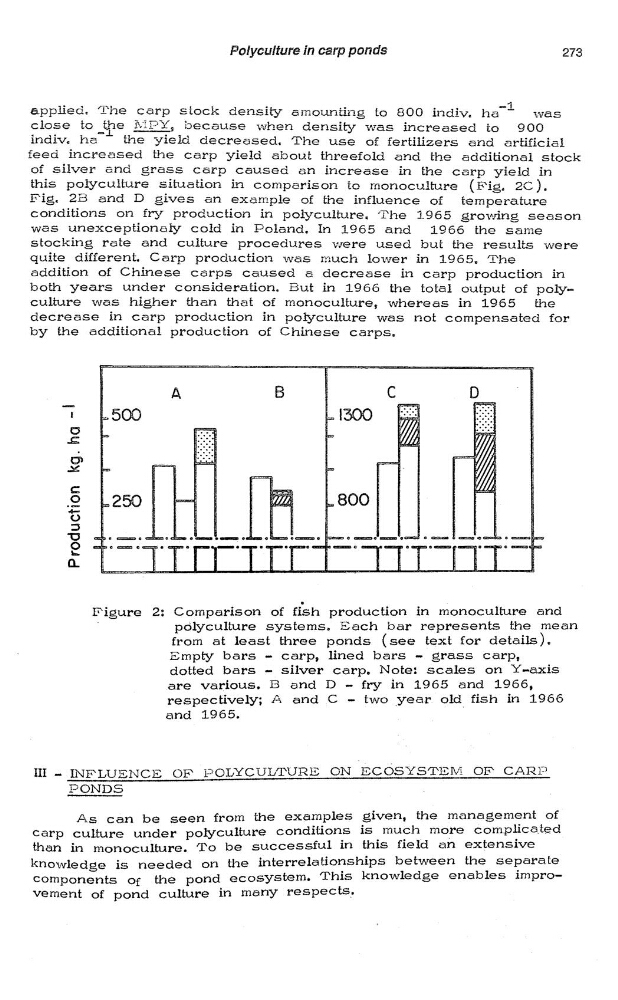
applied. The carp sîock density amounting to 800 indiv. he…1
was
close
to
lui?—Y, because when density was increased to
900
îndîv. ha
'the
“yieîc‘. decreased. The use of ferüzers and articial
feed
increased
the
carp yield about threefoîd and the addiüonai stock
of silver and grass carp caused an increase in îhe carp yield in
this
polycuäure situation in comparison to monoculïure
(Fig. 2C).
Fig. ZB and D gives an example of the inuence of
temperature
conditions
on
fry production in poîycu1ture. The 1965 growing season
was
unexceponaîy coid in Poîand. în 1965 and
1966
the
same
stocking rate and culture procedures were used buî the results were
quite different. Cern production was much lower in 1965. The
addition of Chinese
carpe
caused
a
decrease
in carp
production in
both years
under
consideration. But in 1966
the
total
output of poîy=
culture
was
higher than thaï of monocuïture, whereas in 1965
the
decrease
in
carp
production in poîyculture was not compensated for
by the additionai production of Chinese carpe.
__……._-__…_……_….
.-A
B
C
D
’
.e
W
2-800
3
.‘t
& ._.Î…: mo…-«yo …Ê...o
_.
.
....Ï.…
°—
î
Ê..-__î
' _
.
_.
Î
,_
_
…
_
..
Figure 2: Comparison of fish production in monoculture and
pôlyculture systems. Each bar represents the mean
from
at
least
three
ponds (see text for details).
'
Empty bars -— carp, 1îned bars -— grass carp,
dotted bars - silver carp. Note: scales
on
Y—axis
are
various. B and D -— £ry in 1965 and 1966,
respectively; A and C - two year old
fish in
1966
and
1965.
PONDS
As
can
be
seen
from
the
examples given, the management of
carp culture under polycu1ture
conditions is
much more compiioated
than in monocultuï‘e. To be successful in this eld an extens1ve
knowledge is needed on the interrelaüonships between the
Components of
the
pond ecosystem. This knowledge enables impro—
vement of pond culture in many resPeCt5r
273
applied. The carp sîock density amounting to 800 indiv. he…1
was
close
to
lui?—Y, because when density was increased to
900
îndîv. ha
'the
“yieîc‘. decreased. The use of ferüzers and articial
feed
increased
the
carp yield about threefoîd and the addiüonai stock
of silver and grass carp caused an increase in îhe carp yield in
this
polycuäure situation in comparison to monoculïure
(Fig. 2C).
Fig. ZB and D gives an example of the inuence of
temperature
conditions
on
fry production in poîycu1ture. The 1965 growing season
was
unexceponaîy coid in Poîand. în 1965 and
1966
the
same
stocking rate and culture procedures were used buî the results were
quite different. Cern production was much lower in 1965. The
addition of Chinese
carpe
caused
a
decrease
in carp
production in
both years
under
consideration. But in 1966
the
total
output of poîy=
culture
was
higher than thaï of monocuïture, whereas in 1965
the
decrease
in
carp
production in poîyculture was not compensated for
by the additionai production of Chinese carpe.
__……._-__…_……_….
.-A
B
C
D
’
.e
W
2-800
3
.‘t
& ._.Î…: mo…-«yo …Ê...o
_.
.
....Ï.…
°—
î
Ê..-__î
' _
.
_.
Î
,_
_
…
_
..
Figure 2: Comparison of fish production in monoculture and
pôlyculture systems. Each bar represents the mean
from
at
least
three
ponds (see text for details).
'
Empty bars -— carp, 1îned bars -— grass carp,
dotted bars - silver carp. Note: scales
on
Y—axis
are
various. B and D -— £ry in 1965 and 1966,
respectively; A and C - two year old
fish in
1966
and
1965.
PONDS
As
can
be
seen
from
the
examples given, the management of
carp culture under polycu1ture
conditions is
much more compiioated
than in monocultuï‘e. To be successful in this eld an extens1ve
knowledge is needed on the interrelaüonships between the
Components of
the
pond ecosystem. This knowledge enables impro—
vement of pond culture in many resPeCt5r