

Larva! nutritionai physioiagy
221
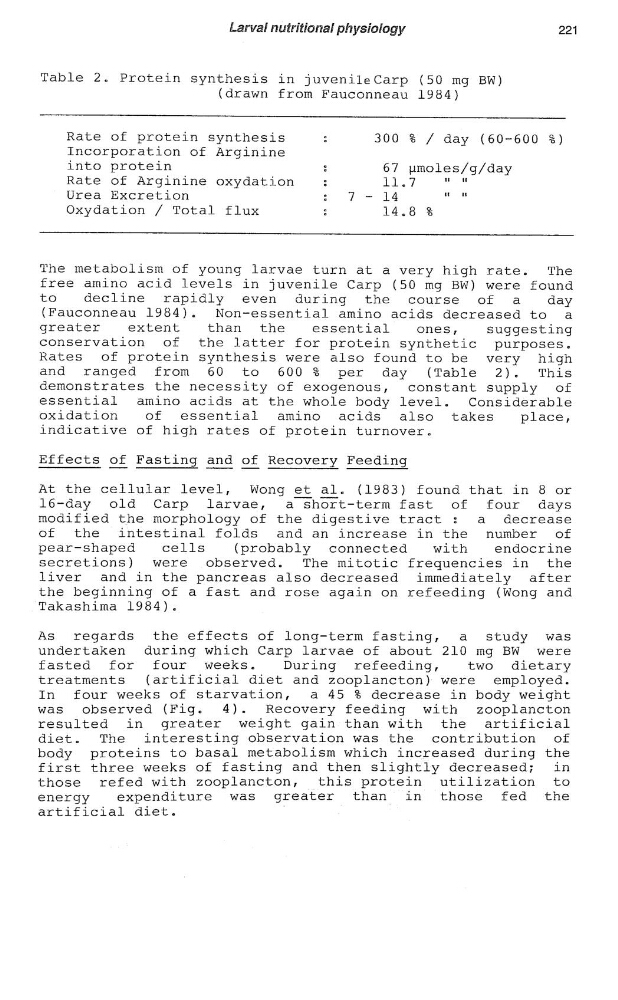
Table
2.:
Protein
synthesis in juvenileCarp (50 mg BW)
(drawn from Fauconneau 1984)
…_…_________________________________________________________
Rate
of
protein synthesis
:
300
%
/ day (60—600 %)
Incorporation of Arginine
into protein
:
67
umoles/g/day
Rate
of
Arginine oxydation
:
11.7
"
"
Urea
Excretion
:
7
—
14
"
"
Oxydation / Total flux
:
14…8
%
_____________________________________________________________
The
metabolism of
young
larvae
turn
at
a
very high rate.
The
free
amino
acid levels
in
juvenile Carp (50 mg BW) were found
to
decline
rapidly
even
during
the
course
of
a
day
(Fauconneau 1984)c
Non—essential
amino
acids
decreased to
a
greater
extent
than
the
essential
ones,
suggesting
conservation
of
the
latter
for
protein synthetic
purposes.
Rates
of
protein synthesis were also found to be
very
high
and
ranged
from
60
to
600
%
per
day
(Table
2)°
This
demonstrates
the
necessity of exogenous,
constant
supply
of
essential
amino
acids
at
the
whole
body level.
Considerable
oxidation
of
essential
amino
acids
also
takes
place,
indicative
of
high rates of protein
Effects
of Fasting and of Recovery Feeding
At
the
cellular
level,
Wong et al.
(1983)
found that
in
8
or
16—day
old
Carp
larvae,
a—EhBÎt—term fast
of
four
days
modified the morphology of the digestive tract :
a
decrease
of
the
intestinal
folds
and
an
increase
in
the
number
of
pear—shaped
cells
(probably
connected
with
endocrine
secretions)
were
observed°
The
mitotic
frequencies in
the
liver
and
in
the
pancreas
also
decreased
immediately
after
the
beginning of a fast and rose again on refeeding (Wong and
1984)"
As
regards
the
effects
of
long—term fasting,
a
study
was
undertaken
during which Carp larvae of about 210 mg BW
were
fasted
for
four
weeks°
During
refeeding,
two
dietary
treatments
(artificial diet and zooplancton) were
employed.
In
four weeks
of
starvation,
a
45
%
decrease
in body weight
was
observed
(Fig°
4)=
Recovery feeding
with
zooplancton
resulted
in
greater
weight gain than with
the
artificial
diet.
The
interesting observation was the
contribution
of
body
proteins to basal metabolism which increased during the
first
three
weeks
of
fasting and then slightly decreased;
in
those
refed with
zooplancton,
this protein
utilization
to
energy
expenditure
was
than
in
those
fed
the
artificial
diet.
221
Table
2.:
Protein
synthesis in juvenileCarp (50 mg BW)
(drawn from Fauconneau 1984)
…_…_________________________________________________________
Rate
of
protein synthesis
:
300
%
/ day (60—600 %)
Incorporation of Arginine
into protein
:
67
umoles/g/day
Rate
of
Arginine oxydation
:
11.7
"
"
Urea
Excretion
:
7
—
14
"
"
Oxydation / Total flux
:
14…8
%
_____________________________________________________________
The
metabolism of
young
larvae
turn
at
a
very high rate.
The
free
amino
acid levels
in
juvenile Carp (50 mg BW) were found
to
decline
rapidly
even
during
the
course
of
a
day
(Fauconneau 1984)c
Non—essential
amino
acids
decreased to
a
greater
extent
than
the
essential
ones,
suggesting
conservation
of
the
latter
for
protein synthetic
purposes.
Rates
of
protein synthesis were also found to be
very
high
and
ranged
from
60
to
600
%
per
day
(Table
2)°
This
demonstrates
the
necessity of exogenous,
constant
supply
of
essential
amino
acids
at
the
whole
body level.
Considerable
oxidation
of
essential
amino
acids
also
takes
place,
indicative
of
high rates of protein
Effects
of Fasting and of Recovery Feeding
At
the
cellular
level,
Wong et al.
(1983)
found that
in
8
or
16—day
old
Carp
larvae,
a—EhBÎt—term fast
of
four
days
modified the morphology of the digestive tract :
a
decrease
of
the
intestinal
folds
and
an
increase
in
the
number
of
pear—shaped
cells
(probably
connected
with
endocrine
secretions)
were
observed°
The
mitotic
frequencies in
the
liver
and
in
the
pancreas
also
decreased
immediately
after
the
beginning of a fast and rose again on refeeding (Wong and
1984)"
As
regards
the
effects
of
long—term fasting,
a
study
was
undertaken
during which Carp larvae of about 210 mg BW
were
fasted
for
four
weeks°
During
refeeding,
two
dietary
treatments
(artificial diet and zooplancton) were
employed.
In
four weeks
of
starvation,
a
45
%
decrease
in body weight
was
observed
(Fig°
4)=
Recovery feeding
with
zooplancton
resulted
in
greater
weight gain than with
the
artificial
diet.
The
interesting observation was the
contribution
of
body
proteins to basal metabolism which increased during the
first
three
weeks
of
fasting and then slightly decreased;
in
those
refed with
zooplancton,
this protein
utilization
to
energy
expenditure
was
than
in
those
fed
the
artificial
diet.