

Larva! nuîrionai physiaiogy
219
In
the
adult
Carp,
the
distribution pattern of activities of
digestive enzymes coincide with substrate availability during
the
course
Of
transit
of
nutrients
(Fraisse et al.:
In
the
larval
Carp,
as
in
all
teleosts,
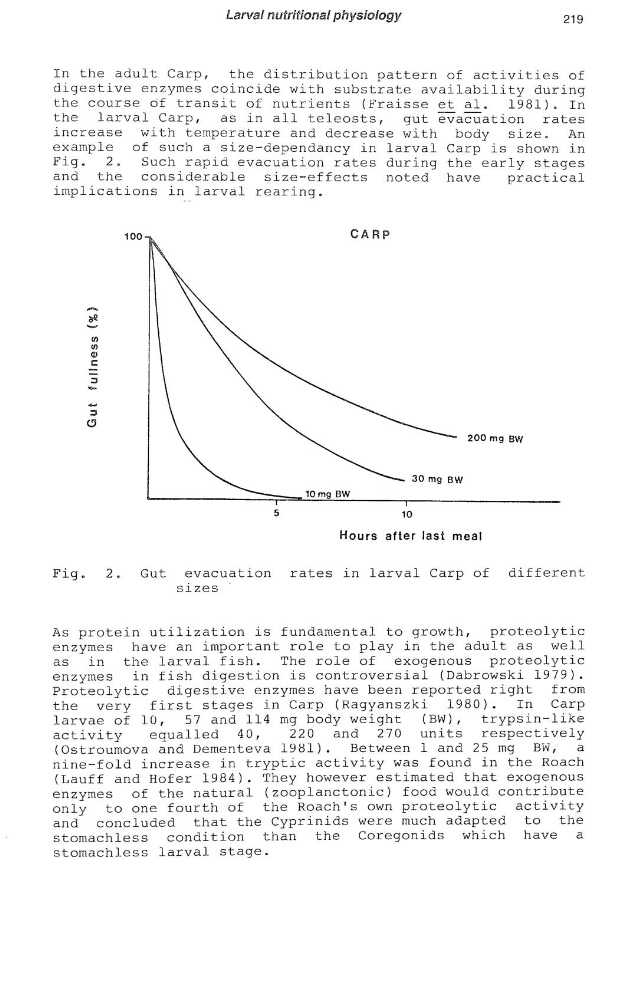
gut evaËation
rates
increase
with
temperature and decrease with
body
size°
An
of
such
a
size—dependancy in larval Carp is shown in
Fig.
2°
Such
rapid evacuation rates during the early stages
and
the
considerable
size—effects
noted
have
practical
implications in larval rearing°
CARP
33
_
03
U)
@
E
.
3
É
(5
'
—
‘
200 mg BW
‘
-
30n@ BW
10mg BW
5
10
Hours aerlastrneal
Fig°
2.
Gut
evacuation
rates
in
larval
Carp of
different
sizes'
As
protein utilization is fundamental to growth,
proteolytic
enzymes
have
an
important role to play in the adult as
well
as
in
the
larval
fish.
The
role
of
exogenous
proteolytic
enzymes
in
fish
digestion is controversial (Dabrowski 1979).
Proteolytic
digestive enzymes have been reported right
from
the
very
first
stages
in Carp
(Ragyanszki
1980).
In
Carp
larvae
of
10,
57
and
114
mg
body weight
(BW),
trypsin—like
activity
equalled
40,
220
and
270
units
respectively
(Ostroumova and Dementeva l98l).
Between
1
and
25
mg
BW,
a
nine—fold
increase
in
tryptic activity was found in the Roach
(Lauff and Hofer 1984).
They however estimated that exogenous
enzymes
of
the
natural
(zooplanctonic) food would contribute
only
to
one
fourth
of
the
Roach's
own
proteolytic
activity
and
concluded
that
the
Cyprinids were much adapted
to
the
'
stomachless
condition
than
the
Coregonids
which
have
a
stomachless
larval
stage.
219
In
the
adult
Carp,
the
distribution pattern of activities of
digestive enzymes coincide with substrate availability during
the
course
Of
transit
of
nutrients
(Fraisse et al.:
In
the
larval
Carp,
as
in
all
teleosts,
gut evaËation
rates
increase
with
temperature and decrease with
body
size°
An
of
such
a
size—dependancy in larval Carp is shown in
Fig.
2°
Such
rapid evacuation rates during the early stages
and
the
considerable
size—effects
noted
have
practical
implications in larval rearing°
CARP
33
_
03
U)
@
E
.
3
É
(5
'
—
‘
200 mg BW
‘
-
30n@ BW
10mg BW
5
10
Hours aerlastrneal
Fig°
2.
Gut
evacuation
rates
in
larval
Carp of
different
sizes'
As
protein utilization is fundamental to growth,
proteolytic
enzymes
have
an
important role to play in the adult as
well
as
in
the
larval
fish.
The
role
of
exogenous
proteolytic
enzymes
in
fish
digestion is controversial (Dabrowski 1979).
Proteolytic
digestive enzymes have been reported right
from
the
very
first
stages
in Carp
(Ragyanszki
1980).
In
Carp
larvae
of
10,
57
and
114
mg
body weight
(BW),
trypsin—like
activity
equalled
40,
220
and
270
units
respectively
(Ostroumova and Dementeva l98l).
Between
1
and
25
mg
BW,
a
nine—fold
increase
in
tryptic activity was found in the Roach
(Lauff and Hofer 1984).
They however estimated that exogenous
enzymes
of
the
natural
(zooplanctonic) food would contribute
only
to
one
fourth
of
the
Roach's
own
proteolytic
activity
and
concluded
that
the
Cyprinids were much adapted
to
the
'
stomachless
condition
than
the
Coregonids
which
have
a
stomachless
larval
stage.