

Worldwide siaîus of cane sulfure
23
ingest much phytoplankton,
but
if
not
utilized
efficiently then
this is merely
clearance
of
a
food
source,
which
a
more
tru1y
omnivorous
fish
(like
a
microphagous tilapia, with acid
secreting
stomach) c0uld use.
The bighead eats
macro-zooplankton.
Most introductions have been successful, since it is easy
to
breed.
Silver carp and bighead probably have limited potential for pellet feeding.
Their main drawbacks, however, are soft bony esh and poor keeping qualities.
Cirrhinus molitorella, the mud carp,
is native to China and is a benthic om nivore
with good cold tolerance. lt does not create very turbid conditions. The black (or
snail) carp, Mylopharyngodon piceus, feeds on molluscs.
Both species are used in
Chinese polyculture.
The Indian major carps, like the Chinese carps, will not reproduce in standing
waters.
Seed
is
obtained
from rivers,
by 'bund spawning'
(an
artificial
spawning
channel
during reins) or induced spawning by injection.
The
rohu
is
superb for pond culture
and grows well (675 to 900g/yr) even in
badly—managed,
weed—infested
ponds.
It is hardy, easily
bred and is attracting interest outside
the
Indian subcontinent.
It is probably
a
good species
for intensive as well as
waste—fed
pond
culture.
The
mrigal
grows well
in
ponds with
rich
benthic
detritus.
Catla
grows
well
in
manured ponds with dense zooplankton, usually
faster than rohu and mrigal. Das et al. (1973) record first year growths for cat1a,
l.£+kg; rohu,
0.85kg:
mrigal, 1.0kg and
silver
carp, 0.92kg. The large head
of
catla
is
a
positive sales
feature in some
Asian markets, but probably negative
elsewhere.
Most
catla
introductions
Outside
the
subcontinent
have
been
unsuccessful since broodstock often fail to mature.
They appear to require more
space than other carps. The only other cultured species of note is Labeo calbasu,
a
benthic
feeder like
mrigal.
The potential of
the
Indian
major
carps
for
intensive aquaculture is not known.
There are
FAO synopses
of data for catla,
(Jhingran, 1966), mrigal (Jhingran and Khan, 1979) and rohu (Khan and Jhingran,
1975).
.
H—
THE STATUS
OF
CAR?
CULTURE
A -
Global statistics
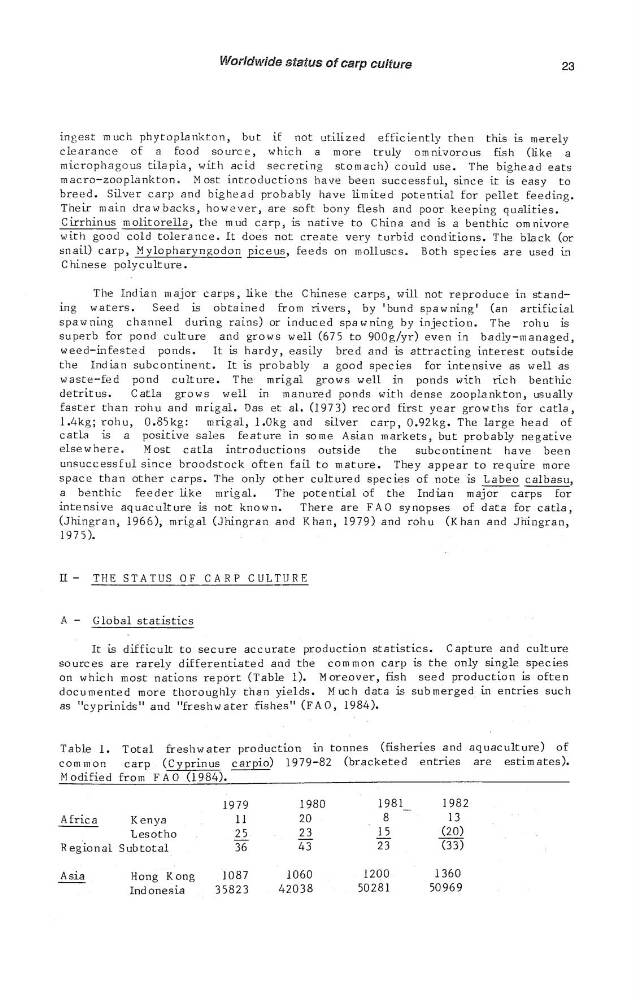
It is difficult to secure accurate production statistics.
Capture and culture
sources
are
rarely differentiated and the
common
carp is the only single species
on
which most nations report (Table 1).
Moreover, fish
seed production is often
documented more thor0ughly than yields.
Much data is submerged in entries such
as
”cyprinids" and "freshwater .fishes" (FAO, 1984).
Table 1.
Total
freshwater production in tonnes
(fisheries and aquaculture)
of
common
carp
(Cyprinus carpio) 1979-82 (bracketed entries 3T€ estimates).
1979
1980
1981_
1982
Africa
Kenya
11
20
8
13
_
Lesotho
25
2_3_
_1_Ë
292
Regional Subtotal
ÎË
43
23
(33)
Asia
Hong Kong
1087
1060
1200
1360
_
Indonesia
35823
42038
50281
50969
23
ingest much phytoplankton,
but
if
not
utilized
efficiently then
this is merely
clearance
of
a
food
source,
which
a
more
tru1y
omnivorous
fish
(like
a
microphagous tilapia, with acid
secreting
stomach) c0uld use.
The bighead eats
macro-zooplankton.
Most introductions have been successful, since it is easy
to
breed.
Silver carp and bighead probably have limited potential for pellet feeding.
Their main drawbacks, however, are soft bony esh and poor keeping qualities.
Cirrhinus molitorella, the mud carp,
is native to China and is a benthic om nivore
with good cold tolerance. lt does not create very turbid conditions. The black (or
snail) carp, Mylopharyngodon piceus, feeds on molluscs.
Both species are used in
Chinese polyculture.
The Indian major carps, like the Chinese carps, will not reproduce in standing
waters.
Seed
is
obtained
from rivers,
by 'bund spawning'
(an
artificial
spawning
channel
during reins) or induced spawning by injection.
The
rohu
is
superb for pond culture
and grows well (675 to 900g/yr) even in
badly—managed,
weed—infested
ponds.
It is hardy, easily
bred and is attracting interest outside
the
Indian subcontinent.
It is probably
a
good species
for intensive as well as
waste—fed
pond
culture.
The
mrigal
grows well
in
ponds with
rich
benthic
detritus.
Catla
grows
well
in
manured ponds with dense zooplankton, usually
faster than rohu and mrigal. Das et al. (1973) record first year growths for cat1a,
l.£+kg; rohu,
0.85kg:
mrigal, 1.0kg and
silver
carp, 0.92kg. The large head
of
catla
is
a
positive sales
feature in some
Asian markets, but probably negative
elsewhere.
Most
catla
introductions
Outside
the
subcontinent
have
been
unsuccessful since broodstock often fail to mature.
They appear to require more
space than other carps. The only other cultured species of note is Labeo calbasu,
a
benthic
feeder like
mrigal.
The potential of
the
Indian
major
carps
for
intensive aquaculture is not known.
There are
FAO synopses
of data for catla,
(Jhingran, 1966), mrigal (Jhingran and Khan, 1979) and rohu (Khan and Jhingran,
1975).
.
H—
THE STATUS
OF
CAR?
CULTURE
A -
Global statistics
It is difficult to secure accurate production statistics.
Capture and culture
sources
are
rarely differentiated and the
common
carp is the only single species
on
which most nations report (Table 1).
Moreover, fish
seed production is often
documented more thor0ughly than yields.
Much data is submerged in entries such
as
”cyprinids" and "freshwater .fishes" (FAO, 1984).
Table 1.
Total
freshwater production in tonnes
(fisheries and aquaculture)
of
common
carp
(Cyprinus carpio) 1979-82 (bracketed entries 3T€ estimates).
1979
1980
1981_
1982
Africa
Kenya
11
20
8
13
_
Lesotho
25
2_3_
_1_Ë
292
Regional Subtotal
ÎË
43
23
(33)
Asia
Hong Kong
1087
1060
1200
1360
_
Indonesia
35823
42038
50281
50969