

616 H Generalized Hammer projection
(iii)
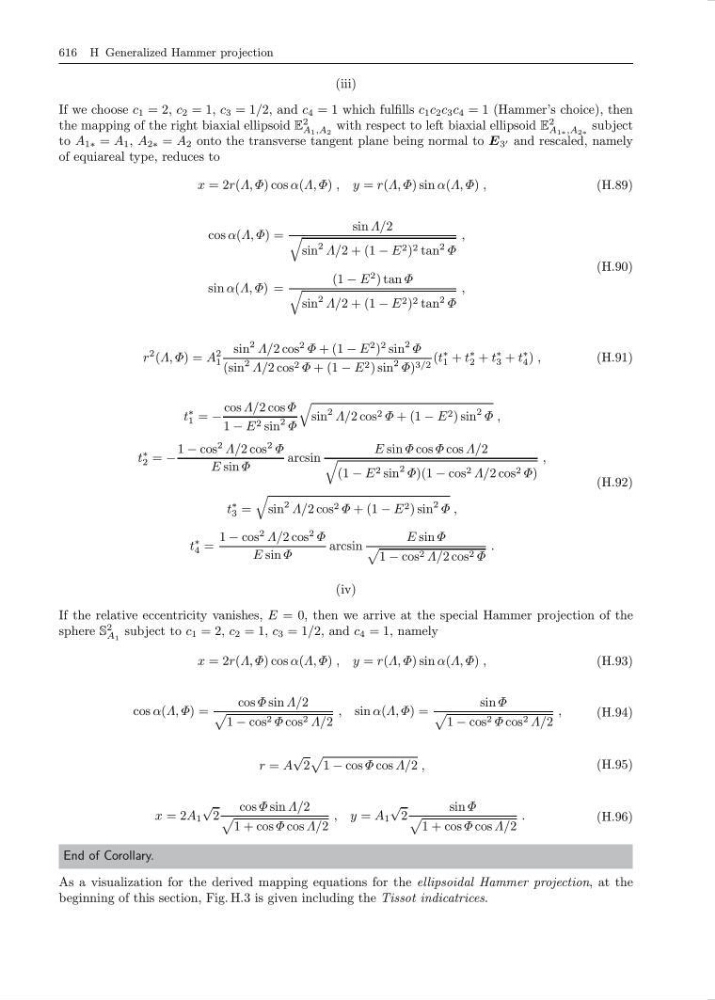
If we choose c 1 = 2, c 2 = 1, c 3 = 1/2, and c 4 = 1 which fulfills c 1 c 2 c 3 c 4 = 1 (Hammer’s choice), then
the mapping of the right biaxial ellipsoid E
2
A 1 ,A 2
with respect to left biaxial ellipsoid E
2
A 1∗ ,A 2∗
subject
to A 1∗ = A 1 , A 2∗ = A 2 onto the transverse tangent plane being normal to E 3 and rescaled, namely
of equiareal type, reduces to
x = 2r(Λ, Φ) cos α(Λ, Φ) , y = r(Λ, Φ) sin α(Λ, Φ) ,
(H.89)
cos α(Λ, Φ) =
sin Λ/2
sin
2 Λ/2 + (1 − E 2 ) 2 tan
2 Φ
,
sin α(Λ, Φ) =
(1 − E
2 ) tan Φ
sin
2 Λ/2 + (1 − E 2 ) 2 tan
2 Φ
,
(H.90)
r
2 (Λ, Φ) = A
2
1
sin
2 Λ/2 cos
2 Φ + (1 − E
2 )
2 sin
2 Φ
(sin
2 Λ/2 cos 2 Φ + (1 − E 2 ) sin
2 Φ) 3/2 (t
∗
1 + t
∗
2 + t
∗
3 + t
∗
4 ) ,
(H.91)
t
∗
1 = −
cos Λ/2 cos Φ
1 − E 2 sin
2 Φ
sin
2 Λ/2 cos 2 Φ + (1 − E 2 ) sin
2 Φ ,
t
∗
2 = −
1 − cos
2 Λ/2 cos
2 Φ
E sin Φ
arcsin
E sin Φ cos Φ cos Λ/2
(1 − E 2 sin
2 Φ)(1 − cos 2 Λ/2 cos 2 Φ)
,
t
∗
3 =
sin
2 Λ/2 cos 2 Φ + (1 − E 2 ) sin
2 Φ ,
t
∗
4 =
1 − cos
2 Λ/2 cos
2 Φ
E sin Φ
arcsin
E sin Φ
1 − cos 2 Λ/2 cos 2 Φ
.
(H.92)
(iv)
If the relative eccentricity vanishes, E = 0, then we arrive at the special Hammer projection of the
sphere S
2
A 1
subject to c 1 = 2, c 2 = 1, c 3 = 1/2, and c 4 = 1, namely
x = 2r(Λ, Φ) cos α(Λ, Φ) , y = r(Λ, Φ) sin α(Λ, Φ) ,
(H.93)
cos α(Λ, Φ) =
cos Φ sin Λ/2
1 − cos 2 Φ cos 2 Λ/2
, sin α(Λ, Φ) =
sin Φ
1 − cos 2 Φ cos 2 Λ/2
,
(H.94)
r = A
√
2
1 − cos Φ cos Λ/2 ,
(H.95)
x = 2A 1
√
2
cos Φ sin Λ/2
1 + cos Φ cos Λ/2
, y = A 1
√
2
sin Φ
1 + cos Φ cos Λ/2
.
(H.96)
End of Corollary.
As a visualization for the derived mapping equations for the ellipsoidal Hammer projection, at the
beginning of this section, Fig. H.3 is given including the Tissot indicatrices.