

H-2 The ellipsoidal Hammer projection 611
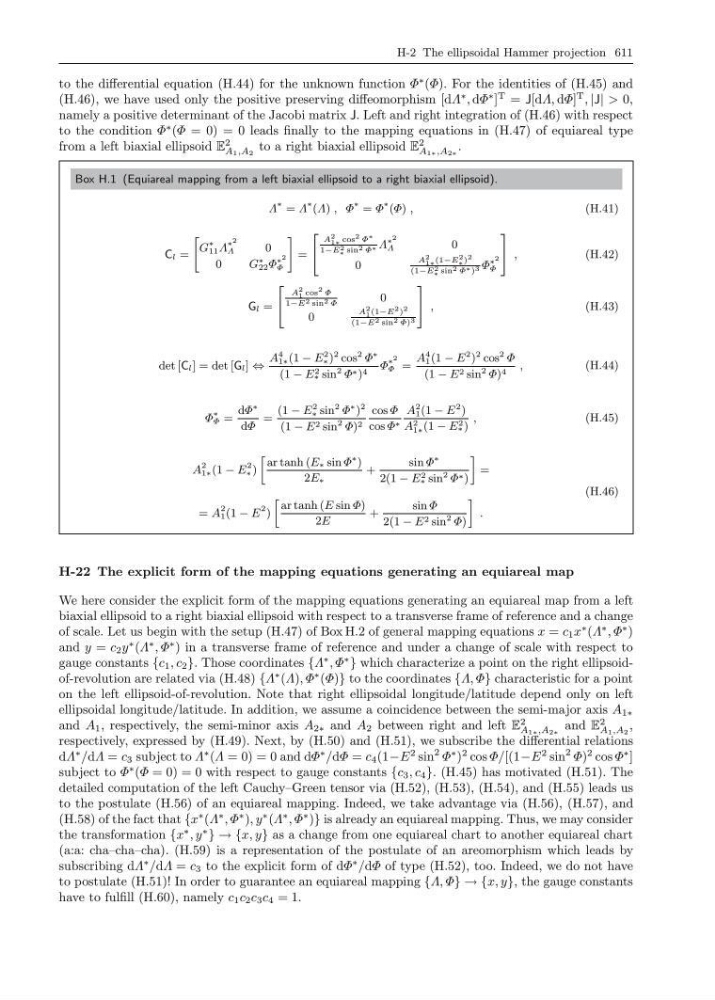
to the differential equation (H.44) for the unknown function Φ
∗ (Φ). For the identities of (H.45) and
(H.46), we have used only the positive preserving diffeomorphism [dΛ
∗ , dΦ
∗ ]
T = J[dΛ, dΦ]
T , |J| > 0,
namely a positive determinant of the Jacobi matrix J. Left and right integration of (H.46) with respect
to the condition Φ
∗ (Φ = 0) = 0 leads finally to the mapping equations in (H.47) of equiareal type
from a left biaxial ellipsoid E
2
A 1 ,A 2
to a right biaxial ellipsoid E
2
A 1∗ ,A 2∗
.
Box H.1 (Equiareal mapping from a left biaxial ellipsoid to a right biaxial ellipsoid).
Λ
∗ = Λ
∗ (Λ) , Φ
∗ = Φ
∗ (Φ) ,
(H.41)
C l =
"
G
∗
11 Λ
∗
2
Λ
0
0
G
∗
22 Φ
∗
2
Φ
#
=
2
4
A
2
1∗ cos
2 Φ
∗
1−E 2
∗ sin 2 Φ ∗ Λ
∗
2
Λ
0
0
A
2
1∗ (1−E
2
∗ )
2
(1−E 2
∗ sin 2 Φ ∗ ) 3 Φ
∗
2
Φ
3
5 ,
(H.42)
G l =
2
4
A
2
1 cos
2 Φ
1−E 2 sin 2 Φ
0
0
A
2
1 (1−E
2 )
2
(1−E 2 sin 2 Φ) 3
3
5 ,
(H.43)
det [C l ] = det [G l ] ⇔
A
4
1∗ (1 − E
2
∗ )
2 cos
2 Φ
∗
(1 − E
2
∗ sin
2 Φ ∗ ) 4 Φ
∗
2
Φ =
A
4
1 (1 − E
2 )
2 cos
2 Φ
(1 − E 2 sin
2 Φ) 4 ,
(H.44)
Φ
∗
Φ =
dΦ
∗
dΦ
=
(1 − E
2
∗ sin
2 Φ
∗ )
2
(1 − E 2 sin
2 Φ) 2
cos Φ
cos Φ ∗
A
2
1 (1 − E
2 )
A
2
1∗ (1 − E
2
∗ )
,
(H.45)
A
2
1∗ (1 − E
2
∗ )
»
ar tanh (E ∗ sin Φ
∗ )
2E ∗
+
sin Φ
∗
2(1 − E
2
∗ sin
2 Φ ∗ )
–
=
= A
2
1 (1 − E
2 )
»
ar tanh (E sin Φ)
2E
+
sin Φ
2(1 − E 2 sin
2 Φ)
–
.
(H.46)
H-22 The explicit form of the mapping equations generating an equiareal map
We here consider the explicit form of the mapping equations generating an equiareal map from a left
biaxial ellipsoid to a right biaxial ellipsoid with respect to a transverse frame of reference and a change
of scale. Let us begin with the setup (H.47) of Box H.2 of general mapping equations x = c 1 x
∗ (Λ
∗ , Φ
∗ )
and y = c 2 y
∗ (Λ
∗ , Φ
∗ ) in a transverse frame of reference and under a change of scale with respect to
gauge constants {c 1 , c 2 }. Those coordinates {Λ
∗ , Φ
∗
} which characterize a point on the right ellipsoidof-revolution are related via (H.48) {Λ
∗ (Λ), Φ
∗ (Φ)} to the coordinates {Λ, Φ} characteristic for a point
on the left ellipsoid-of-revolution. Note that right ellipsoidal longitude/latitude depend only on left
ellipsoidal longitude/latitude. In addition, we assume a coincidence between the semi-major axis A 1∗
and A 1 , respectively, the semi-minor axis A 2∗ and A 2 between right and left E
2
A 1∗ ,A 2∗
and E
2
A 1 ,A 2
,
respectively, expressed by (H.49). Next, by (H.50) and (H.51), we subscribe the differential relations
dΛ
∗ /dΛ = c 3 subject to Λ
∗ (Λ = 0) = 0 and dΦ
∗ /dΦ = c 4 (1−E
2 sin
2 Φ
∗ )
2 cos Φ/[(1−E
2 sin
2 Φ)
2 cos Φ
∗ ]
subject to Φ
∗ (Φ = 0) = 0 with respect to gauge constants {c 3 , c 4 }. (H.45) has motivated (H.51). The
detailed computation of the left Cauchy–Green tensor via (H.52), (H.53), (H.54), and (H.55) leads us
to the postulate (H.56) of an equiareal mapping. Indeed, we take advantage via (H.56), (H.57), and
(H.58) of the fact that {x
∗ (Λ
∗ , Φ
∗ ), y
∗ (Λ
∗ , Φ
∗ )} is already an equiareal mapping. Thus, we may consider
the transformation {x
∗ , y
∗
} → {x, y} as a change from one equiareal chart to another equiareal chart
(a:a: cha–cha–cha). (H.59) is a representation of the postulate of an areomorphism which leads by
subscribing dΛ
∗ /dΛ = c 3 to the explicit form of dΦ
∗ /dΦ of type (H.52), too. Indeed, we do not have
to postulate (H.51)! In order to guarantee an equiareal mapping {Λ, Φ} → {x, y}, the gauge constants
have to fulfill (H.60), namely c 1 c 2 c 3 c 4 = 1.