

610 H Generalized Hammer projection
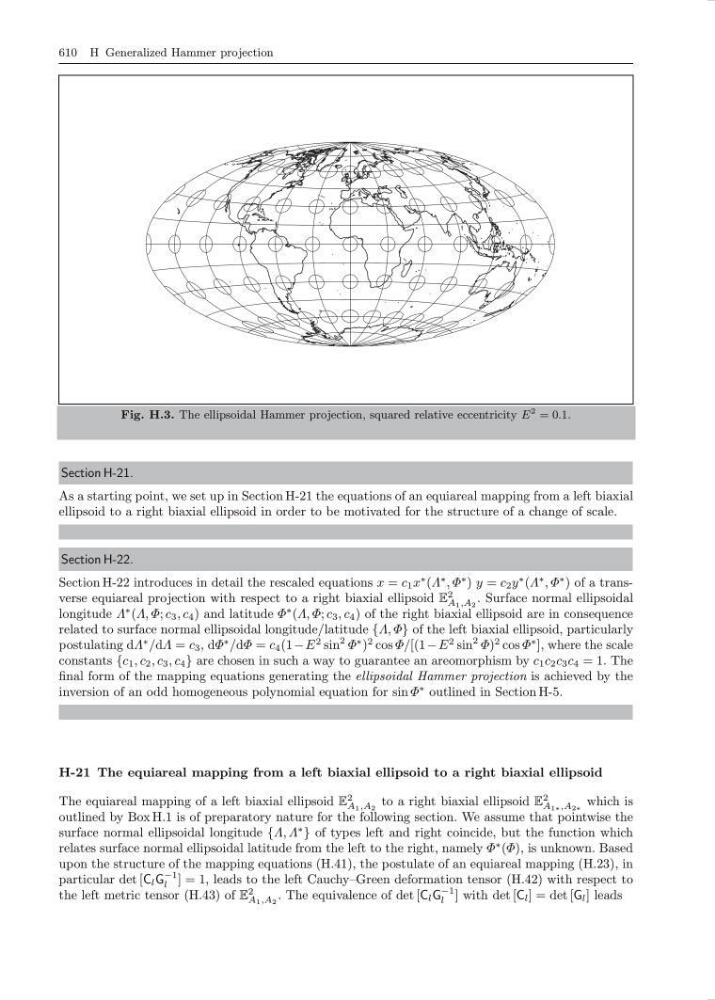
Fig. H.3. The ellipsoidal Hammer projection, squared relative eccentricity E
2 = 0.1.
Section H-21.
As a starting point, we set up in Section H-21 the equations of an equiareal mapping from a left biaxial
ellipsoid to a right biaxial ellipsoid in order to be motivated for the structure of a change of scale.
Section H-22.
Section H-22 introduces in detail the rescaled equations x = c 1 x
∗ (Λ
∗ , Φ
∗ ) y = c 2 y
∗ (Λ
∗ , Φ
∗ ) of a transverse equiareal projection with respect to a right biaxial ellipsoid E
2
A 1 ,A 2
. Surface normal ellipsoidal
longitude Λ
∗ (Λ, Φ; c 3 , c 4 ) and latitude Φ
∗ (Λ, Φ; c 3 , c 4 ) of the right biaxial ellipsoid are in consequence
related to surface normal ellipsoidal longitude/latitude {Λ, Φ} of the left biaxial ellipsoid, particularly
postulating dΛ
∗ /dΛ = c 3 , dΦ
∗ /dΦ = c 4 (1 − E
2 sin
2 Φ
∗ )
2 cos Φ/[(1 − E
2 sin
2 Φ)
2 cos Φ
∗ ], where the scale
constants {c 1 , c 2 , c 3 , c 4 } are chosen in such a way to guarantee an areomorphism by c 1 c 2 c 3 c 4 = 1. The
final form of the mapping equations generating the ellipsoidal Hammer projection is achieved by the
inversion of an odd homogeneous polynomial equation for sin Φ
∗ outlined in Section H-5.
H-21 The equiareal mapping from a left biaxial ellipsoid to a right biaxial ellipsoid
The equiareal mapping of a left biaxial ellipsoid E
2
A 1 ,A 2
to a right biaxial ellipsoid E
2
A 1∗ ,A 2∗
which is
outlined by Box H.1 is of preparatory nature for the following section. We assume that pointwise the
surface normal ellipsoidal longitude {Λ, Λ
∗
} of types left and right coincide, but the function which
relates surface normal ellipsoidal latitude from the left to the right, namely Φ
∗ (Φ), is unknown. Based
upon the structure of the mapping equations (H.41), the postulate of an equiareal mapping (H.23), in
particular det [C l G
−1
l ] = 1, leads to the left Cauchy–Green deformation tensor (H.42) with respect to
the left metric tensor (H.43) of E
2
A 1 ,A 2
. The equivalence of det [C l G
−1
l ] with det [C l ] = det [G l ] leads