

G-2 The generalized Mollweide projections for the biaxial ellipsoid 595
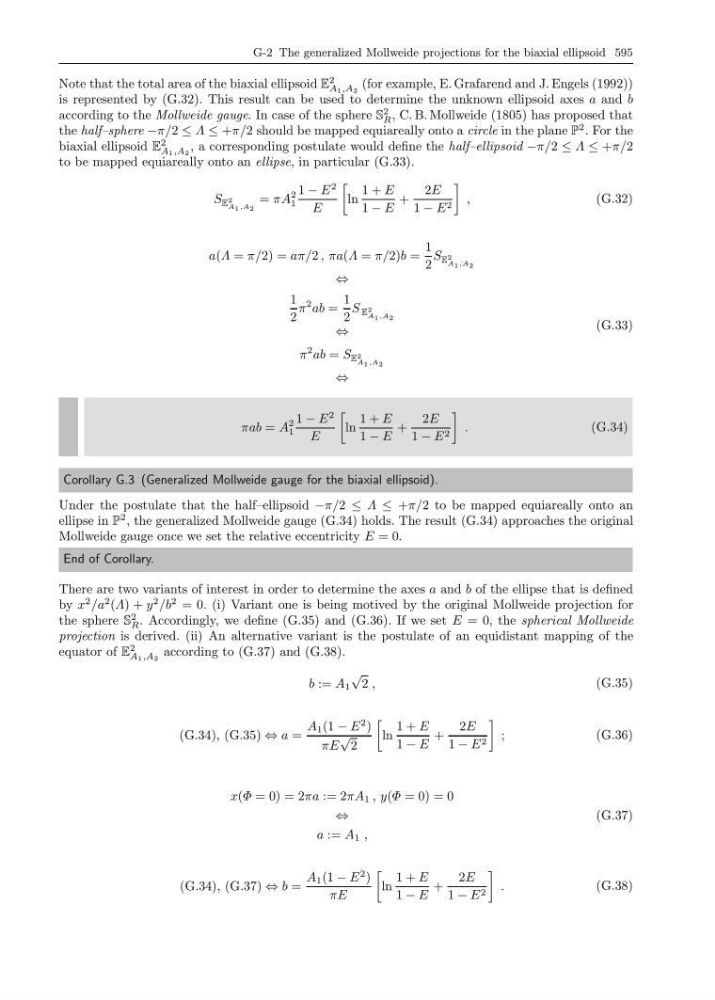
Note that the total area of the biaxial ellipsoid E
2
A 1 ,A 2
(for example, E. Grafarend and J. Engels (1992))
is represented by (G.32). This result can be used to determine the unknown ellipsoid axes a and b
according to the Mollweide gauge. In case of the sphere S
2
R , C. B. Mollweide (1805) has proposed that
the half–sphere −π/2 ≤ Λ ≤ +π/2 should be mapped equiareally onto a circle in the plane P
2 . For the
biaxial ellipsoid E
2
A 1 ,A 2
, a corresponding postulate would define the half–ellipsoid −π/2 ≤ Λ ≤ +π/2
to be mapped equiareally onto an ellipse, in particular (G.33).
S E 2
A 1 ,A 2
= πA
2
1
1 − E
2
E
ln
1 + E
1 − E
+
2E
1 − E 2
,
(G.32)
a(Λ = π/2) = aπ/2 , πa(Λ = π/2)b =
1
2
S E 2
A 1 ,A 2
⇔
1
2
π
2 ab =
1
2
S E 2
A 1 ,A 2
⇔
π
2 ab = S E 2
A 1 ,A 2
⇔
(G.33)
πab = A
2
1
1 − E
2
E
ln
1 + E
1 − E
+
2E
1 − E 2
.
(G.34)
Corollary G.3 (Generalized Mollweide gauge for the biaxial ellipsoid).
Under the postulate that the half–ellipsoid −π/2 ≤ Λ ≤ +π/2 to be mapped equiareally onto an
ellipse in P
2 , the generalized Mollweide gauge (G.34) holds. The result (G.34) approaches the original
Mollweide gauge once we set the relative eccentricity E = 0.
End of Corollary.
There are two variants of interest in order to determine the axes a and b of the ellipse that is defined
by x
2 /a
2 (Λ) + y
2 /b
2 = 0. (i) Variant one is being motived by the original Mollweide projection for
the sphere S
2
R . Accordingly, we define (G.35) and (G.36). If we set E = 0, the spherical Mollweide
projection is derived. (ii) An alternative variant is the postulate of an equidistant mapping of the
equator of E
2
A 1 ,A 2
according to (G.37) and (G.38).
b := A 1
√
2 ,
(G.35)
(G.34), (G.35) ⇔ a =
A 1 (1 − E
2 )
πE
√
2
ln
1 + E
1 − E
+
2E
1 − E 2
;
(G.36)
x(Φ = 0) = 2πa := 2πA 1 , y(Φ = 0) = 0
⇔
a := A 1 ,
(G.37)
(G.34), (G.37) ⇔ b =
A 1 (1 − E
2 )
πE
ln
1 + E
1 − E
+
2E
1 − E 2
.
(G.38)