

F-3 Deformation analysis of vertically/horizontally averaged equiareal cylindric mappings 583
The right Jacobi matrix [∂U
A /∂u
α ] =: J r is the inverse of the left Jacobi matrix [∂u
µ /∂U
A ] =: J l ,
i. e. J r = J
−1
l . Since we have already computed J l , we are left with the problem of calculating
J r = J
−1
l
= (x Λ y Φ )
−1
y Φ −x Φ
0
x Λ
=
Λ x Λ y
Φ x Φ y
,
(F.68)
Λ x = x
−1
Λ , Λ y = −x Φ (x Λ y Φ )
−1 , Φ x = 0 , Φ y = y
−1
Φ ,
(F.69)
C 11 = G 11 Λ
2
x + G 22 Φ
2
x ,
C 12 = G 11 Λ x Λ y + G 22 Φ x Φ y ,
C 22 = G 11 Λ
2
y + G 22 Φ
2
y ,
(F.70)
C 11 =
N
2 cos
2 Φ
x 2
Λ
,
C 12 = −
N
2 cos
2 Φx Φ
x 2
Λ y Φ
,
C 22 =
N
2 cos
2 Φx
2
Φ
x 2
Λ y 2
Φ
+
M
2
y 2
Φ
.
(F.71)
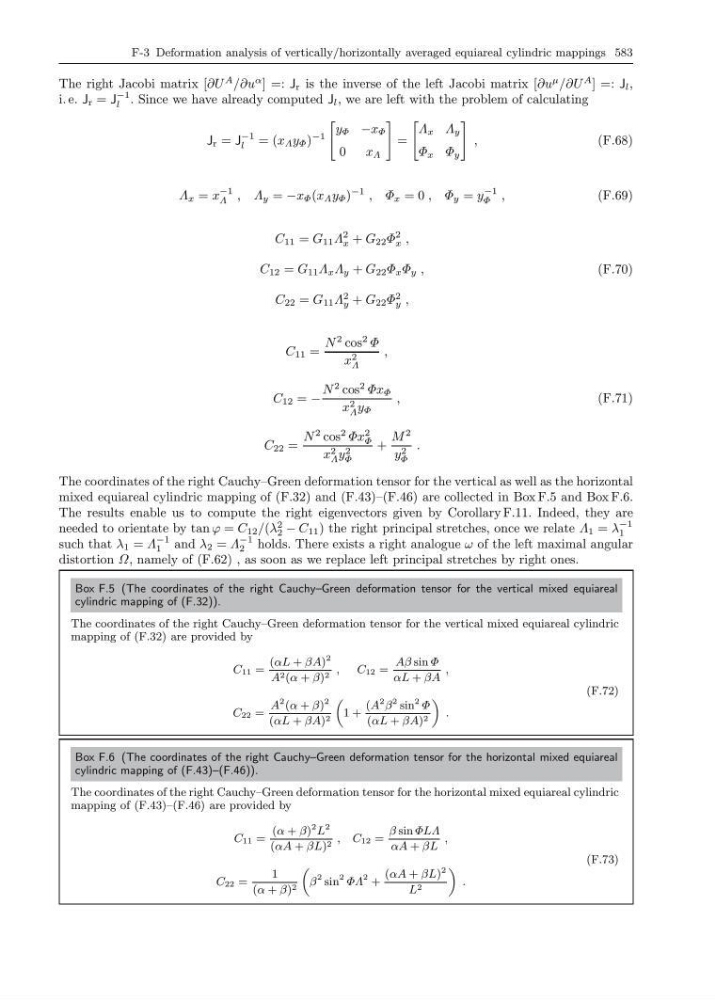
The coordinates of the right Cauchy–Green deformation tensor for the vertical as well as the horizontal
mixed equiareal cylindric mapping of (F.32) and (F.43)–(F.46) are collected in Box F.5 and Box F.6.
The results enable us to compute the right eigenvectors given by Corollary F.11. Indeed, they are
needed to orientate by tan ϕ = C 12 /(λ
2
2 − C 11 ) the right principal stretches, once we relate Λ 1 = λ
−1
1
such that λ 1 = Λ
−1
1 and λ 2 = Λ
−1
2 holds. There exists a right analogue ω of the left maximal angular
distortion Ω, namely of (F.62) , as soon as we replace left principal stretches by right ones.
Box F.5 (The coordinates of the right Cauchy–Green deformation tensor for the vertical mixed equiareal
cylindric mapping of (F.32)).
The coordinates of the right Cauchy–Green deformation tensor for the vertical mixed equiareal cylindric
mapping of (F.32) are provided by
C 11 =
(αL + βA)
2
A 2 (α + β) 2 , C 12 =
Aβ sin Φ
αL + βA
,
C 22 =
A
2 (α + β)
2
(αL + βA) 2
„
1 +
(A
2 β
2 sin
2 Φ
(αL + βA) 2
«
.
(F.72)
Box F.6 (The coordinates of the right Cauchy–Green deformation tensor for the horizontal mixed equiareal
cylindric mapping of (F.43)–(F.46)).
The coordinates of the right Cauchy–Green deformation tensor for the horizontal mixed equiareal cylindric
mapping of (F.43)–(F.46) are provided by
C 11 =
(α + β)
2 L
2
(αA + βL) 2 , C 12 =
β sin ΦLΛ
αA + βL
,
C 22 =
1
(α + β) 2
„
β
2 sin
2 ΦΛ
2 +
(αA + βL)
2
L 2
«
.
(F.73)