

E-3 The Newton form of a geodesic in Maupertuis gauge (sphere, ellipsoid-of-revolution) 563
Continuation of Box.
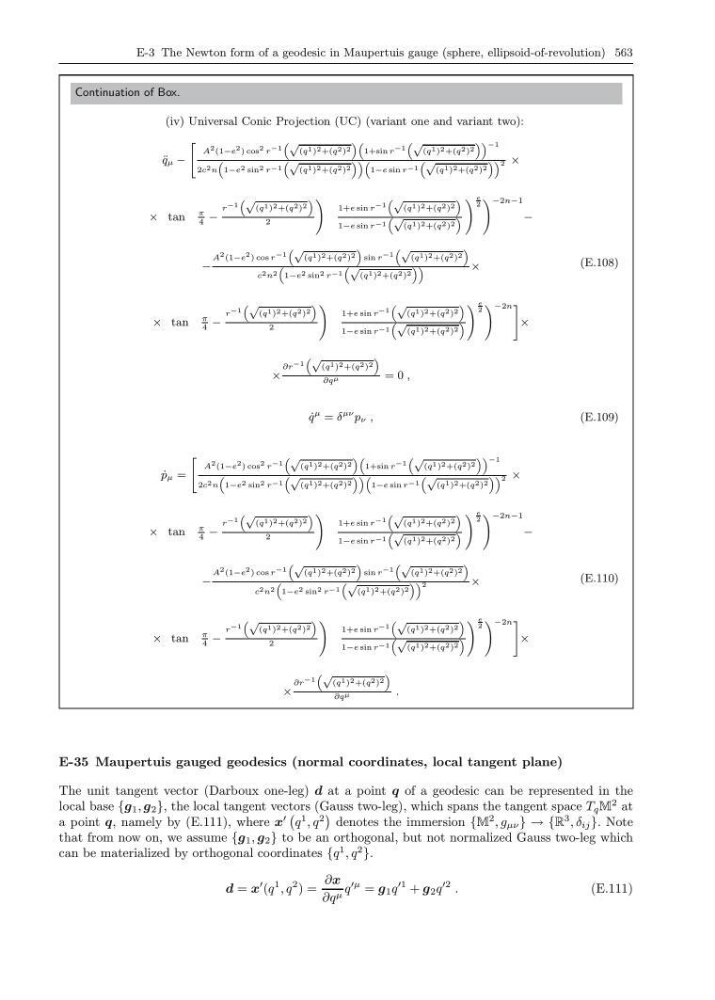
(iv) Universal Conic Projection (UC) (variant one and variant two):
¨
q µ −
"
A
2 (1−e
2 ) cos
2 r
−1
“ √
(q 1 ) 2 +(q 2 ) 2
”“
1+sin r
−1
“ √
(q 1 ) 2 +(q 2 ) 2
”” −1
2c 2 n
“
1−e 2 sin 2 r −1
“ √
(q 1 ) 2 +(q 2 ) 2
””“
1−e sin r −1
“ √
(q 1 ) 2 +(q 2 ) 2
”” 2 ×
× tan
π
4
−
r
−1
“ √
(q 1 ) 2 +(q 2 ) 2
”
2
!
1+e sin r
−1
“ √
(q 1 ) 2 +(q 2 ) 2
”
1−e sin r −1
“ √
(q 1 ) 2 +(q 2 ) 2
”
! e
2
! −2n−1
−
−
A
2 (1−e
2 ) cos r
−1
“ √
(q 1 ) 2 +(q 2 ) 2
”
sin r
−1
“ √
(q 1 ) 2 +(q 2 ) 2
”
c 2 n 2
“
1−e 2 sin 2 r −1
“ √
(q 1 ) 2 +(q 2 ) 2
””
×
× tan
π
4
−
r
−1
“ √
(q 1 ) 2 +(q 2 ) 2
”
2
!
1+e sin r
−1
“ √
(q 1 ) 2 +(q 2 ) 2
”
1−e sin r −1
“ √
(q 1 ) 2 +(q 2 ) 2
”
! e
2
! −2n #
×
×
∂r
−1
“ √
(q 1 ) 2 +(q 2 ) 2
”
∂q µ
= 0 ,
(E.108)
˙
q
µ = δ
µν p ν ,
(E.109)
˙
p µ =
"
A
2 (1−e
2 ) cos
2 r
−1
“ √
(q 1 ) 2 +(q 2 ) 2
”“
1+sin r
−1
“ √
(q 1 ) 2 +(q 2 ) 2
”” −1
2c 2 n
“
1−e 2 sin 2 r −1
“ √
(q 1 ) 2 +(q 2 ) 2
””“
1−e sin r −1
“ √
(q 1 ) 2 +(q 2 ) 2
”” 2 ×
× tan
π
4
−
r
−1
“ √
(q 1 ) 2 +(q 2 ) 2
”
2
!
1+e sin r
−1
“ √
(q 1 ) 2 +(q 2 ) 2
”
1−e sin r −1
“ √
(q 1 ) 2 +(q 2 ) 2
”
! e
2
! −2n−1
−
−
A
2 (1−e
2 ) cos r
−1
“ √
(q 1 ) 2 +(q 2 ) 2
”
sin r
−1
“ √
(q 1 ) 2 +(q 2 ) 2
”
c 2 n 2
“
1−e 2 sin 2 r −1
“ √
(q 1 ) 2 +(q 2 ) 2
”” 2
×
× tan
π
4
−
r
−1
“ √
(q 1 ) 2 +(q 2 ) 2
”
2
!
1+e sin r
−1
“ √
(q 1 ) 2 +(q 2 ) 2
”
1−e sin r −1
“ √
(q 1 ) 2 +(q 2 ) 2
”
! e
2
! −2n #
×
×
∂r
−1
“ √
(q 1 ) 2 +(q 2 ) 2
”
∂q µ
.
(E.110)
E-35 Maupertuis gauged geodesics (normal coordinates, local tangent plane)
The unit tangent vector (Darboux one-leg) d at a point q of a geodesic can be represented in the
local base {g 1 , g 2 }, the local tangent vectors (Gauss two-leg), which spans the tangent space T q M
2 at
a point q, namely by (E.111), where x
q
1 , q
2
denotes the immersion {M
2 , g µν } → {R
3 , δ ij }. Note
that from now on, we assume {g 1 , g 2 } to be an orthogonal, but not normalized Gauss two-leg which
can be materialized by orthogonal coordinates {q
1 , q
2
}.
d = x
(q
1 , q
2 ) =
∂x
∂q µ q
µ = g 1 q
1 + g 2 q
2 .
(E.111)
Continuation of Box.
(iv) Universal Conic Projection (UC) (variant one and variant two):
¨
q µ −
"
A
2 (1−e
2 ) cos
2 r
−1
“ √
(q 1 ) 2 +(q 2 ) 2
”“
1+sin r
−1
“ √
(q 1 ) 2 +(q 2 ) 2
”” −1
2c 2 n
“
1−e 2 sin 2 r −1
“ √
(q 1 ) 2 +(q 2 ) 2
””“
1−e sin r −1
“ √
(q 1 ) 2 +(q 2 ) 2
”” 2 ×
× tan
π
4
−
r
−1
“ √
(q 1 ) 2 +(q 2 ) 2
”
2
!
1+e sin r
−1
“ √
(q 1 ) 2 +(q 2 ) 2
”
1−e sin r −1
“ √
(q 1 ) 2 +(q 2 ) 2
”
! e
2
! −2n−1
−
−
A
2 (1−e
2 ) cos r
−1
“ √
(q 1 ) 2 +(q 2 ) 2
”
sin r
−1
“ √
(q 1 ) 2 +(q 2 ) 2
”
c 2 n 2
“
1−e 2 sin 2 r −1
“ √
(q 1 ) 2 +(q 2 ) 2
””
×
× tan
π
4
−
r
−1
“ √
(q 1 ) 2 +(q 2 ) 2
”
2
!
1+e sin r
−1
“ √
(q 1 ) 2 +(q 2 ) 2
”
1−e sin r −1
“ √
(q 1 ) 2 +(q 2 ) 2
”
! e
2
! −2n #
×
×
∂r
−1
“ √
(q 1 ) 2 +(q 2 ) 2
”
∂q µ
= 0 ,
(E.108)
˙
q
µ = δ
µν p ν ,
(E.109)
˙
p µ =
"
A
2 (1−e
2 ) cos
2 r
−1
“ √
(q 1 ) 2 +(q 2 ) 2
”“
1+sin r
−1
“ √
(q 1 ) 2 +(q 2 ) 2
”” −1
2c 2 n
“
1−e 2 sin 2 r −1
“ √
(q 1 ) 2 +(q 2 ) 2
””“
1−e sin r −1
“ √
(q 1 ) 2 +(q 2 ) 2
”” 2 ×
× tan
π
4
−
r
−1
“ √
(q 1 ) 2 +(q 2 ) 2
”
2
!
1+e sin r
−1
“ √
(q 1 ) 2 +(q 2 ) 2
”
1−e sin r −1
“ √
(q 1 ) 2 +(q 2 ) 2
”
! e
2
! −2n−1
−
−
A
2 (1−e
2 ) cos r
−1
“ √
(q 1 ) 2 +(q 2 ) 2
”
sin r
−1
“ √
(q 1 ) 2 +(q 2 ) 2
”
c 2 n 2
“
1−e 2 sin 2 r −1
“ √
(q 1 ) 2 +(q 2 ) 2
”” 2
×
× tan
π
4
−
r
−1
“ √
(q 1 ) 2 +(q 2 ) 2
”
2
!
1+e sin r
−1
“ √
(q 1 ) 2 +(q 2 ) 2
”
1−e sin r −1
“ √
(q 1 ) 2 +(q 2 ) 2
”
! e
2
! −2n #
×
×
∂r
−1
“ √
(q 1 ) 2 +(q 2 ) 2
”
∂q µ
.
(E.110)
E-35 Maupertuis gauged geodesics (normal coordinates, local tangent plane)
The unit tangent vector (Darboux one-leg) d at a point q of a geodesic can be represented in the
local base {g 1 , g 2 }, the local tangent vectors (Gauss two-leg), which spans the tangent space T q M
2 at
a point q, namely by (E.111), where x
q
1 , q
2
denotes the immersion {M
2 , g µν } → {R
3 , δ ij }. Note
that from now on, we assume {g 1 , g 2 } to be an orthogonal, but not normalized Gauss two-leg which
can be materialized by orthogonal coordinates {q
1 , q
2
}.
d = x
(q
1 , q
2 ) =
∂x
∂q µ q
µ = g 1 q
1 + g 2 q
2 .
(E.111)