

548 E Geodesics
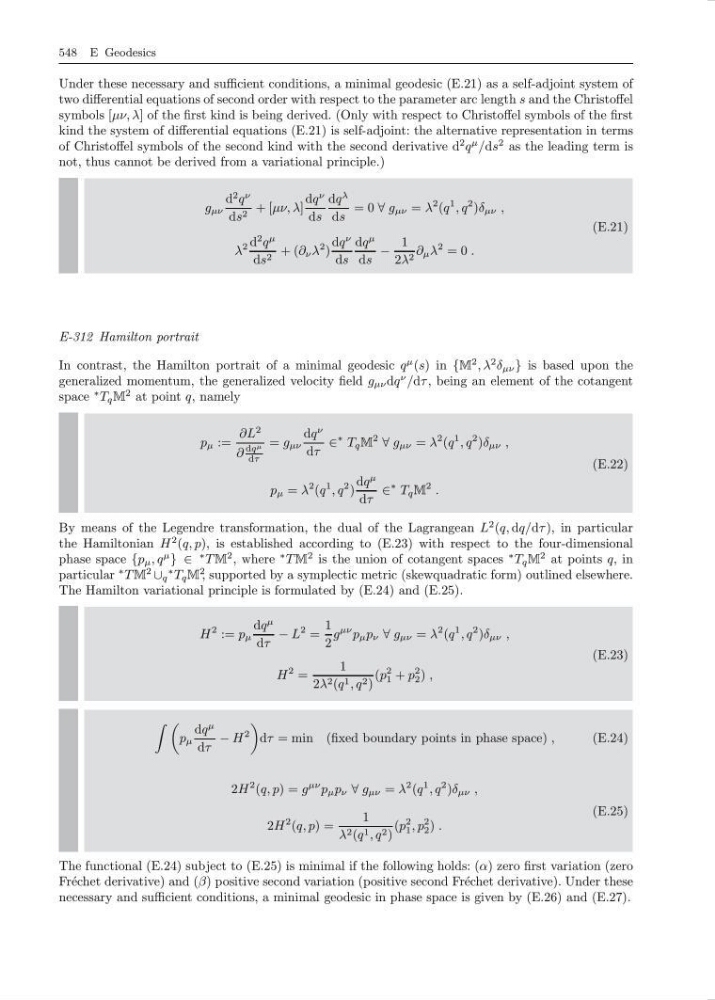
Under these necessary and sufficient conditions, a minimal geodesic (E.21) as a self-adjoint system of
two differential equations of second order with respect to the parameter arc length s and the Christoffel
symbols [µν, λ] of the first kind is being derived. (Only with respect to Christoffel symbols of the first
kind the system of differential equations (E.21) is self-adjoint: the alternative representation in terms
of Christoffel symbols of the second kind with the second derivative d
2 q
µ /ds
2 as the leading term is
not, thus cannot be derived from a variational principle.)
g µν
d
2 q
ν
ds 2 + [µν, λ]
dq
ν
ds
dq
λ
ds
= 0 ∀ g µν = λ
2 (q
1 , q
2 )δ µν ,
λ
2 d
2 q
µ
ds 2 + (∂ ν λ
2 )
dq
ν
ds
dq
µ
ds
−
1
2λ 2 ∂ µ λ
2 = 0 .
(E.21)
E-312 Hamilton portrait
In contrast, the Hamilton portrait of a minimal geodesic q
µ (s) in {M
2 , λ
2 δ µν } is based upon the
generalized momentum, the generalized velocity field g µν dq
ν /dτ , being an element of the cotangent
space
∗ T q M
2 at point q, namely
p µ :=
∂L
2
∂
dq µ
dτ
= g µν
dq
ν
dτ
∈
∗ T q M
2
∀ g µν = λ
2 (q
1 , q
2 )δ µν ,
p µ = λ
2 (q
1 , q
2 )
dq
µ
dτ
∈
∗ T q M
2 .
(E.22)
By means of the Legendre transformation, the dual of the Lagrangean L
2 (q, dq/dτ ), in particular
the Hamiltonian H
2 (q, p), is established according to (E.23) with respect to the four-dimensional
phase space {p µ , q
µ
} ∈
∗ T M
2 , where
∗ T M
2 is the union of cotangent spaces
∗ T q M
2 at points q, in
particular
∗ T M
2
∪ q
∗ T q M
2
, supported by a symplectic metric (skewquadratic form) outlined elsewhere.
The Hamilton variational principle is formulated by (E.24) and (E.25).
H
2 := p µ
dq
µ
dτ
− L
2 =
1
2
g
µν p µ p ν ∀ g µν = λ
2 (q
1 , q
2 )δ µν ,
H
2 =
1
2λ 2 (q 1 , q 2 )
(p
2
1 + p
2
2 ) ,
(E.23)
p µ
dq
µ
dτ
− H
2
dτ = min (fixed boundary points in phase space) ,
(E.24)
2H
2 (q, p) = g
µν p µ p ν ∀ g µν = λ
2 (q
1 , q
2 )δ µν ,
2H
2 (q, p) =
1
λ 2 (q 1 , q 2 )
(p
2
1 , p
2
2 ) .
(E.25)
The functional (E.24) subject to (E.25) is minimal if the following holds: (α) zero first variation (zero
Fr´ echet derivative) and (β) positive second variation (positive second Fr´ echet derivative). Under these
necessary and sufficient conditions, a minimal geodesic in phase space is given by (E.26) and (E.27).
Under these necessary and sufficient conditions, a minimal geodesic (E.21) as a self-adjoint system of
two differential equations of second order with respect to the parameter arc length s and the Christoffel
symbols [µν, λ] of the first kind is being derived. (Only with respect to Christoffel symbols of the first
kind the system of differential equations (E.21) is self-adjoint: the alternative representation in terms
of Christoffel symbols of the second kind with the second derivative d
2 q
µ /ds
2 as the leading term is
not, thus cannot be derived from a variational principle.)
g µν
d
2 q
ν
ds 2 + [µν, λ]
dq
ν
ds
dq
λ
ds
= 0 ∀ g µν = λ
2 (q
1 , q
2 )δ µν ,
λ
2 d
2 q
µ
ds 2 + (∂ ν λ
2 )
dq
ν
ds
dq
µ
ds
−
1
2λ 2 ∂ µ λ
2 = 0 .
(E.21)
E-312 Hamilton portrait
In contrast, the Hamilton portrait of a minimal geodesic q
µ (s) in {M
2 , λ
2 δ µν } is based upon the
generalized momentum, the generalized velocity field g µν dq
ν /dτ , being an element of the cotangent
space
∗ T q M
2 at point q, namely
p µ :=
∂L
2
∂
dq µ
dτ
= g µν
dq
ν
dτ
∈
∗ T q M
2
∀ g µν = λ
2 (q
1 , q
2 )δ µν ,
p µ = λ
2 (q
1 , q
2 )
dq
µ
dτ
∈
∗ T q M
2 .
(E.22)
By means of the Legendre transformation, the dual of the Lagrangean L
2 (q, dq/dτ ), in particular
the Hamiltonian H
2 (q, p), is established according to (E.23) with respect to the four-dimensional
phase space {p µ , q
µ
} ∈
∗ T M
2 , where
∗ T M
2 is the union of cotangent spaces
∗ T q M
2 at points q, in
particular
∗ T M
2
∪ q
∗ T q M
2
, supported by a symplectic metric (skewquadratic form) outlined elsewhere.
The Hamilton variational principle is formulated by (E.24) and (E.25).
H
2 := p µ
dq
µ
dτ
− L
2 =
1
2
g
µν p µ p ν ∀ g µν = λ
2 (q
1 , q
2 )δ µν ,
H
2 =
1
2λ 2 (q 1 , q 2 )
(p
2
1 + p
2
2 ) ,
(E.23)
p µ
dq
µ
dτ
− H
2
dτ = min (fixed boundary points in phase space) ,
(E.24)
2H
2 (q, p) = g
µν p µ p ν ∀ g µν = λ
2 (q
1 , q
2 )δ µν ,
2H
2 (q, p) =
1
λ 2 (q 1 , q 2 )
(p
2
1 , p
2
2 ) .
(E.25)
The functional (E.24) subject to (E.25) is minimal if the following holds: (α) zero first variation (zero
Fr´ echet derivative) and (β) positive second variation (positive second Fr´ echet derivative). Under these
necessary and sufficient conditions, a minimal geodesic in phase space is given by (E.26) and (E.27).