

E Geodesics
Geodetic curvature, geodetic torsion, geodesics. Lagrangean portrait, Hamiltonian portrait. Maupertuis
gauge, Universal Lambert Projection, Universal Stereographic Projection, dynamic time.
Three topics are presented here.
Section E-1.
In Section E-1, we review the presentation of geodetic curvature, geodetic torsion, and normal curvatures of a submanifold on a two-dimensional Riemann manifold.
Section E-2.
In Section E-2, in some detail, we review the Darboux equations. Relatively unknown is the derivation
of the differential equations of third order of a geodesic circle.
Section E-3.
In Section E-3, we concentrate on the Newton form of a geodesic in Maupertuis gauge on the sphere
and the ellipsoid-of-revolution.
E-1 Geodetic curvature, geodetic torsion, and normal curvature
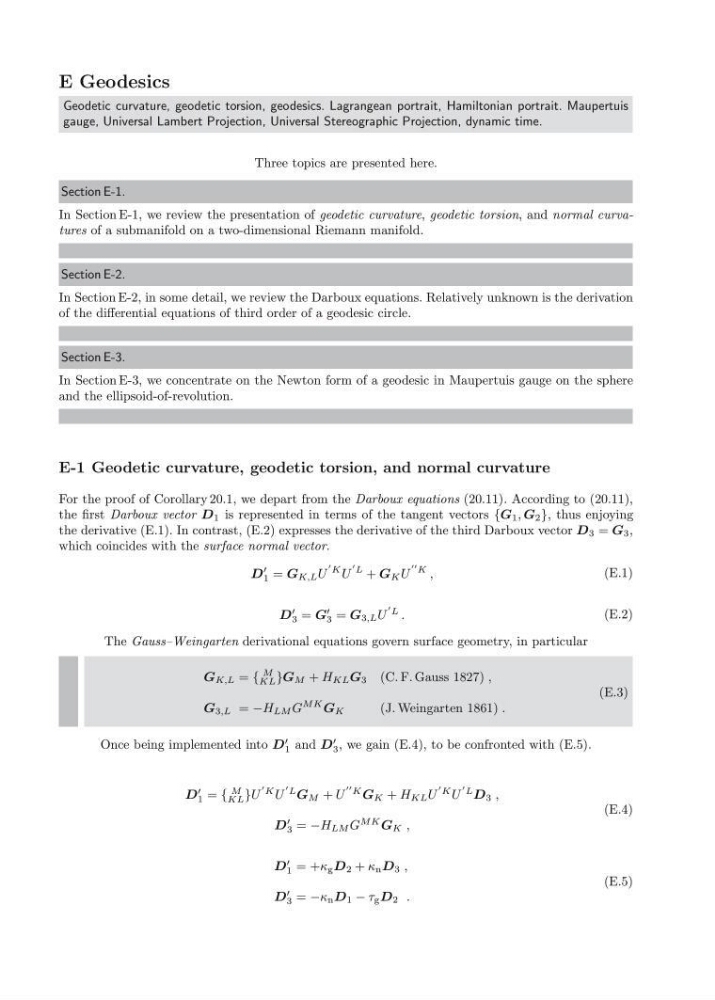
For the proof of Corollary 20.1, we depart from the Darboux equations (20.11). According to (20.11),
the first Darboux vector D 1 is represented in terms of the tangent vectors {G 1 , G 2 }, thus enjoying
the derivative (E.1). In contrast, (E.2) expresses the derivative of the third Darboux vector D 3 = G 3 ,
which coincides with the surface normal vector.
D
1 = G K,L U
K U
L + G K U
K ,
(E.1)
D
3 = G
3 = G 3,L U
L .
(E.2)
The Gauss–Weingarten derivational equations govern surface geometry, in particular
G K,L = {
M
KL }G M + H KL G 3 (C. F. Gauss 1827) ,
G 3,L = −H LM G
MK G K
(J. Weingarten 1861) .
(E.3)
Once being implemented into D
1 and D
3 , we gain (E.4), to be confronted with (E.5).
D
1 = {
M
KL }U
K U
L G M + U
K G K + H KL U
K U
L D 3 ,
D
3 = −H LM G
MK G K ,
(E.4)
D
1 = +κ g D 2 + κ n D 3 ,
D
3 = −κ n D 1 − τ g D 2 .
(E.5)
Geodetic curvature, geodetic torsion, geodesics. Lagrangean portrait, Hamiltonian portrait. Maupertuis
gauge, Universal Lambert Projection, Universal Stereographic Projection, dynamic time.
Three topics are presented here.
Section E-1.
In Section E-1, we review the presentation of geodetic curvature, geodetic torsion, and normal curvatures of a submanifold on a two-dimensional Riemann manifold.
Section E-2.
In Section E-2, in some detail, we review the Darboux equations. Relatively unknown is the derivation
of the differential equations of third order of a geodesic circle.
Section E-3.
In Section E-3, we concentrate on the Newton form of a geodesic in Maupertuis gauge on the sphere
and the ellipsoid-of-revolution.
E-1 Geodetic curvature, geodetic torsion, and normal curvature
For the proof of Corollary 20.1, we depart from the Darboux equations (20.11). According to (20.11),
the first Darboux vector D 1 is represented in terms of the tangent vectors {G 1 , G 2 }, thus enjoying
the derivative (E.1). In contrast, (E.2) expresses the derivative of the third Darboux vector D 3 = G 3 ,
which coincides with the surface normal vector.
D
1 = G K,L U
K U
L + G K U
K ,
(E.1)
D
3 = G
3 = G 3,L U
L .
(E.2)
The Gauss–Weingarten derivational equations govern surface geometry, in particular
G K,L = {
M
KL }G M + H KL G 3 (C. F. Gauss 1827) ,
G 3,L = −H LM G
MK G K
(J. Weingarten 1861) .
(E.3)
Once being implemented into D
1 and D
3 , we gain (E.4), to be confronted with (E.5).
D
1 = {
M
KL }U
K U
L G M + U
K G K + H KL U
K U
L D 3 ,
D
3 = −H LM G
MK G K ,
(E.4)
D
1 = +κ g D 2 + κ n D 3 ,
D
3 = −κ n D 1 − τ g D 2 .
(E.5)