

1-7 Angular shear 37
1-6 Review: the deformation measures
Review: the family of twentytwo different deformation measures, compatibility conditions, integrability
conditions, differential forms.
By means of Table 1.3, let us introduce a collection of various deformation measures, i. e. deformation
tensors of the first kind based upon the reviews by D. B. Macvean (1968), K. N. Morman (1986), and
E. Grafarend (1995). For the classification scheme various representation theorems of T. C. T. Ting
(1985) are most useful. Compatibility conditions for Cauchy–Green deformation fields have been formulated by F. P. Duda and L. C. Martins (1995). They are needed for the problem to determine the
mapping equations U
K = f
K (u
k ) or u
k = f
k (U
K ) from prescribed left or right Cauchy–Green
deformation fields as tensor-valued functions. In the context of exterior calculus, these compatiblity
conditions are classified as integrability conditions. The various deformation measures honor the works
of E. Almansi (1911), A. Cauchy (1889,1890), J. Finger (1894a), G. Green (1839), H. Hencky (1928),
Z. Karni and M. Reiner (1960), G. Piola (1836), and B. R. Seth (1964a,b). The inverse deformation
matrices, namely E 5 , E 6 , E 15 , E 16 , E 17 , and E 18 , appear in the various forms of distortion energy.
Logarithmic and root measures of deformation appear in special stress–strain relations, which very
often are called constitutive equations. The measures E 3 and E 4 as well as E 13 and E 14 build up the
special eigenvalue problems. They correspond to definitions of the curvature matrix K = −HG
−1 , in
surface geometry built on the matrices of the first differential form I ∼ (dg)
2 = g µν du
µ du
ν as well as
on the second differential form II ∼ (dh)
2 = h µν du
µ du
ν , which is also called the Hesse form. Indeed,
they establish the matrix pair {H, G}, where G is positive definite.
1-7 Angular shear
A second additive measure of deformation: angular shear (also called angular distortion), left and right
surfaces, parameterized curves.
An alternative additive measure of deformation is angular shear, also called angular distortion. Assume
that two parameterized curves in M
2
l as well as their images in M
2
r intersect at the point U 0 as well as
u 0 , respectively. Two vectors ˙
U 1
M and ˙
U 2
N as well as ˙
u
µ
1 and ˙
u
ν
2 being elements of the corresponding
local tangent spaces T U 0 M
2
l as well as T U 0 M
2
r ,
˙
U
M
1 ∈ T U 0 M
2
l , ˙
U
N
2 ∈ T U 0 M
2
l
versus
˙
u
µ
1 ∈ T U 0 M
2
r , ˙
u
ν
2 ∈ T U 0 M
2
r ,
(1.132)
include the angles Ψ l and Ψ r . (Note that prime differentiation is understood as differentiation with
respect to arc length. In contrast, dot differentiation is understood as differentiation with respect to
an arbitrary curve parameter, called “t l ” and “t r ”, respectively.) As it is illustrated by Fig. 1.19, the
left angle Ψ l as well as the right angle Ψ r are represented by the inner products
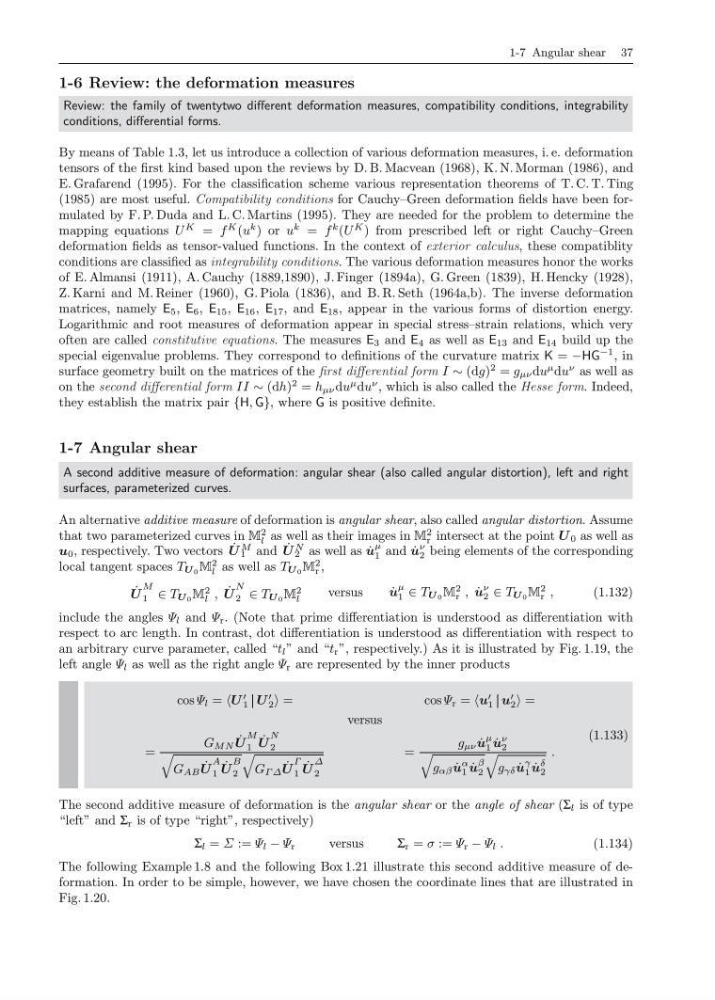
cos Ψ l = U
1 U
2 =
c o s Ψ r = u
1 u
2 =
versus
=
G MN ˙
U
M
1
˙
U
N
2
G AB ˙
U
A
1
˙
U
B
2
G Γ ∆ ˙
U
Γ
1
˙
U
∆
2
=
g µν ˙
u
µ
1 ˙
u
ν
2
g αβ ˙
u
α
1 ˙
u
β
2
g γδ ˙
u
γ
1 ˙
u
δ
2
.
(1.133)
The second additive measure of deformation is the angular shear or the angle of shear (Σ l is of type
“left” and Σ r is of type “right”, respectively)
Σ l = Σ := Ψ l − Ψ r
versus
Σ r = σ := Ψ r − Ψ l .
(1.134)
The following Example 1.8 and the following Box 1.21 illustrate this second additive measure of deformation. In order to be simple, however, we have chosen the coordinate lines that are illustrated in
Fig. 1.20.
1-6 Review: the deformation measures
Review: the family of twentytwo different deformation measures, compatibility conditions, integrability
conditions, differential forms.
By means of Table 1.3, let us introduce a collection of various deformation measures, i. e. deformation
tensors of the first kind based upon the reviews by D. B. Macvean (1968), K. N. Morman (1986), and
E. Grafarend (1995). For the classification scheme various representation theorems of T. C. T. Ting
(1985) are most useful. Compatibility conditions for Cauchy–Green deformation fields have been formulated by F. P. Duda and L. C. Martins (1995). They are needed for the problem to determine the
mapping equations U
K = f
K (u
k ) or u
k = f
k (U
K ) from prescribed left or right Cauchy–Green
deformation fields as tensor-valued functions. In the context of exterior calculus, these compatiblity
conditions are classified as integrability conditions. The various deformation measures honor the works
of E. Almansi (1911), A. Cauchy (1889,1890), J. Finger (1894a), G. Green (1839), H. Hencky (1928),
Z. Karni and M. Reiner (1960), G. Piola (1836), and B. R. Seth (1964a,b). The inverse deformation
matrices, namely E 5 , E 6 , E 15 , E 16 , E 17 , and E 18 , appear in the various forms of distortion energy.
Logarithmic and root measures of deformation appear in special stress–strain relations, which very
often are called constitutive equations. The measures E 3 and E 4 as well as E 13 and E 14 build up the
special eigenvalue problems. They correspond to definitions of the curvature matrix K = −HG
−1 , in
surface geometry built on the matrices of the first differential form I ∼ (dg)
2 = g µν du
µ du
ν as well as
on the second differential form II ∼ (dh)
2 = h µν du
µ du
ν , which is also called the Hesse form. Indeed,
they establish the matrix pair {H, G}, where G is positive definite.
1-7 Angular shear
A second additive measure of deformation: angular shear (also called angular distortion), left and right
surfaces, parameterized curves.
An alternative additive measure of deformation is angular shear, also called angular distortion. Assume
that two parameterized curves in M
2
l as well as their images in M
2
r intersect at the point U 0 as well as
u 0 , respectively. Two vectors ˙
U 1
M and ˙
U 2
N as well as ˙
u
µ
1 and ˙
u
ν
2 being elements of the corresponding
local tangent spaces T U 0 M
2
l as well as T U 0 M
2
r ,
˙
U
M
1 ∈ T U 0 M
2
l , ˙
U
N
2 ∈ T U 0 M
2
l
versus
˙
u
µ
1 ∈ T U 0 M
2
r , ˙
u
ν
2 ∈ T U 0 M
2
r ,
(1.132)
include the angles Ψ l and Ψ r . (Note that prime differentiation is understood as differentiation with
respect to arc length. In contrast, dot differentiation is understood as differentiation with respect to
an arbitrary curve parameter, called “t l ” and “t r ”, respectively.) As it is illustrated by Fig. 1.19, the
left angle Ψ l as well as the right angle Ψ r are represented by the inner products
cos Ψ l = U
1 U
2 =
c o s Ψ r = u
1 u
2 =
versus
=
G MN ˙
U
M
1
˙
U
N
2
G AB ˙
U
A
1
˙
U
B
2
G Γ ∆ ˙
U
Γ
1
˙
U
∆
2
=
g µν ˙
u
µ
1 ˙
u
ν
2
g αβ ˙
u
α
1 ˙
u
β
2
g γδ ˙
u
γ
1 ˙
u
δ
2
.
(1.133)
The second additive measure of deformation is the angular shear or the angle of shear (Σ l is of type
“left” and Σ r is of type “right”, respectively)
Σ l = Σ := Ψ l − Ψ r
versus
Σ r = σ := Ψ r − Ψ l .
(1.134)
The following Example 1.8 and the following Box 1.21 illustrate this second additive measure of deformation. In order to be simple, however, we have chosen the coordinate lines that are illustrated in
Fig. 1.20.