

36
1 From Riemann manifolds to Riemann manifolds
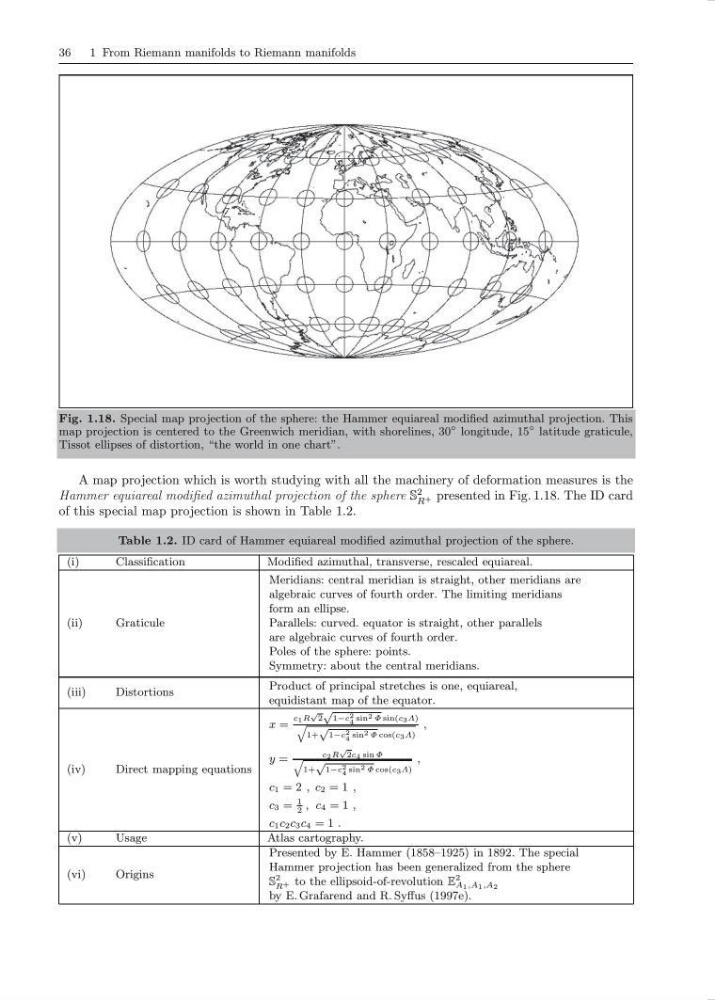
Fig. 1.18. Special map projection of the sphere: the Hammer equiareal modified azimuthal projection. This
map projection is centered to the Greenwich meridian, with shorelines, 30
◦ longitude, 15
◦ latitude graticule,
Tissot ellipses of distortion, “the world in one chart”.
A map projection which is worth studying with all the machinery of deformation measures is the
Hammer equiareal modified azimuthal projection of the sphere S
2
R + presented in Fig. 1.18. The ID card
of this special map projection is shown in Table 1.2.
Table 1.2. ID card of Hammer equiareal modified azimuthal projection of the sphere.
(i)
Classification
Modified azimuthal, transverse, rescaled equiareal.
(ii)
Graticule
Meridians: central meridian is straight, other meridians are
algebraic curves of fourth order. The limiting meridians
form an ellipse.
Parallels: curved. equator is straight, other parallels
are algebraic curves of fourth order.
Poles of the sphere: points.
Symmetry: about the central meridians.
(iii)
Distortions
Product of principal stretches is one, equiareal,
equidistant map of the equator.
(iv)
Direct mapping equations
x =
c 1 R
√
2
√
1−c 2
4
sin 2 Φ sin(c 3 Λ)
q
1+
√
1−c 2
4
sin 2 Φ cos(c 3 Λ)
,
y =
c 2 R
√
2c 4 sin Φ
q
1+
√
1−c 2
4
sin 2 Φ cos(c 3 Λ)
,
c 1 = 2 , c 2 = 1 ,
c 3 =
1
2
, c 4 = 1 ,
c 1 c 2 c 3 c 4 = 1 .
(v)
Usage
Atlas cartography.
(vi)
Origins
Presented by E. Hammer (1858–1925) in 1892. The special
Hammer projection has been generalized from the sphere
S
2
R + to the ellipsoid-of-revolution E
2
A 1 ,A 1 ,A 2
by E. Grafarend and R. Syffus (1997e).
1 From Riemann manifolds to Riemann manifolds
Fig. 1.18. Special map projection of the sphere: the Hammer equiareal modified azimuthal projection. This
map projection is centered to the Greenwich meridian, with shorelines, 30
◦ longitude, 15
◦ latitude graticule,
Tissot ellipses of distortion, “the world in one chart”.
A map projection which is worth studying with all the machinery of deformation measures is the
Hammer equiareal modified azimuthal projection of the sphere S
2
R + presented in Fig. 1.18. The ID card
of this special map projection is shown in Table 1.2.
Table 1.2. ID card of Hammer equiareal modified azimuthal projection of the sphere.
(i)
Classification
Modified azimuthal, transverse, rescaled equiareal.
(ii)
Graticule
Meridians: central meridian is straight, other meridians are
algebraic curves of fourth order. The limiting meridians
form an ellipse.
Parallels: curved. equator is straight, other parallels
are algebraic curves of fourth order.
Poles of the sphere: points.
Symmetry: about the central meridians.
(iii)
Distortions
Product of principal stretches is one, equiareal,
equidistant map of the equator.
(iv)
Direct mapping equations
x =
c 1 R
√
2
√
1−c 2
4
sin 2 Φ sin(c 3 Λ)
q
1+
√
1−c 2
4
sin 2 Φ cos(c 3 Λ)
,
y =
c 2 R
√
2c 4 sin Φ
q
1+
√
1−c 2
4
sin 2 Φ cos(c 3 Λ)
,
c 1 = 2 , c 2 = 1 ,
c 3 =
1
2
, c 4 = 1 ,
c 1 c 2 c 3 c 4 = 1 .
(v)
Usage
Atlas cartography.
(vi)
Origins
Presented by E. Hammer (1858–1925) in 1892. The special
Hammer projection has been generalized from the sphere
S
2
R + to the ellipsoid-of-revolution E
2
A 1 ,A 1 ,A 2
by E. Grafarend and R. Syffus (1997e).