

524 C Elliptic integrals
Definition C.7 (Elliptic integrals of the first, second, and third kinds).
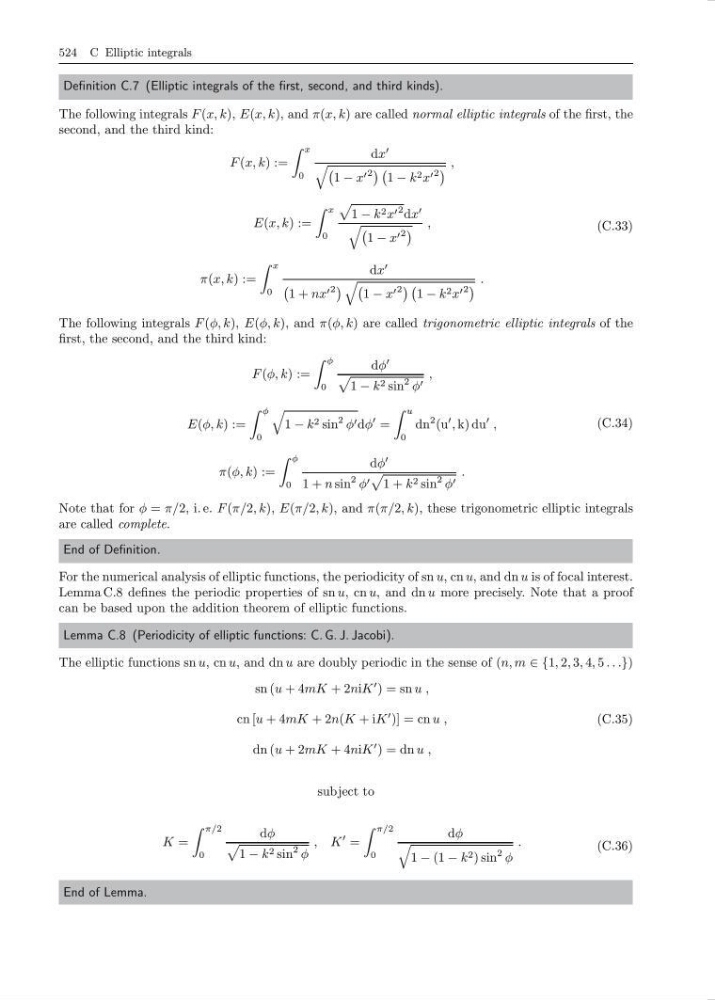
The following integrals F (x, k), E(x, k), and π(x, k) are called normal elliptic integrals of the first, the
second, and the third kind:
F (x, k) :=
x
0
dx
1 − x 2
1 − k 2 x 2 ,
E(x, k) :=
x
0
1 − k 2 x 2 dx
1 − x 2 ,
π(x, k) :=
x
0
dx
1 + nx 2
1 − x 2
1 − k 2 x 2 .
(C.33)
The following integrals F (φ, k), E(φ, k), and π(φ, k) are called trigonometric elliptic integrals of the
first, the second, and the third kind:
F (φ, k) :=
φ
0
dφ
1 − k 2 sin
2 φ
,
E(φ, k) :=
φ
0
1 − k 2 sin
2 φ dφ
=
u
0
dn
2 (u
, k) du
,
π(φ, k) :=
φ
0
dφ
1 + n sin
2 φ
1 + k 2 sin
2 φ
.
(C.34)
Note that for φ = π/2, i. e. F (π/2, k), E(π/2, k), and π(π/2, k), these trigonometric elliptic integrals
are called complete.
End of Definition.
For the numerical analysis of elliptic functions, the periodicity of sn u, cn u, and dn u is of focal interest.
Lemma C.8 defines the periodic properties of sn u, cn u, and dn u more precisely. Note that a proof
can be based upon the addition theorem of elliptic functions.
Lemma C.8 (Periodicity of elliptic functions: C. G. J. Jacobi).
The elliptic functions sn u, cn u, and dn u are doubly periodic in the sense of (n, m ∈ {1, 2, 3, 4, 5 . . .})
sn (u + 4mK + 2niK
) = sn u ,
cn [u + 4mK + 2n(K + iK
)] = cn u ,
dn (u + 2mK + 4niK
) = dn u ,
(C.35)
subject to
K =
π/2
0
dφ
1 − k 2 sin
2 φ
, K
=
π/2
0
dφ
1 − (1 − k 2 ) sin
2 φ
.
(C.36)
End of Lemma.
Definition C.7 (Elliptic integrals of the first, second, and third kinds).
The following integrals F (x, k), E(x, k), and π(x, k) are called normal elliptic integrals of the first, the
second, and the third kind:
F (x, k) :=
x
0
dx
1 − x 2
1 − k 2 x 2 ,
E(x, k) :=
x
0
1 − k 2 x 2 dx
1 − x 2 ,
π(x, k) :=
x
0
dx
1 + nx 2
1 − x 2
1 − k 2 x 2 .
(C.33)
The following integrals F (φ, k), E(φ, k), and π(φ, k) are called trigonometric elliptic integrals of the
first, the second, and the third kind:
F (φ, k) :=
φ
0
dφ
1 − k 2 sin
2 φ
,
E(φ, k) :=
φ
0
1 − k 2 sin
2 φ dφ
=
u
0
dn
2 (u
, k) du
,
π(φ, k) :=
φ
0
dφ
1 + n sin
2 φ
1 + k 2 sin
2 φ
.
(C.34)
Note that for φ = π/2, i. e. F (π/2, k), E(π/2, k), and π(π/2, k), these trigonometric elliptic integrals
are called complete.
End of Definition.
For the numerical analysis of elliptic functions, the periodicity of sn u, cn u, and dn u is of focal interest.
Lemma C.8 defines the periodic properties of sn u, cn u, and dn u more precisely. Note that a proof
can be based upon the addition theorem of elliptic functions.
Lemma C.8 (Periodicity of elliptic functions: C. G. J. Jacobi).
The elliptic functions sn u, cn u, and dn u are doubly periodic in the sense of (n, m ∈ {1, 2, 3, 4, 5 . . .})
sn (u + 4mK + 2niK
) = sn u ,
cn [u + 4mK + 2n(K + iK
)] = cn u ,
dn (u + 2mK + 4niK
) = dn u ,
(C.35)
subject to
K =
π/2
0
dφ
1 − k 2 sin
2 φ
, K
=
π/2
0
dφ
1 − (1 − k 2 ) sin
2 φ
.
(C.36)
End of Lemma.