

B-2 Inversion of a bivariate homogeneous polynomial of degree n 513
1st polynomial:
x 1
x 2
= B 11
A 11
x 1
x 2
+ A 12
x 1
x 2
⊗
x 1
x 2
+
+B 12
A 11
x 1
x 2
+ A 12
x 1
x 2
⊗
x 1
x 2
⊗
A 11
x 1
x 2
+ A 12
x 1
x 2
⊗
x 1
x 2
=
= B 11 A 11
x 1
x 2
+ (B 11 A 12 + B 12 A 11 ⊗ A 11 )
x 1
x 2
[2]
+ β
13 .
(B.40)
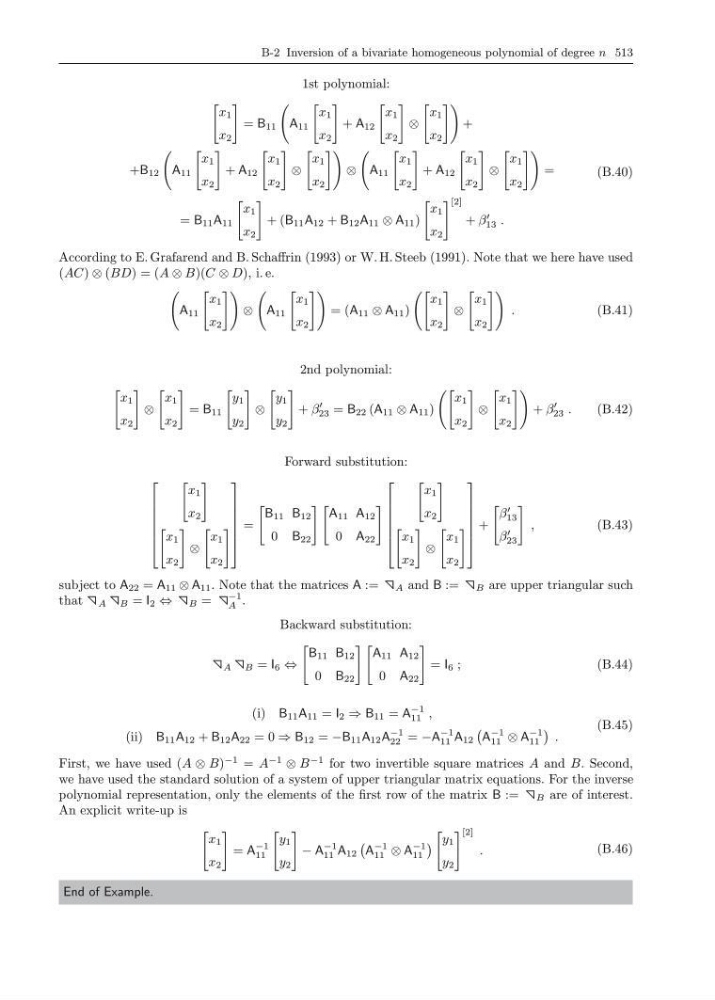
According to E. Grafarend and B. Schaffrin (1993) or W. H. Steeb (1991). Note that we here have used
(AC) ⊗ (BD) = (A ⊗ B)(C ⊗ D), i. e.
A 11
x 1
x 2
⊗
A 11
x 1
x 2
= (A 11 ⊗ A 11 )
x 1
x 2
⊗
x 1
x 2
.
(B.41)
2nd polynomial:
x 1
x 2
⊗
x 1
x 2
= B 11
y 1
y 2
⊗
y 1
y 2
+ β
23 = B 22 (A 11 ⊗ A 11 )
x 1
x 2
⊗
x 1
x 2
+ β
23 .
(B.42)
Forward substitution:
⎡
⎢
⎢
⎢
⎢
⎢
⎣
x 1
x 2
x 1
x 2
⊗
x 1
x 2
⎤
⎥
⎥
⎥
⎥
⎥
⎦
=
B 11 B 12
0 B 22
A 11 A 12
0 A 22
⎡
⎢
⎢
⎢
⎢
⎢
⎣
x 1
x 2
x 1
x 2
⊗
x 1
x 2
⎤
⎥
⎥
⎥
⎥
⎥
⎦
+
β
13
β
23
,
(B.43)
subject to A 22 = A 11 ⊗ A 11 . Note that the matrices A := A and B := B are upper triangular such
that A B = I 2 ⇔ B =
−1
A .
Backward substitution:
A B = I 6 ⇔
B 11 B 12
0 B 22
A 11 A 12
0 A 22
= I 6 ;
(B.44)
(i) B 11 A 11 = I 2 ⇒ B 11 = A
−1
11 ,
(ii) B 11 A 12 + B 12 A 22 = 0 ⇒ B 12 = −B 11 A 12 A
−1
22 = −A
−1
11 A 12
A
−1
11 ⊗ A
−1
11
.
(B.45)
First, we have used (A ⊗ B)
−1 = A
−1
⊗ B
−1 for two invertible square matrices A and B. Second,
we have used the standard solution of a system of upper triangular matrix equations. For the inverse
polynomial representation, only the elements of the first row of the matrix B := B are of interest.
An explicit write-up is
x 1
x 2
= A
−1
11
y 1
y 2
− A
−1
11 A 12
A
−1
11 ⊗ A
−1
11
y 1
y 2
[2]
.
(B.46)
End of Example.
1st polynomial:
x 1
x 2
= B 11
A 11
x 1
x 2
+ A 12
x 1
x 2
⊗
x 1
x 2
+
+B 12
A 11
x 1
x 2
+ A 12
x 1
x 2
⊗
x 1
x 2
⊗
A 11
x 1
x 2
+ A 12
x 1
x 2
⊗
x 1
x 2
=
= B 11 A 11
x 1
x 2
+ (B 11 A 12 + B 12 A 11 ⊗ A 11 )
x 1
x 2
[2]
+ β
13 .
(B.40)
According to E. Grafarend and B. Schaffrin (1993) or W. H. Steeb (1991). Note that we here have used
(AC) ⊗ (BD) = (A ⊗ B)(C ⊗ D), i. e.
A 11
x 1
x 2
⊗
A 11
x 1
x 2
= (A 11 ⊗ A 11 )
x 1
x 2
⊗
x 1
x 2
.
(B.41)
2nd polynomial:
x 1
x 2
⊗
x 1
x 2
= B 11
y 1
y 2
⊗
y 1
y 2
+ β
23 = B 22 (A 11 ⊗ A 11 )
x 1
x 2
⊗
x 1
x 2
+ β
23 .
(B.42)
Forward substitution:
⎡
⎢
⎢
⎢
⎢
⎢
⎣
x 1
x 2
x 1
x 2
⊗
x 1
x 2
⎤
⎥
⎥
⎥
⎥
⎥
⎦
=
B 11 B 12
0 B 22
A 11 A 12
0 A 22
⎡
⎢
⎢
⎢
⎢
⎢
⎣
x 1
x 2
x 1
x 2
⊗
x 1
x 2
⎤
⎥
⎥
⎥
⎥
⎥
⎦
+
β
13
β
23
,
(B.43)
subject to A 22 = A 11 ⊗ A 11 . Note that the matrices A := A and B := B are upper triangular such
that A B = I 2 ⇔ B =
−1
A .
Backward substitution:
A B = I 6 ⇔
B 11 B 12
0 B 22
A 11 A 12
0 A 22
= I 6 ;
(B.44)
(i) B 11 A 11 = I 2 ⇒ B 11 = A
−1
11 ,
(ii) B 11 A 12 + B 12 A 22 = 0 ⇒ B 12 = −B 11 A 12 A
−1
22 = −A
−1
11 A 12
A
−1
11 ⊗ A
−1
11
.
(B.45)
First, we have used (A ⊗ B)
−1 = A
−1
⊗ B
−1 for two invertible square matrices A and B. Second,
we have used the standard solution of a system of upper triangular matrix equations. For the inverse
polynomial representation, only the elements of the first row of the matrix B := B are of interest.
An explicit write-up is
x 1
x 2
= A
−1
11
y 1
y 2
− A
−1
11 A 12
A
−1
11 ⊗ A
−1
11
y 1
y 2
[2]
.
(B.46)
End of Example.