

1-4 Euler–Lagrange deformation tensor 31
∂/∂U
1
∂/∂V
1
∂/∂u
∂/∂v
√
K 1
√
K 2
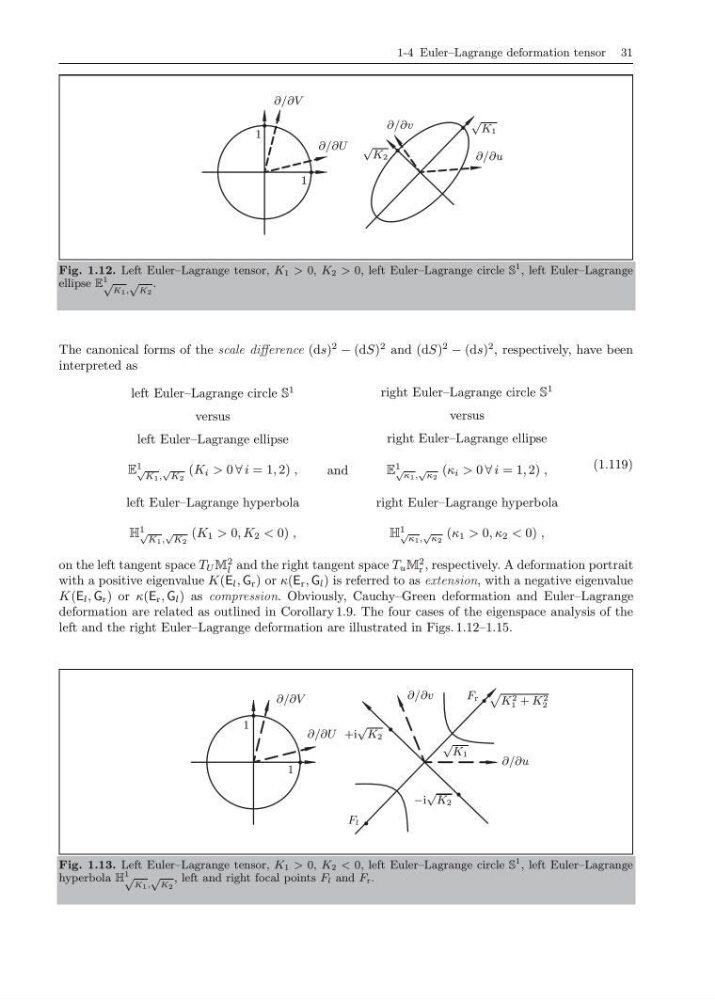
Fig. 1.12. Left Euler–Lagrange tensor, K 1 > 0, K 2 > 0, left Euler–Lagrange circle S
1 , left Euler–Lagrange
ellipse E
1 √
K 1 ,
√
K 2
.
The canonical forms of the scale difference (ds)
2
− (dS)
2 and (dS)
2
− (ds)
2 , respectively, have been
interpreted as
left Euler–Lagrange circle S
1
versus
left Euler–Lagrange ellipse
E
1 √
K 1 ,
√
K 2
(K i > 0 ∀ i = 1, 2) ,
left Euler–Lagrange hyperbola
H
1 √
K 1 ,
√
K 2
(K 1 > 0, K 2 < 0) ,
and
right Euler–Lagrange circle S
1
versus
right Euler–Lagrange ellipse
E
1 √ κ 1 ,
√ κ 2
(κ i > 0 ∀ i = 1, 2) ,
right Euler–Lagrange hyperbola
H
1 √
κ 1 ,
√
κ 2
(κ 1 > 0, κ 2 < 0) ,
(1.119)
on the left tangent space T U M
2
l and the right tangent space T u M
2
r , respectively. A deformation portrait
with a positive eigenvalue K(E l , G r ) or κ(E r , G l ) is referred to as extension, with a negative eigenvalue
K(E l , G r ) or κ(E r , G l ) as compression. Obviously, Cauchy–Green deformation and Euler–Lagrange
deformation are related as outlined in Corollary 1.9. The four cases of the eigenspace analysis of the
left and the right Euler–Lagrange deformation are illustrated in Figs. 1.12–1.15.
∂/∂U
1
∂/∂V
1
∂/∂u
∂/∂v
p
K
2
1 + K
2
2
+i
√
K 2
−i
√
K 2
F r
F l
√
K 1
Fig. 1.13. Left Euler–Lagrange tensor, K 1 > 0, K 2 < 0, left Euler–Lagrange circle S
1 , left Euler–Lagrange
hyperbola H
1 √
K 1 ,
√
K 2
, left and right focal points F l and F r .
∂/∂U
1
∂/∂V
1
∂/∂u
∂/∂v
√
K 1
√
K 2
Fig. 1.12. Left Euler–Lagrange tensor, K 1 > 0, K 2 > 0, left Euler–Lagrange circle S
1 , left Euler–Lagrange
ellipse E
1 √
K 1 ,
√
K 2
.
The canonical forms of the scale difference (ds)
2
− (dS)
2 and (dS)
2
− (ds)
2 , respectively, have been
interpreted as
left Euler–Lagrange circle S
1
versus
left Euler–Lagrange ellipse
E
1 √
K 1 ,
√
K 2
(K i > 0 ∀ i = 1, 2) ,
left Euler–Lagrange hyperbola
H
1 √
K 1 ,
√
K 2
(K 1 > 0, K 2 < 0) ,
and
right Euler–Lagrange circle S
1
versus
right Euler–Lagrange ellipse
E
1 √ κ 1 ,
√ κ 2
(κ i > 0 ∀ i = 1, 2) ,
right Euler–Lagrange hyperbola
H
1 √
κ 1 ,
√
κ 2
(κ 1 > 0, κ 2 < 0) ,
(1.119)
on the left tangent space T U M
2
l and the right tangent space T u M
2
r , respectively. A deformation portrait
with a positive eigenvalue K(E l , G r ) or κ(E r , G l ) is referred to as extension, with a negative eigenvalue
K(E l , G r ) or κ(E r , G l ) as compression. Obviously, Cauchy–Green deformation and Euler–Lagrange
deformation are related as outlined in Corollary 1.9. The four cases of the eigenspace analysis of the
left and the right Euler–Lagrange deformation are illustrated in Figs. 1.12–1.15.
∂/∂U
1
∂/∂V
1
∂/∂u
∂/∂v
p
K
2
1 + K
2
2
+i
√
K 2
−i
√
K 2
F r
F l
√
K 1
Fig. 1.13. Left Euler–Lagrange tensor, K 1 > 0, K 2 < 0, left Euler–Lagrange circle S
1 , left Euler–Lagrange
hyperbola H
1 √
K 1 ,
√
K 2
, left and right focal points F l and F r .